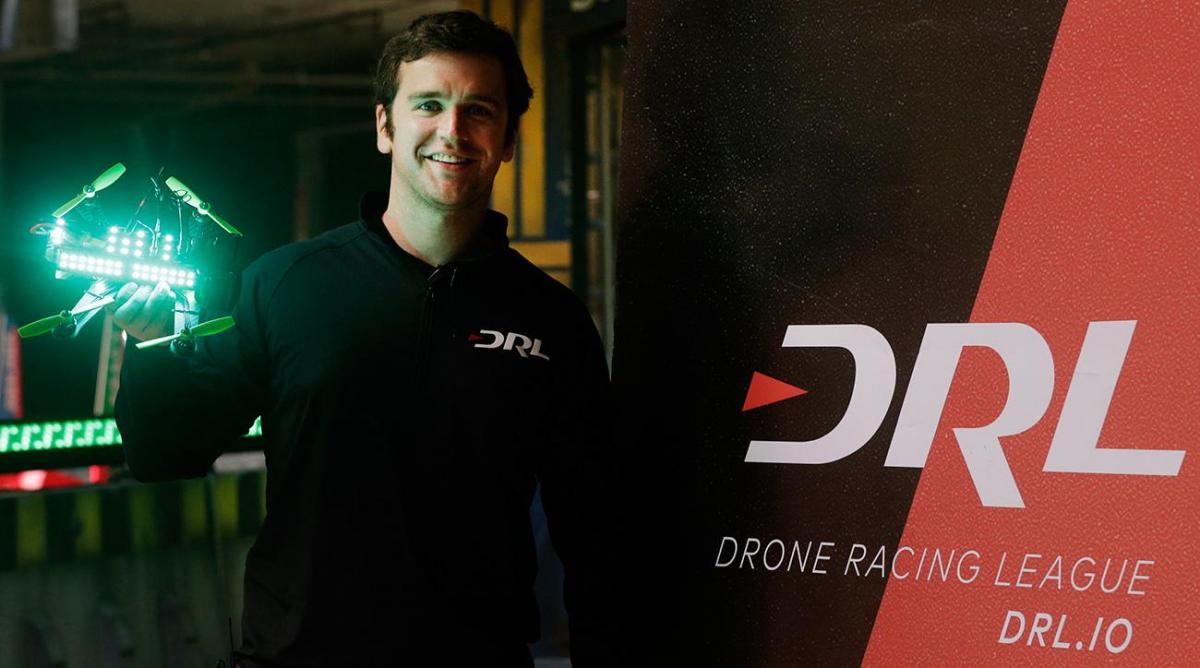
Behind a Home Depot on Long Island, a group of hobbyists had found something better to do with a weekend than shop. They were racing homemade drones. In early 2015, Ryan Gury brought Nicholas Horbaczewski out to see them. There was no television contract waiting at the edge of the field. There were small aircraft, people who knew how to fly them, and an experience Horbaczewski wanted more people to share.
He would found the Drone Racing League that year. Getting from the field to a professional competition, however, would involve an awkward discovery: the future looked considerably more reliable in the imagination than it did on a workbench.
A field with no grandstand
Horbaczewski was careful about the origin story. Drone racing already existed. Enthusiasts had been meeting, swapping information and building machines before he arrived. The interesting possibility was to turn their activity into something a spectator could follow. A hobby can survive on the pleasure of participation. A sports league has to give the person watching a reason to come back.
First-person-view flying supplied an unusually intimate invitation. A camera aboard the drone sent its view to goggles worn by the pilot. The aircraft might be a small object in the distance, but the pilot experienced the course from inside the action. For an audience raised on video games, that perspective offered a familiar way into a physical competition.
Twelve drones at the Gates of Hell
An early demonstration exposed the distance between the pitch and the machinery. Horbaczewski had invited investors to what he billed as a Grand Prix. The venue was an abandoned power plant in Yonkers, nicknamed the Gates of Hell. It was an excellent name for a dramatic race and a less comforting one for a demonstration running short of equipment.
He had hoped to bring 120 drones. He brought 12, some incomplete. Nine pilots had travelled to the event; there were enough aircraft for six. Two months earlier, the team had realized it needed to build its own drones. Horbaczewski personally visited prospective investors to lower expectations before they arrived.
They would see a proof of concept. That was what the team could deliver. There were still moments when six drones racing close together through a large room made the idea tangible. Nearly all the prospective investors who attended subsequently invested, he recalled. The first round was oversubscribed. The lesson cost him some embarrassment: an ambitious vision needed a frank account of what was actually ready.
A peculiar apprenticeship
His route to that power plant had passed through several seemingly unrelated businesses. He studied history and literature at Harvard and earned a Harvard Business School MBA in 2008. He began his career at Bain & Company, co-founded the independent-film business Leeden Media, and served as chief information officer at ADS, a distributor of equipment to the US government.
At ADS, he developed an interest in multicopters. At Tough Mudder, where he held senior revenue roles from 2013 to 2015, he worked on a different kind of competition: getting people to sign up for demanding obstacle events. Equipment, entertainment and participation would all become relevant to the league he founded next.
The film connection is particularly useful for understanding him. A drone race could be exhilarating for the people flying and confusing for everyone standing nearby. Production experience meant thinking about the person on the other side of the screen. Before asking an audience to become fans, the league had to let them see what they were supposed to enjoy.
The audience needed a way in
By January 2017, DRL had 19 staff, including 10 full-time engineers and technologists maintaining a fleet of 350 drones. The league had developed aircraft, circuit boards, communications equipment and courses. Those are unusual items on the shopping list for a sports promoter. They became prerequisites for producing the competition.
The radio connection was part of the drama even when viewers never noticed it. A pilot needed to see an obstacle soon enough to react. The league also needed pictures that made small, fast aircraft understandable on television. Horbaczewski put the production requirement neatly: “The technology has to be invisible to the viewer.”
“The technology has to be invisible to the viewer.”
Nicholas Horbaczewski / 2017
Standardized aircraft added another piece of clarity. DRL supplied the drones so the contest could focus on the pilots’ performance. The audience needed to trust the result as well as admire the footage. A winner is more interesting when the viewer understands what has been won and why.
The workshop could also produce something with an immediately legible result. In July 2017, Gury and DRL’s engineers set a Guinness speed record with the battery-powered RacerX quadcopter. Earlier prototypes had burst into flames under acceleration. Engineering had supplied both a credential and a persuasive argument for keeping the test area clear.
Getting everyone into orbit
Strauss Zelnick, the Take-Two executive who became an investor and mentor, gave Horbaczewski a useful way to think about the organization. A league depended on a whole set of participants moving together: broadcasters, sponsors, athletes, venues and fans. Signing one helped make the next conversation easier. None could sustain the enterprise alone.
The first season reached television in 2016 through ESPN, Sky Sports and ProSiebenSat.1. Allianz became the title sponsor in 2017. The arrival of recognizable partners gave the young league commercial credibility, while also raising expectations about the standard of programming it had to deliver.
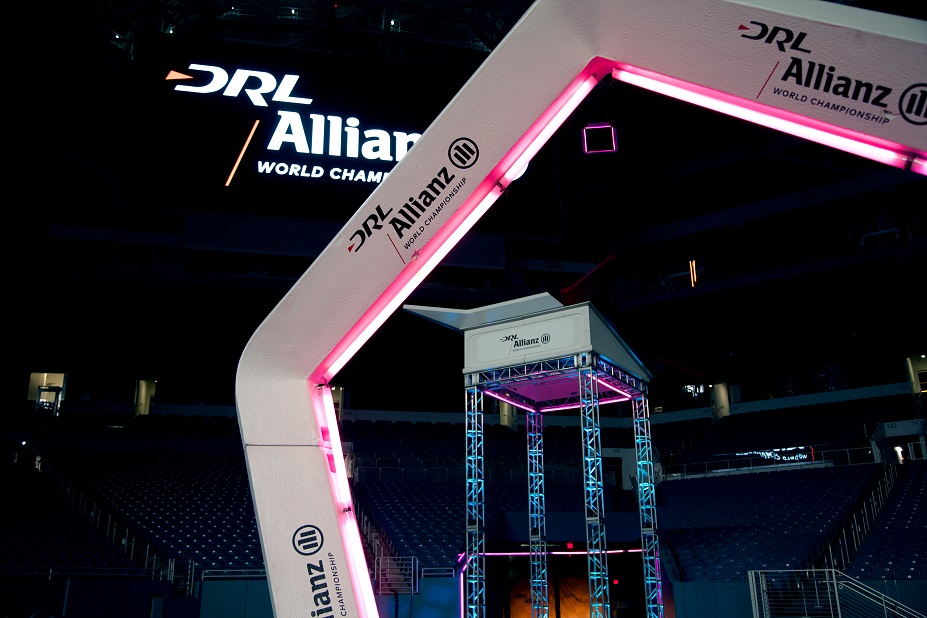
Venues gave the broadcasts their own character. Horbaczewski looked for substantial indoor spaces, including abandoned industrial buildings and parts of stadiums normally passed through on the way to the main event. Corridors, concourses and tunnels became useful terrain. Racing could climb and dive through a building rather than remain politely on a field.
In 2017 he described looking for spaces of roughly 60,000 to 100,000 square feet. Early events admitted only a few hundred spectators as the league concentrated on broadcast production. The empty mill and the stadium passageway made practical sense: their shapes gave the aircraft something interesting to do.
The founder at the coffee shop
The working day behind the races looked less cinematic. In 2018, Horbaczewski described beginning email at five in the morning to keep pace with international partners. He liked to have coffee with individual colleagues at Birch Coffee near the office, a way to hear what was happening as the organization grew.
He also reserved time around noon for the technology team. Aircraft, radio systems, timing and scoring were being built internally; staying close to that work helped him decide where the company should spend its time. The calendar had to accommodate both sponsor meetings and the next technical problem.
He flew, too, while acknowledging the distance between his abilities and those of professional racers. In 2019, he described learning through the DRL Simulator. There is something pleasingly practical about a league founder using his own training product. It also gave him another route into the experience he was asking viewers and partners to understand.
When the pilot is a program
By 2019, Horbaczewski was also looking beyond human pilots. Working with Lockheed Martin, DRL developed the Artificial Intelligence Robotic Racing competition, or AIRR. Teams would write software to guide autonomous racing drones. The ambition was to test machine decision-making in a physical course, where movement and obstacles complicated the problem.
He spoke about eventually matching an autonomous drone against a leading human pilot. He also imagined the work contributing to applications such as disaster response. These were ambitions he articulated at the time. They explain why a racing league could interest him as a place to develop technology as well as sell entertainment.
His account of the 2019 season also returned to a more immediate audience request: easier access. DRL was bringing races to NBC and Twitter. Building sophisticated machines would mean little to a prospective fan who could not conveniently watch them race.
The next workshop
In April 2024, Infinite Reality announced a definitive agreement to acquire DRL in a transaction valued at $250 million. Horbaczewski described the team’s work as a combination of technical development, media capture and race competition. It was an apt inventory of the things that had needed to work together since the first demonstration.
His involvement with small aircraft also extended to Performance Drone Works. He co-founded PDW with Matt Higgins, Ryan Gury and Trevor Smith. The Huntsville company develops drones for defense and government applications, including the backpack-sized C100. Horbaczewski serves on its board, a role recorded in an April 2026 SEC filing.
In July 2026, PDW announced a conditional loan commitment of up to $820 million for domestic drone-component manufacturing. It remained subject to further requirements before financial close. In September, the company announced engineering expansion in Denver and Boston, connecting development teams to manufacturing in Alabama.
The scale and purpose had changed considerably since Long Island. The recurring problem remained recognizable: an aircraft has to work outside the pitch. Horbaczewski’s first demonstration made that point with 12 drones and an uncomfortable conversation. The spectators could imagine the future. Someone still had to finish building it.
Keep following the flight
Conversations, profiles and places to explore.
Nicholas on LinkedIn ↗Nicholas on X ↗Performance Drone Works ↗The Drone Racing League ↗Watch: The future of sports is robotics / TNW 2018 ↗Listen: A conversation with Neil deGrasse Tyson / 2020 ↗Read: The early demonstration, in his own words / 2016 ↗Read: The latest from PDW ↗