Nicholas Donahue had already helped people build houses when he decided to start over. Atmos, the company he co-founded, had put land, design and builder selection into one guided experience. It closed in early 2025. Later that year, he was working on Drafted, another home-design company. He had changed the business while keeping the question: why should a house be so difficult to make your own?
There is something revealing about that choice. A founder can leave a difficult industry with a considerable collection of reasons never to return. Donahue returned to residential design. The first attempt had taught him how much work could hide behind a friendly interface; the second would concentrate on helping people explore a house before the construction process took over.
By May 2026, Drafted had announced a $16 million seed round. That provides a convenient headline. The more interesting development sits underneath it: Donahue was learning where to draw the boundary around his own ambition. In housing, a boundary can be a surprisingly productive thing.
A return ticket, briefly useful
Donahue grew up in North Carolina, with both parents working in homebuilding. Houses were familiar long before they became his business. Familiarity did not immediately translate into a career plan. He went to North Carolina State University, studied mechanical engineering, and tried a placement at Dell. Eventually, he left college.
The early ventures ranged some distance from a foundation trench. He co-founded NextUp Music, a shared music-queue app with the social logic of a digital jukebox. His professional history also includes Hilo, a platform for cryptocurrency traders, where he worked on the founding team. These were experiments in what he wanted to spend his time building.
A friend suggested visiting San Francisco. Donahue bought a return ticket for a month-long trip. Two weeks into the visit, he had joined Hilo. The itinerary had acquired a competing business plan. Alongside Austin Kahn, he spent evenings on side projects; the work that became Atmos emerged from that period.
He also published. His 2018 writing for Hilo covered subjects including stablecoins, custodial services and the platform's launch. It is an earlier version of the same occupational problem: taking a complicated system and finding a way for someone outside it to participate. The subject would change considerably. The need to explain it would follow him.
The first blueprint was virtual
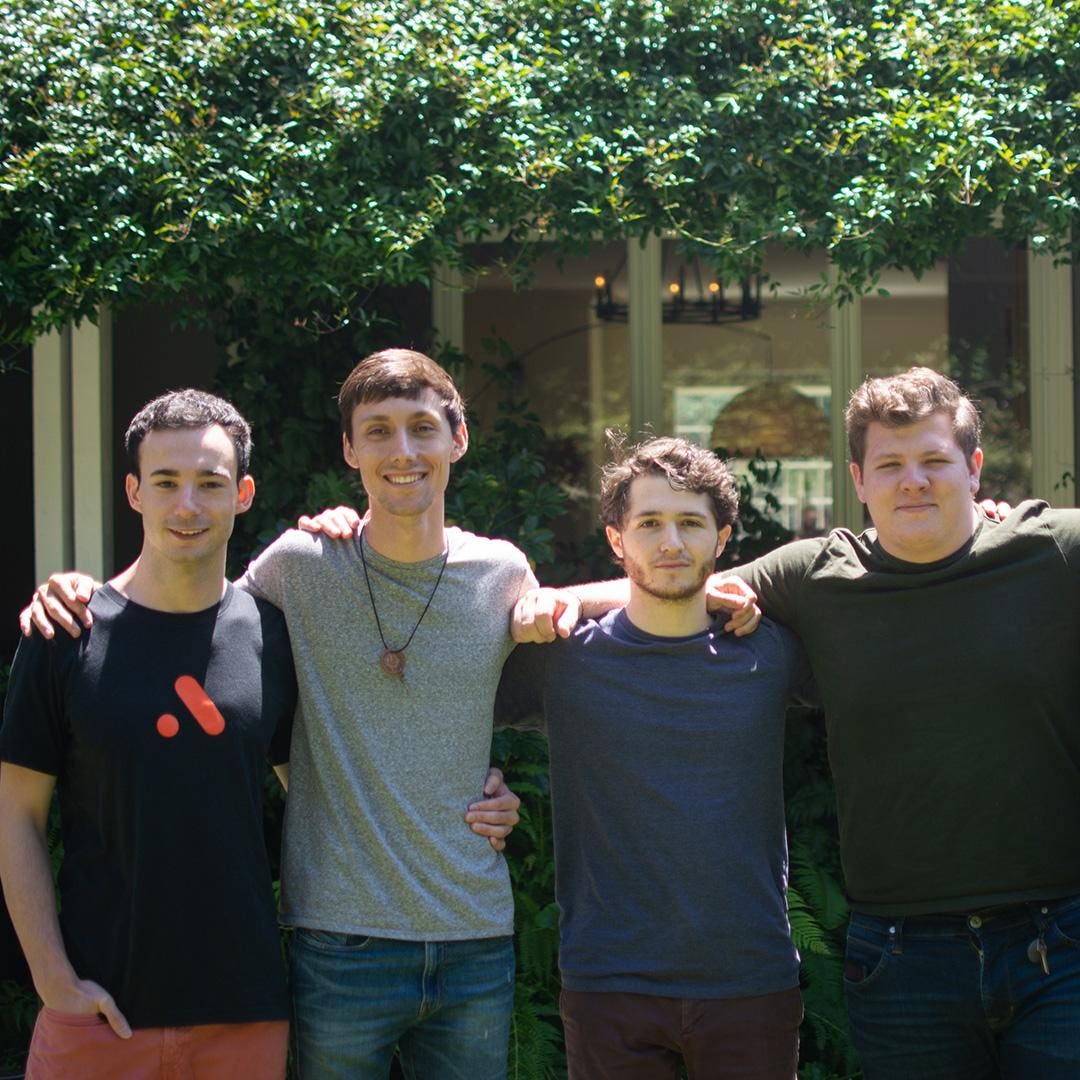
Atmos began with an interest in virtual and augmented reality. Donahue has described changing direction when the original idea failed to work. Rather than abandon the interest in physical space, the team turned toward homes. The company he built with Trent Hedge, Austin Kahn and Matthew Rastovac connected digital design to an industry he had grown up around.
That family connection gave the idea a practical setting. It also gave it a particular human scale. A house is a place where preferences become expensive: the arrangement of rooms, the shape of a roof, the amount of space someone wants for work or company. Each choice can be perfectly reasonable on its own. Getting the choices to agree is another occupation altogether.
Atmos's proposition was to bring the process together. Its platform helped people work through land selection, design and local building partners. Homebuyers could see their proposed homes in 3D. The company operated around Raleigh, Durham and Charlotte, while its startup identity belonged to San Francisco.
For Donahue, this meant selling something far more consequential than a new app subscription. Early customers had to trust a young company with a major investment. He later acknowledged that the team expected its first home sale to happen sooner than it did. Optimism had arrived promptly. The sale preferred its own schedule.
A rent calculator opens the conversation
One of the early marketing tools was a rent calculator. It invited people in expensive cities to consider what their rent might buy elsewhere. In 2021, Donahue discussed the widget's spread, his introduction to Sam Altman through laser tag, and his preference for weekly investor updates over monthly ones.
The details make an appealing miniature of startup life: a tool someone can try, an introduction made away from a meeting table, a deliberately frequent account of progress. They also show a founder working on access. Customers needed a reason to imagine a different home. Investors needed a reason to keep following the effort.
Atmos joined Y Combinator's Summer 2020 batch. Its four founders appeared on the 2021 Forbes 30 Under 30 Consumer Technology list. By then, the platform had attracted $6 million in funding. An idea that began among evening projects had become an institution with customers, backers and expectations.
- 2018Atmos takes shape around a new approach to custom homes.
- 2020Atmos joins Y Combinator's summer batch.
- 2025Atmos closes; Donahue starts Drafted.
- 2026Drafted joins YC's spring batch and announces a $16M seed round.
The education after college
Donahue's account of leaving university contains a modest detail that deserves room beside the fundraising: he started writing for 15 minutes each day. He also joined an entrepreneurship club. Before the move to San Francisco, he was deliberately changing what he learned and whom he spent time around.
Later, asked which traits mattered to him, he offered three instructions: “Be open to change.” “Take every shot.” “Be a founder.” The final phrase meant taking responsibility for finding and solving problems. He wanted that behavior inside Atmos, too. His version of entrepreneurship gave employees permission to notice something broken and act on it.
He also described a shift from collecting new experiences to staying with one field long enough for knowledge to accumulate. That distinction helps explain his return to home design. Moving from music to cryptocurrency to houses had widened his experience. Staying with houses would require a different kind of patience.
His connections extended beyond fundraising. He credited Leap Motion co-founder David Holz with helping him think about technology's future, Altman with building confidence, and DoorDash's Toby Espinoza with sharpening his understanding of business mechanics. The list contains encouragement, imagination and operating advice. A founder can need all three in the same afternoon.
The work behind the screen
Homebuilding gave the software ambition a demanding test. Atmos's offering involved an actual plot of land and people who understood it. Surveyors, soil testers, civil engineers and structural engineers belonged to the process Donahue later described. The screen could make the choices easier to see. Someone still had to work through what those choices required.
As a business model, that creates an awkward question: when a company makes complexity disappear for the customer, where does the complexity go? Sometimes the company absorbs it. Service can be valuable and still consume more time and coordination than a software business expects. A smooth customer experience may have a very busy room behind it.
Atmos closed in early 2025 after higher interest rates made it harder for customers to proceed with their homes. The closure gives Donahue's story a weight that a list of investors cannot supply. The company had confronted the gap between helping people choose a house and helping them afford to build it.
For a founder who had already spoken about learning from failed ideas, this was a concrete test of the principle. His next company would stay nearer the beginning of the process, where people decide what they want and need ways to see alternatives.
Keeping the question, changing the company
Drafted was founded in 2025 and entered Y Combinator's Spring 2026 batch. Its product takes inputs such as room requirements, target square footage, footprints and spatial relationships, then generates floor plans and exterior designs. Users can examine alternatives in 2D and 3D and export files into the broader design and construction process.
The distinction matters to the person using it. A vague wish for a home becomes something visible enough to discuss. One arrangement can be compared with another. A preference that sounded sensible in conversation may look different in a plan. Exploration has value before anyone has settled on a final answer.
Donahue's funding announcement described users generating dozens of designs, comparing layouts and testing room relationships. The behavior interested him because people wanted to explore possibilities. Drafted reported more than 120,000 people using the product and over 325,000 designs generated in the preceding month. Those are company-reported measures of exploration, with each design representing an option rather than a finished house.
“Our goal is to make changing the physical world as easy as changing a website.”
Nicholas Donahue, May 2026
The $16 million seed round was led by Buckley Ventures, with participants including Y Combinator, Samsung NEXT, Ben Silbermann, Convective Capital and Ryan Tedder. In a field concerned with personal taste, it is an unusually apt collection of interests: technology, consumer products and someone who knows a thing or two about a room's acoustics.
A home, still in pencil
At the Builder's Show, Donahue got to meet people using the product in person. He described the pleasure of existing users seeking out the booth. After so much work through screens, there was someone standing in front of him who had already tried what the team was making. The encounter was small enough to be believable and useful enough to remember.
That is where the story becomes personal again. Donahue left a formal engineering education, worked across several startups, and returned to the industry that had surrounded his childhood. His career has moved toward a problem he can describe with increasing precision. Each attempt has changed what he thinks the company should do.
Drafted's future will depend on whether those experiments on a screen become useful decisions for homeowners and professionals. For now, Donahue has given himself another chance to work on the question. The house remains in pencil. After everything he has learned about changing a plan, that seems a sensible place to begin.