Nic Patee’s business lives in an unfashionable sliver of time. It is after a worker begins a shift but before discomfort becomes an incident, a claim or an appointment. Nothing dramatic has happened yet. That is precisely the point. The minutes before trouble are easy to ignore, difficult to invoice and, in Patee’s telling, valuable enough to build a company around.
His path to that idea began with sport. Patee played collegiate baseball at Northwest Nazarene University while studying pre-physical therapy. He went on to earn a doctorate in physical therapy from the Arizona School of Health Sciences at A.T. Still University. The sequence matters: athlete first, clinician next, operator after that. Each role supplied a piece of the vocabulary he would later take into factories, warehouses and forests.
In 2014, Patee and his wife, Mindy, founded Work Right NW in Woodland, Washington. Their frame was deliberately plain. People who push, pull, carry and repeat for a living are “industrial athletes.” The label does useful work. It asks a manager to look at a laborer with the preparatory care normally reserved for a player, and it asks the laborer to see a shift as a physical performance rather than a test of endurance.
“We shouldn’t wait for people to break before we give them access to care.”Nic Patee, on Work Right NW’s tenth anniversary
The empty space before the paperwork
Patee’s early clinical work showed him the cost of delay. In a later webinar, he described the useful intervention as sometimes no larger than a fifteen-minute conversation about posture and ergonomics. That smallness is easy to underestimate. A short exchange cannot compete with the visible machinery of a clinic or a compensation claim. It can, however, arrive first.
Work Right placed athletic trainers and physical therapists close to the work itself. They observed movement, offered early guidance and turned abstract caution into daily practice. The business proposition was not built around a heroic rescue. It was built around repetition: a warm-up, an equipment check, a floor conversation, an adjustment, another shift.
There is a sturdy operator’s instinct here: if the critical window is invisible, give it a ritual. At the American Society of Safety Professionals’ Safety22 conference in Chicago, Patee and colleague Chantel Gorton presented “The Industrial Athlete’s Daily Checklist for Injury Prevention.” Their checklist gathered wellness, ergonomics and hazards into something meant to be used, not admired.
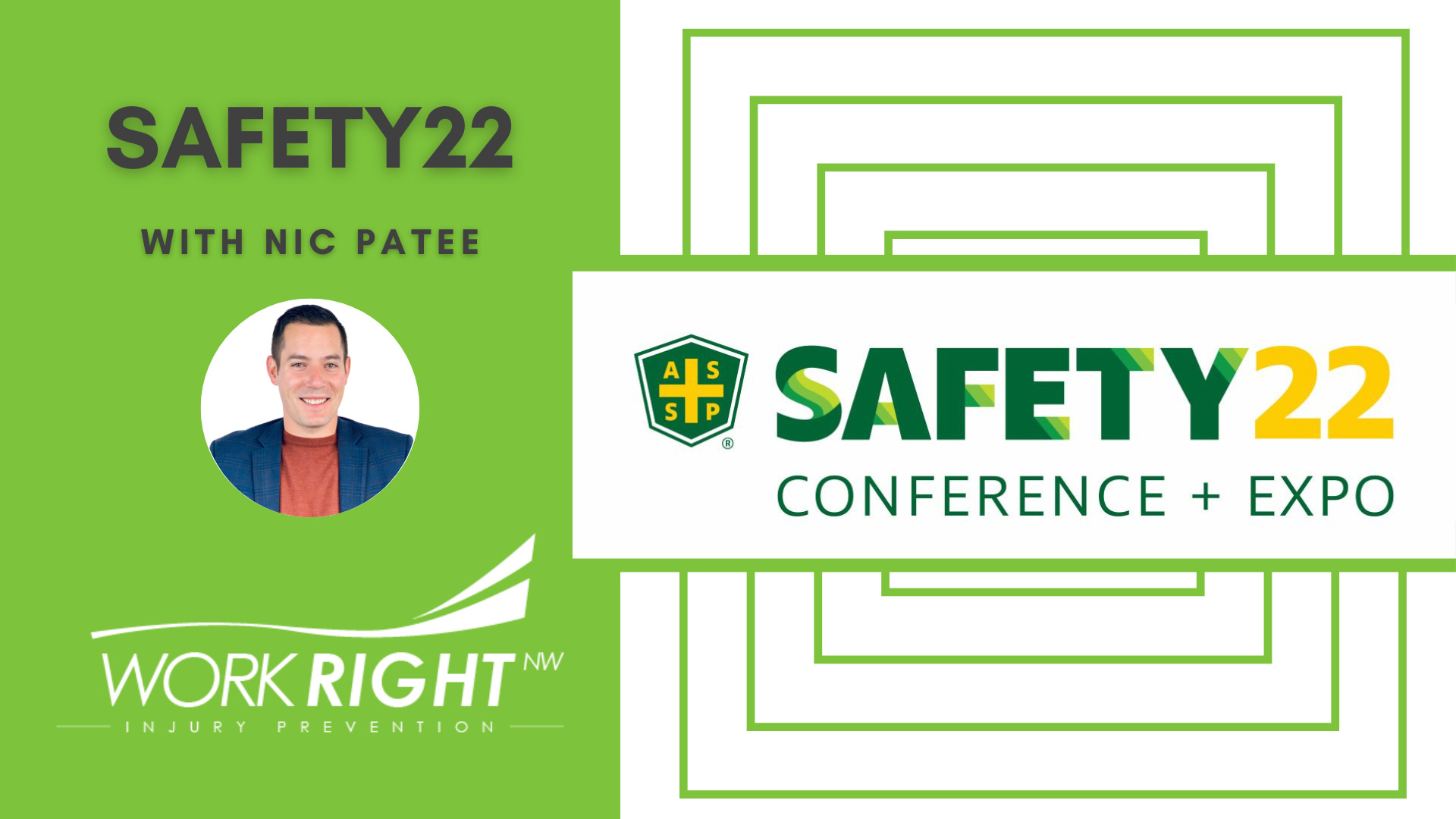
“We all know these principles, but we are human,” Patee said before the presentation. The line contains more operating wisdom than it first appears to. Knowledge alone does not create behavior. A checklist respects the gap. It lowers the distance between agreeing with prevention and practicing it at 6:45 on a damp Tuesday morning.
A lab with bark on it
The philosophy met a particularly unforgiving workplace in Patee’s logging research. Working with Chilton Logging and technology partner dorsaVi on a project supported by Washington State’s Department of Labor & Industries, he led a team that used wearable sensors to quantify the physical demands of logging tasks. The final report, completed in 2017, sought objective profiles of movement and practical controls for risk.
Logging is a useful test of any tidy theory. The terrain moves underfoot. The weather joins the meeting without accepting the calendar invitation. A method has to survive mud, machinery and the complicated choreography of experienced workers. Patee’s project moved measurement out of a controlled room and into that unruly setting.
It also clarified another part of his playbook. At Safety22, Patee urged leaders to build metrics that could cross the barrier between front-line operations and environmental, health and safety teams. Data mattered less as decoration than as a shared language. The spreadsheet had to speak fluent shop floor.
“Strategically work to implement metrics that can cross barriers between your front line operational leaders and your EHS professionals.”Nic Patee, Safety22 interview
Growth without changing the verb
As Work Right grew, the verb stayed remarkably stable: prevent. Patee joined the National Occupational Research Agenda’s Agriculture, Forestry and Fishing Sector Council in 2020. He served on the National Safety Council’s MSD Solutions Lab advisory group and, beginning in 2023, on the advisory board of workplace-technology company Longitude6. These posts placed him among researchers, employers and vendors trying to make prevention function at institutional scale.
The company expanded through transactions and partnerships as well. In 2023, Work Right announced its acquisition of Occupational Athletics, an established company in the same field. Later that year it formed an integrated service partnership with Medcor, combining Work Right’s prevention model with Medcor’s occupational services. On The Granite List Live podcast, Patee and Medcor executive Curtis Smith said the relationship emerged from mutual clients who were already finding value in both offerings. Customer behavior wrote part of the strategy.
The vocabulary becomes infrastructure
A company’s favorite words can become wallpaper. Work Right’s words are arranged more like instructions. Its public values begin with care for the individual, then move through internal motivation, humility, service and team accountability. The phrases explain why Patee’s “industrial athlete” metaphor has lasted. It is not merely a clever name for a customer segment. It changes where attention goes. An organization built around incidents naturally studies the incident. One built around people has to notice the ordinary shift before any form is filed.
The metaphor also gives different professions a place in the same sentence. An athletic trainer understands preparation and movement. A site manager understands output and timing. A safety leader understands exposure. The industrial-athlete frame does not erase those specialties; it gives them a shared object of attention. Patee’s repeated interest in cross-functional metrics follows the same logic. A useful measure should not require a translator at every doorway.
Work Right’s educational material shows how the idea travels. Its ninety-day “PREPARED” program breaks a shift into memorable actions: warm up before work, review hazards, evaluate equipment, use deliberate positioning and debrief afterward. The acronym is almost aggressively practical. It belongs on a toolbox talk, not in a glass case. That portability matters when a company’s staff is distributed across client sites and states. The founder cannot personally deliver the idea each morning, so the idea needs legs of its own.
Patee has described the larger aim as making Work Right an industry expectation rather than a novel addition. Normalization is an unusual founder ambition because it imagines the product becoming unremarkable. Yet that is the proper end state for a routine. Nobody applauds a seat belt after every drive. It simply becomes part of how the trip begins. Patee’s challenge has been to make an upstream service concrete long enough that clients can adopt it, then familiar enough that they wonder how a shift ever started without it.
By its tenth anniversary in August 2024, Work Right said it was serving employers across a broad national footprint. The number is evidence of scale; the more interesting achievement is conceptual. Patee helped make “industrial athlete” a working category inside his corner of occupational safety. It is difficult to prepare for a person you have not quite learned to see.
The coach in the chief executive
Patee’s athletic life did not end when his playing days did. Pacific Northwest Fellowship of Christian Athletes lists him as a regional board member and says his hobby is coaching young ballplayers in their faith and sport. The detail gives his company language a personal echo. “Athlete” is not a branding costume borrowed from afar. It is a world he has inhabited as player, coach and parent.
His public moments also suggest a leader attentive to the team around the thesis. Asked what he anticipated beyond his Safety22 session, Patee did not offer an architectural pilgrimage or a heroic plate of deep-dish pizza. He said he looked forward to time with Work Right colleagues in greater Chicago. In another, lighter glimpse posted to LinkedIn, coworkers wrapped his office desk. Prevention may be serious work; apparently the tape budget was allowed some recreational use.
There is a connection between coaching and Patee’s stated conference ambition: “My desire for this conference is to empower others to share that vision.” A coach cannot take every at-bat. A founder hoping to “normalize injury prevention” faces the same limit. The work succeeds only when other people carry the habit without the founder standing beside them.
That is the quiet difficulty of his project. Treatment announces itself. Prevention must be invited into the schedule, then repeated until it becomes ordinary. Patee’s career has been an exercise in giving that ordinary work names, numbers and routines. An industrial athlete. A daily checklist. A measure that matters. A useful conversation held early enough to remain small.
Founders are often advised to find a painful problem. Patee found something more elusive: the moment before the pain becomes the problem everyone can see. He built upstream, where success may leave no dramatic artifact. Sometimes the absence is the artifact. The shift ends. The worker goes home. The checklist waits for morning.