There is a quiet absurdity in implantable electronics: the component most likely to demand a return visit is often the one buried under the skin. In sacral neuromodulation, a treatment that sends electrical pulses to nerves involved in bladder control, a battery-powered generator traditionally occupies its own pocket in the upper buttock. The pulses may help. The pocket can still make its presence felt when someone sits, sleeps, or moves.
Neuspera Medical, a San Jose device company, looked at that arrangement and moved the power source out. Its approved bladder-control system leaves a small neurostimulator near the sacral nerve and powers it wirelessly from a disc worn against the lower back. The patient wears the disc for a daily therapy session, then takes it off and recharges it. The implant stays put; the battery goes home with the laundry.
- Neuspera treats urinary urge incontinence with an implanted sacral nerve stimulator.
- The implant has no battery; a wearable transmitter supplies power during therapy.
- The FDA approved the sacral system in June 2025 for patients whose conservative options failed, were intolerable, or were unsuitable.
- The tradeoff is straightforward: less implanted hardware, plus a daily wearing and charging routine.
A different answer to an old problem
Urgency urinary incontinence is the sort of condition that edits a person’s map of the city. A trip is measured in bathrooms; an invitation acquires a logistical footnote. People generally try less invasive steps first. When those do not work, a clinician may consider advanced treatments such as Botox injections, tibial nerve stimulation, or sacral neuromodulation. Neuspera belongs to that later conversation. It is a prescription implant placed by a clinician, not a wellness device bought on impulse.
The basic target is familiar. Established systems from Medtronic and Boston Scientific’s Axonics franchise stimulate sacral nerves too. Neuspera’s distinction lies in the architecture. Its implant combines the stimulating electrode and receiver near the nerve, while the power source sits in an external transmitter. That avoids the separate implanted generator and the surgical tunnel that typically connects generator to lead. It also changes the patient’s part of the bargain: therapy works while the transmitter is in place.
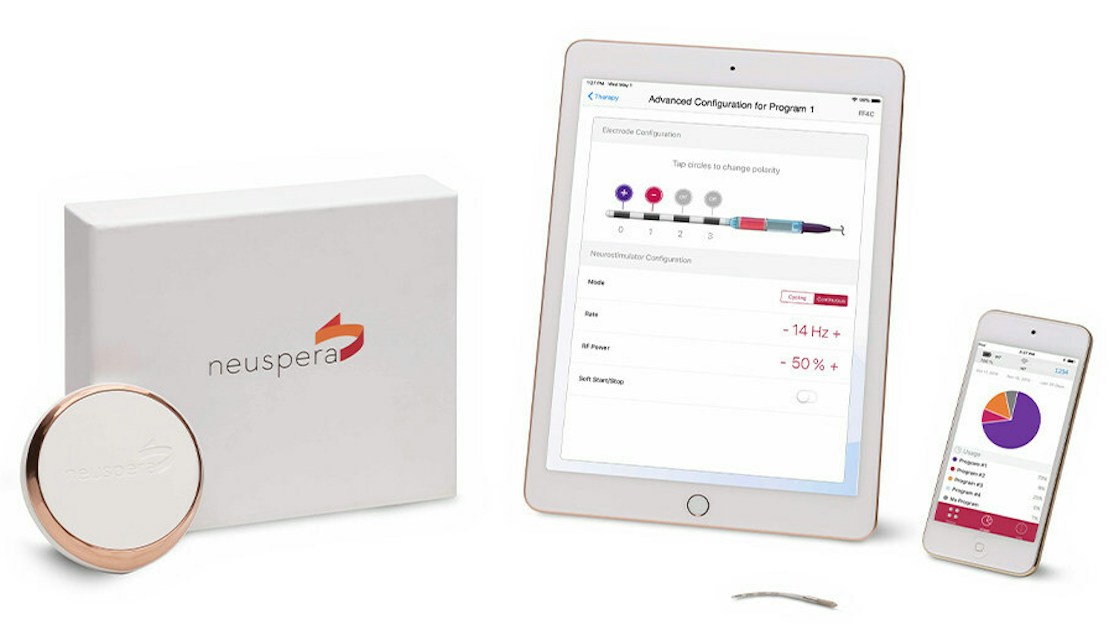
Founder and chief technology officer Alexander J. Yeh conceived the company’s mid-field power-transfer approach while doing electrical-engineering doctoral work at Stanford. In simple terms, the design uses electromagnetic waves to send energy deeper into the body than a conventional close-range charging pad might suggest. Neuspera says the platform can reach implants 10 centimeters or more beneath the skin. That is a technology claim about the platform; for the approved bladder system, what matters to patients is more ordinary: put the transmitter in the supplied garment, position it correctly, and use it as prescribed.

The expensive path to a smaller object
Making the implant smaller did not make the development program small. Neuspera, previously known as Vivonda Medical, announced an $8 million Series A in 2016. Its $26 million Series B closed in two tranches, the second arriving after development and regulatory objectives were met. A $65 million Series C in 2021 paid for the pivotal SANS-UUI program. A further $23 million Series D in 2024 was intended to carry the company through expected FDA review. Those disclosed rounds add to roughly $122 million, before allowing for the different totals reported by private-company databases. They describe capital raised, not the price of a procedure.
The first regulatory success was for a separate peripheral nerve stimulation system for pain: FDA records date its 510(k) clearance to August 2021, though the company announced it in 2023. The bladder device faced a different bar, premarket approval. The FDA received its application in September 2024 and approved it on June 17, 2025. That sequence matters. A promising prototype does not become a urology product because the miniaturization is elegant; it becomes one after engineering, a clinical study, manufacturing controls, and the regulatory file all meet.
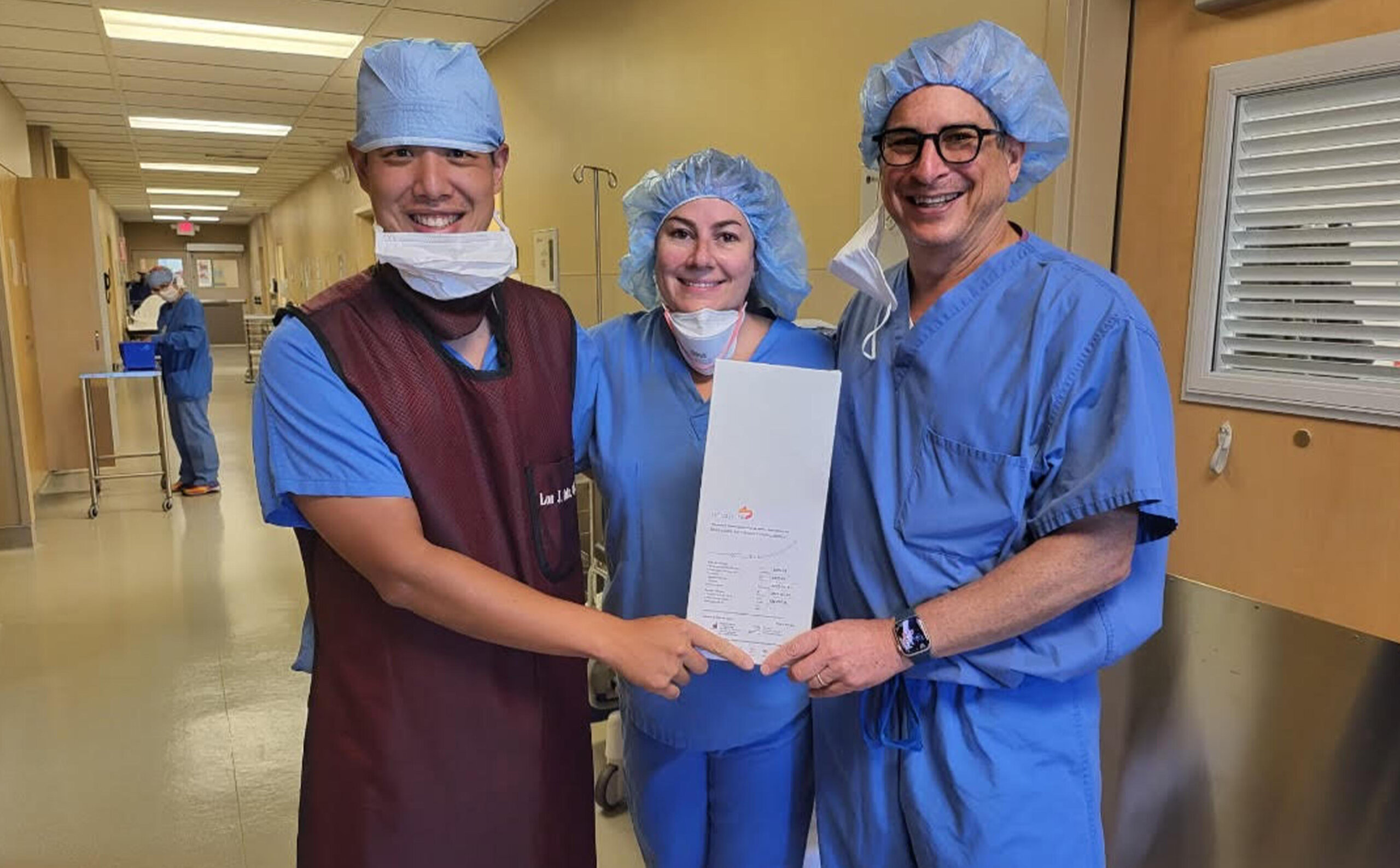
The broader FDA-described single-arm study enrolled 242 people at 31 sites. The numbers above refer to a later implanted subgroup.
What the numbers say, and what they do not
In the company’s six-month report on 128 implanted Phase II patients, 84.2 percent had at least a 50 percent reduction in urgent leaks. At 12 months, Neuspera reported that 94 percent of test-phase responders reached that threshold. Those are not interchangeable denominators. Among therapy responders at 12 months, the company said 81 percent saw at least a 75 percent reduction and 43 percent reported no urgent leaks. It reported no serious device-related adverse events and no infections through that follow-up.
Those figures give clinicians a reason to look closely. They do not, by themselves, prove the system outperforms Medtronic or Axonics: the pivotal study was single-arm, not a randomized head-to-head comparison. Nor do they answer how people will feel after five years of daily positioning and charging. The FDA required continued follow-up through 72 months, a useful reminder that an implant’s first year is only its introduction.
“Reduced therapy time could improve the patient experience while maintaining outcomes.”Andrea Pezzella, MD, on early shorter-session data, 2026
Two hours a day is the routine described in Neuspera’s approved-system announcements. In 2026 the company also discussed early observations with 30-minute sessions. That shorter schedule is intriguing, but it is preliminary. The deeper question is behavioral. A battery-free implant avoids a battery-pocket problem; it depends on a person remembering the external device, charging it, and aligning it over the implant. The best hardware design still has to survive Tuesday afternoon.
The market will decide in clinics and kitchens
Neuspera sells a medical system into a market built around clinicians, hospitals, insurers, and patient selection. The person living with incontinence is the user, but a urologist or urogynecologist decides whether the procedure fits. A hospital must be willing to buy and support the device. An insurer must decide how it pays. There is no trustworthy public patient price to put beside the product photo; a proposed 2027 Medicare outpatient payment of $22,150 is a provider payment level, not a retail price or a promise of what anyone owes.
A reported 2026 case at University of Louisville Health gives the company’s thesis a human face. A 21-year-old patient who had discomfort from a conventional implanted generator underwent a revision to Neuspera’s system after an earlier revision using conventional hardware failed to help. Her surgeon reported relief from that battery-related pain. It is one case, not an outcomes study. Neuspera has begun a registry of people switching from conventional systems, which should make the claim more measurable than an anecdote can.
The lesson other device makers can copy is almost embarrassingly plain: identify which part of a treatment creates repeat procedures, then ask whether it truly needs to live inside the patient. But the trick works only when external power reaches the target reliably, the therapy tolerates sessions rather than continuous stimulation, and patients accept the routine. Neuspera’s achievement is that it made that trade specific enough to test, then obtained approval for a defined group of people. The next verdict will be delivered less ceremoniously, in clinics, insurance offices, and the daily business of getting dressed.