In December 2017, Channel Medsystems was living a medical-device startup's happiest cliché. It had a single promising product, a regulatory application in motion and a giant buyer waiting in the wings. Boston Scientific had agreed to acquire the company in a transaction worth as much as $275 million. Then two executives found something that had nothing to do with uterine tissue and everything to do with trust: the man responsible for quality had been paying fake vendors and falsifying documents. Roughly $2.6 million was gone. Worse, six compromised test reports had entered material sent to regulators.
The short version
- Cerene is a single-use device that uses nitrous oxide to freeze and ablate the endometrial lining.
- It is for certain premenopausal women with benign heavy bleeding who have finished childbearing.
- The treatment cycle is 2.5 minutes and was studied chiefly with local pain control, not general anesthesia.
- Channel sells to gynecology practices, hospitals and outpatient centers, with training and patient education around the hardware.
- The copyable lesson: disclose bad news early, audit the damage independently and let reproducible evidence do the persuading.
This is where most corporate stories reach for euphemism. Channel did something more expensive and more useful. It brought in lawyers, forensic accountants and regulatory specialists; checked manufacturing records; reconstructed invoices; told the FDA and its would-be buyer; and set about proving which work could still be trusted. Boston Scientific changed its mind anyway and terminated the deal in May 2018.
Yet the curious survivor was the product itself. The FDA accepted Channel's remediation plan, inspected the company and approved Cerene in March 2019. A Delaware judge later ruled that the misconduct had not produced the kind of lasting material damage required to end the merger agreement, and ordered Boston Scientific to close. In 2020 the companies settled instead: the purchase died, Boston Scientific surrendered its stake and Channel remained independent. The settlement amount was confidential. The glamorous exit had vanished. The work remained.
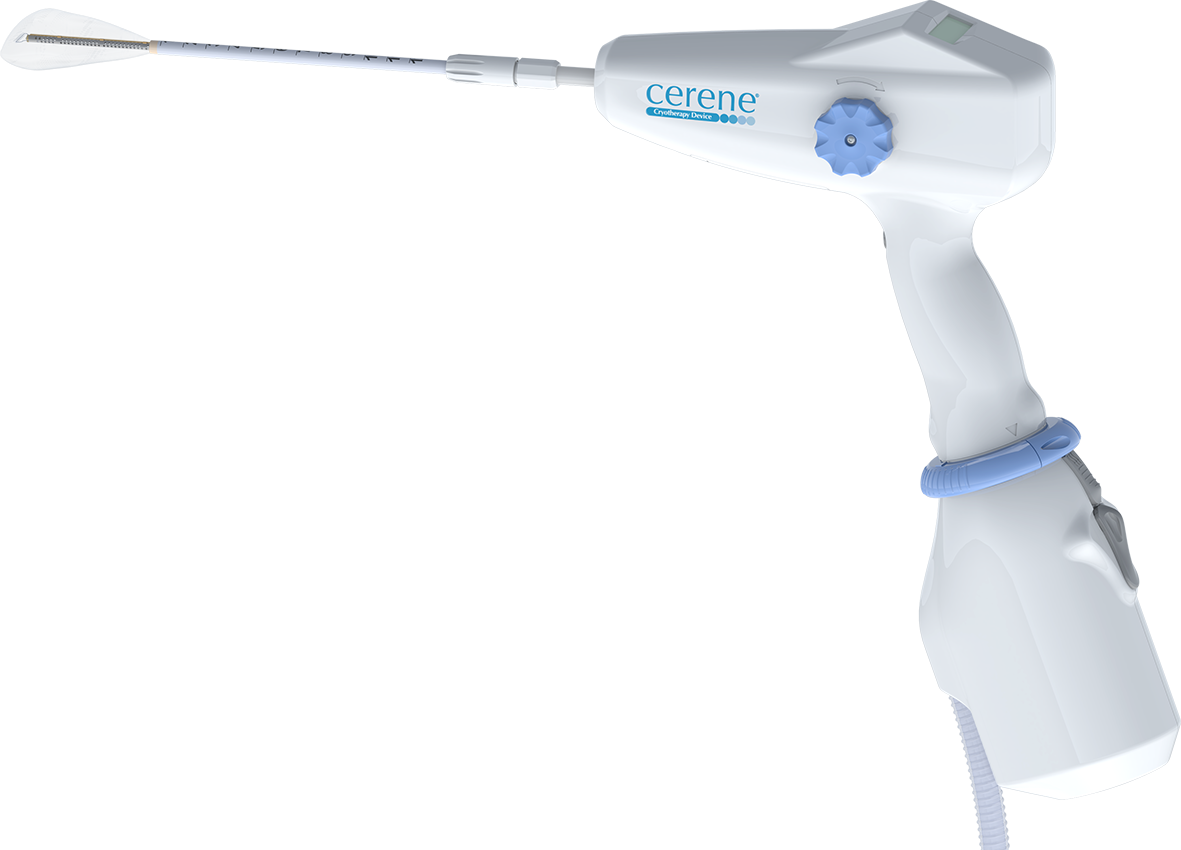
Cold is the feature. The office is the strategy.
Cerene treats heavy menstrual bleeding by delivering nitrous oxide through a slender probe. A soft liner contacts the uterine cavity; the cryogen cools and destroys the endometrial tissue that produces menstrual bleeding. The treatment phase is fixed at 150 seconds. In the pivotal CLARITY study, the mean time from insertion to removal was 6.9 minutes.
That short cycle is easy to advertise. The more consequential design choice is anesthesia. None of the 242 treated participants received general anesthesia. Ninety-seven percent used a paracervical block with oral medication or no additional medication; 3 percent received IV sedation. Nearly three quarters of procedures took place in physicians' offices, with the rest in hospital treatment rooms. For a clinic, avoiding an operating room can mean fewer scheduling dependencies and less facility machinery. For a patient, it can mean a procedure that occupies less of the day.
The business model follows the procedure. Channel sells a sterile, prescription-only, single-use device to OB/GYN practices, ambulatory surgery centers and hospitals. Each procedure creates another disposable sale. But the company is not simply shipping a box: physician training, in-case clinical support, reimbursement work, patient education and a provider finder are part of the commercial apparatus. In office medicine, the workflow is part of the product.
The shortest part of Cerene's story is the treatment. Everything around those 150 seconds - selection, trust, training and access - takes longer.YesPress analysis
Success is lighter, not necessarily absent
Here is an important piece of honesty. Cerene is not principally a machine for making periods disappear. At 12 months, 76.9 percent of patients met the FDA-defined primary endpoint for reduced bleeding. At 36 months, among 201 patients evaluated, 89 percent described their most recent period as absent, lighter than normal or normal. Eighty-five percent were satisfied or very satisfied. The cumulative hysterectomy rate was 5 percent; reintervention was 8.7 percent.
Single-arm study, not a head-to-head comparison. Satisfaction was reported by 181 participants at their final visit; other denominators differ by measure.
Those qualifications are not a blemish on the data. They are the data. Endometrial ablation sits between long-term medical management and more invasive surgery. The relevant question is not whether every patient stops bleeding, but whether the treatment produces a durable, acceptable improvement with a tolerable burden. In CLARITY, 91 percent reported no or only slight limitations in daily activities at three years. That is the number that understands calendars.
A market full of heat
Cerene competes with radiofrequency systems such as Hologic's NovaSure and Minerva Surgical's Minerva ES, plus heated-saline and water-vapor systems. It also competes with things that do not resemble it: pills, hormonal IUDs, dilation and curettage, and hysterectomy. Channel's distinction is not that cold wins every contest. There is no public head-to-head pivotal trial proving that. Its distinction is that cryotherapy was engineered around tolerability and office use.
| Choice | What it asks of the patient | Where Cerene differs |
|---|---|---|
| Medication or hormonal IUD | Ongoing therapy or an implanted contraceptive | One non-hormonal procedure, but pregnancy prevention is still required |
| Heat-based ablation | A brief device procedure using radiofrequency, hot fluid or vapor | Uses nitrous-oxide cryotherapy and evidence built around local pain control |
| Hysterectomy | Definitive surgery with greater recovery demands | Incision-free and uterus-preserving, but not guaranteed to prevent later surgery |
The addressable patient is specific. Cerene is approved for premenopausal women with heavy menstrual bleeding from benign causes who have completed childbearing. It is not contraception. Pregnancy after ablation can be dangerous, so contraception remains necessary until menopause. Known or suspected uterine cancer, active pelvic or urinary infection, an IUD in place, prior ablation, and certain uterine conditions are among the reasons a clinician may rule it out. The pivotal study also excluded significant cavity distortion. A clever device does not repeal anatomy.
The second launch
The independent company returned to market with an unusually literal second chance. InnovaHealth Partners led a growth investment in 2021. Channel reported crossing 5,000 treated women in November 2025, a small number beside mass-market pharmaceuticals but a meaningful threshold for a specialized procedure. That same year it installed Nelson Whistance as chief executive, a commercial operator who had helped build the U.S. business at Gynesonics before its acquisition by Hologic.

In August 2026, Channel said its ongoing Series C had reached $30 million. The uses of cash reveal the current bottleneck: more commercial staff, physician engagement, professional education, patient awareness, market access, infrastructure and further clinical evidence. None is as photogenic as the pale blue device. All decide whether it leaves the storeroom.
What another company can copy
Channel's useful lesson is not “be resilient,” the corporate equivalent of telling a patient to breathe. The lesson is procedural. When fraud touched the regulatory file, the company did not argue that good intentions should outweigh compromised paperwork. It scoped the damage, hired outsiders, disclosed early and built a record that the FDA and, later, a court could inspect. The response worked because the underlying clinical case remained reproducible.
That playbook has conditions. It fails if the misconduct is systemic, if leaders conceal it, if independent testing cannot reproduce the claims, or if the product's benefit disappears under scrutiny. Transparency is not disinfectant by itself. It merely lets everyone see whether there is still something worth saving.
Cerene's other transferable idea is quieter: redesign the setting, not merely the instrument. Channel chose cold partly because tolerability could support the gynecologist's office. A shorter cycle matters, but an easier site of care changes staffing, scheduling and patient experience at once. That is not a universal recipe. Some patients need hospital resources; some physicians will prefer familiar systems; payers and practice economics vary. Yet it is a sharper strategy than declaring a familiar procedure “innovative” and changing only the brochure.
There is a certain justice in where Channel has landed. The acquisition that was supposed to validate the company vanished. Validation came instead in smaller units: an FDA approval, a published three-year follow-up, a physician trained, a patient treated, then 5,000 of them. Cerene is still a one-product bet in a competitive market. It may never become the default. But after a corporate crisis built around false documents, its second life rests on an admirably unfashionable asset: evidence that held up when strangers looked at it.