A gynecologist looking into a uterus has a geometry problem. The route in is narrow. The instrument that removes a polyp or fibroid needs room to work. Make the scope thicker and access can become more demanding; make the tool smaller and its usefulness may suffer. Meditrina, a San Jose medical device company founded in 2016, built its Aveta platform around that squeeze.
- Aveta combines HD video, tissue resection, and fluid management in one hysteroscopy platform.
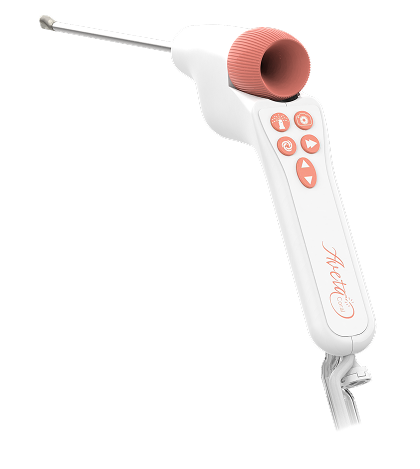
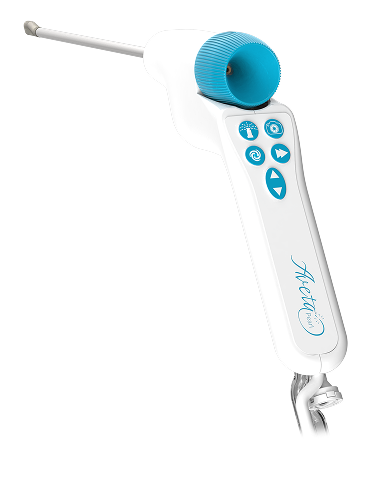
- Its single-use Coral scope has a 4.6 mm insertion diameter and a 3 mm working channel; Pearl is 5.7 mm with a 4 mm channel.
- Meditrina sells to gynecology teams in operating rooms and offices, with disposable scopes and accessories alongside the controller.
- The company has moved from its 2019 U.S. launch to CE and UKCA marks and distribution in Britain and Ireland.
The trick sits at the scope's tip: a patented expandable working channel. In Coral, a 3 mm channel travels through a 4.6 mm insertion profile. Pearl pairs a 4 mm channel with a 5.7 mm scope. These measurements are not a verdict on which procedure a patient should have. They are the design brief, expressed in millimeters. Meditrina wants the clinician to keep a useful resection tool while entering with a narrower instrument.
The problem begins before the first cut
Hysteroscopy is a way to see and treat conditions inside the uterus. Aveta is built for diagnostic work, biopsy, removal of polyps, fibroids, and retained products of conception. Its customers are gynecologists, OB/GYN practices, hospitals, and ambulatory centers. The patient experiences a procedure; the buyer also sees a setup process, a staff workflow, and a supply bill.
That wider view explains why Aveta is a system, not merely a scope. Its controller collects HD imaging, tissue resection, and fluid management in one unit. The monitor can show the surgical field beside live pressure and fluid-deficit information. Controls on the hysteroscope handle give the physician direct access to functions that otherwise may require a handoff. SteadiView technology keeps the picture upright as the instrument turns. It is easy to dismiss these as interface details until one imagines trying to operate while a screen tilts and a colleague adjusts a separate box.
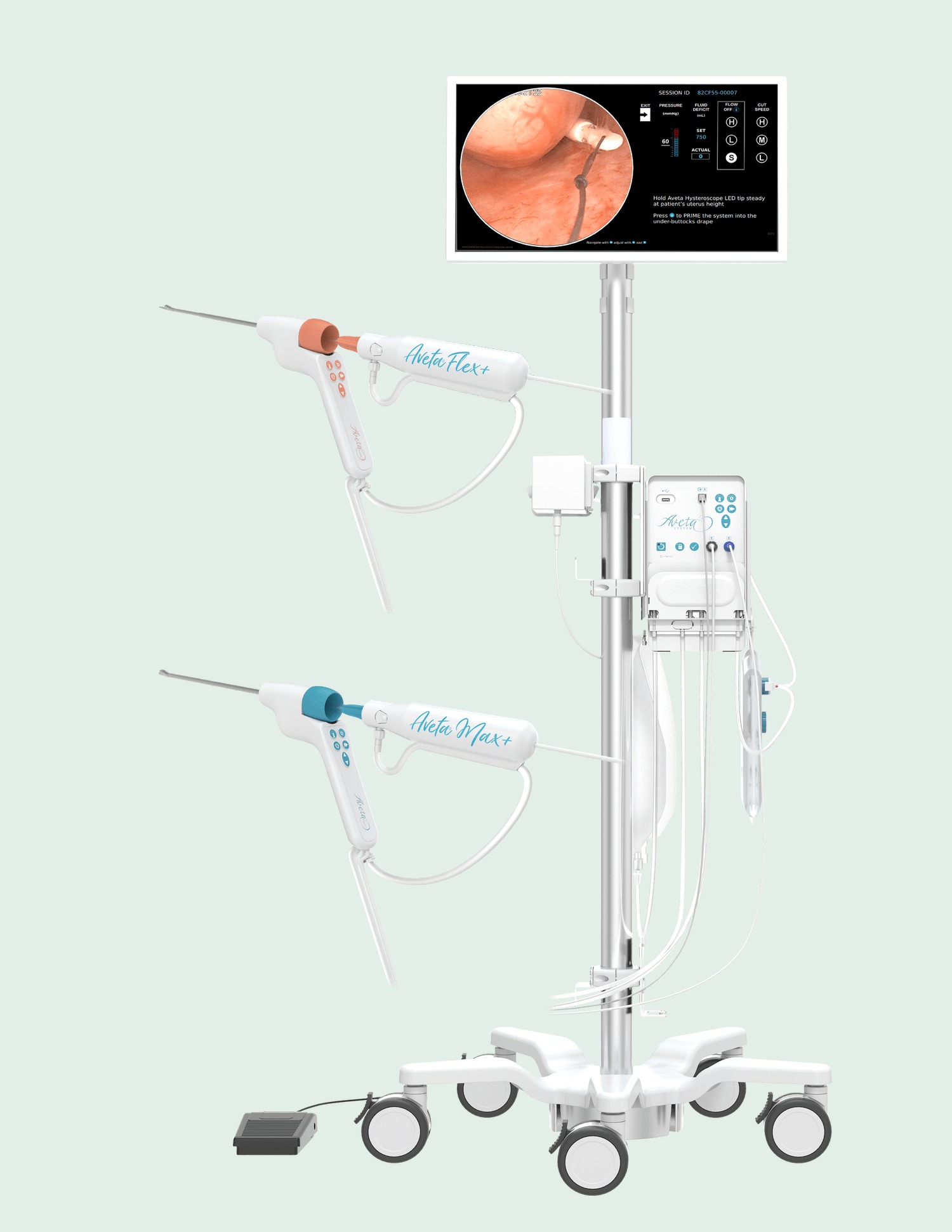
Fluid matters as much as the picture. Saline expands the uterine cavity so a surgeon can see and work; inflow, outflow, pressure, and the amount retained have to be watched. Aveta integrates those readings rather than asking the team to treat fluid as a side conversation. Meditrina says its fluid system can also work with standard operative hysteroscopes, a useful concession for facilities that already own equipment.
The office is a different room
The first Aveta system was introduced at the 2019 AAGL meeting after U.S. FDA 510(k) clearance that May. Meditrina followed with the Aveta Office Suite in 2021. The office version made a different bet: some selected procedures could be simpler to conduct in a physician's room if the equipment arrived ready for that room. Aveta Auto, a single-use resection device, puts a motorized suction pump and tissue specimen container inside its handle. It can work with a pressurized saline bag, so a clinician doing an office polypectomy need not recreate every part of an operating-room setup.
The pandemic gave that argument urgency. In April 2020, while elective procedures were being reorganized, Meditrina explicitly pitched moving appropriate cases from hospitals to ambulatory centers and offices. The company did not invent office hysteroscopy; it adapted its platform to a moment when access, turnaround, and reprocessing all mattered in new ways. The lesson is modest and portable: changing the room can be as consequential as changing the instrument.
“The Aveta System was designed with full flexibility and scalability to perform various procedures in any setting.”Csaba Truckai, founder and CEO, in a Meditrina release
Meditrina's business reflects that division of labor. A facility buys into a controller and workflow, then uses single-use hysteroscopes, resection devices, and fluid or waste accessories case by case. The recurring disposables are central to the model. They can remove the need to reprocess a scope between patients, but they also make per-case supply economics worth examining. The company argues for lower procedure costs; the sensible test for a buyer is the whole case cost, including staffing, room time, capital equipment, and disposable supplies.
Capital for the unglamorous middle
Csaba Truckai, whom Meditrina identifies as its founder and CEO, assembled the company around surgical-device experience. The money trail shows the long distance between an engineering idea and broad clinical distribution: a $5 million Horizon loan facility in 2019, with $3 million initially funded; a $13 million equity financing later that year led by ShangBay Capital and Aethan Capital; and a $10 million first tranche of a commercialization round led by Deerfield in 2020. In 2024, Meditrina said it had closed the final $5 million tranche of a $77 million Series C, alongside $5 million of debt financing from SLR Capital Partners. Those are company-announced financing figures, not a price tag for a hospital or a measure of clinical benefit.
The product line has widened too. Smol, Flex+, and Max+ are disposable resection devices aimed at different tissue densities. In 2024, the FDA cleared Aveta System 2.0 and the Glo bipolar radiofrequency device, giving the platform another approach to tissue removal and hemostasis. The company publishes comparative bench results against MyoSure and TruClear on synthetic calcified tissue. Bench tests are useful for understanding what a blade does to a model; they are not a promise that every patient or surgeon will see the same speed.
Where the small opening leads
Aveta competes with established hysteroscopic tissue-removal systems, including MyoSure and TruClear, as well as conventional resectoscopes. Meditrina's pitch is specific: a narrow single-use scope with room for a substantial working tool, surgeon-controlled settings, and integrated imaging and fluid handling. A hospital choosing among these options will still have to weigh anatomy, pathology, existing equipment, training, and its own cost per case.
The idea worth borrowing is to find the constraint that makes every other task harder. For Meditrina, that constraint was partly physical - the entry diameter against the tool channel - and partly organizational: the setup and handoffs around the procedure. Aveta addresses both in the same design. That approach has limits. An integrated platform helps most when its components fit a team's actual case mix and room. Where a facility's current scopes and workflow already serve those cases well, the savings claim needs proof in that facility's own numbers.
The company is now working beyond the U.S. In 2024, it announced CE and UKCA marks and initial procedures in Spain and Denmark. In July 2025, M.E.D. Surgical, part of Uniphar Medtech, agreed to distribute Aveta in Ireland and the UK. In August 2026, Meditrina added former Johnson & Johnson executive Janis Smith-Gomez to its board, a move that speaks to the commercial work of selling a medical system across more markets. None of those milestones changes the central geometry. The story still begins with a narrow path, a useful tool, and the decision to let one make room for the other.
Follow the work
For product details, demonstrations, and company updates, start with Meditrina's own channels: