In the global-health version of a junk drawer, the objects are not mystery cables and dead batteries. They are donated medical machines - sophisticated, expensive and silent. Sona Shah and Teresa Cauvel saw rooms of them during a 2015 needs assessment in Uganda. The equipment had arrived with good intentions and assumptions that did not survive contact with the ward: reliable electricity, replacement parts, disposable accessories, enough space and technicians who could maintain it.
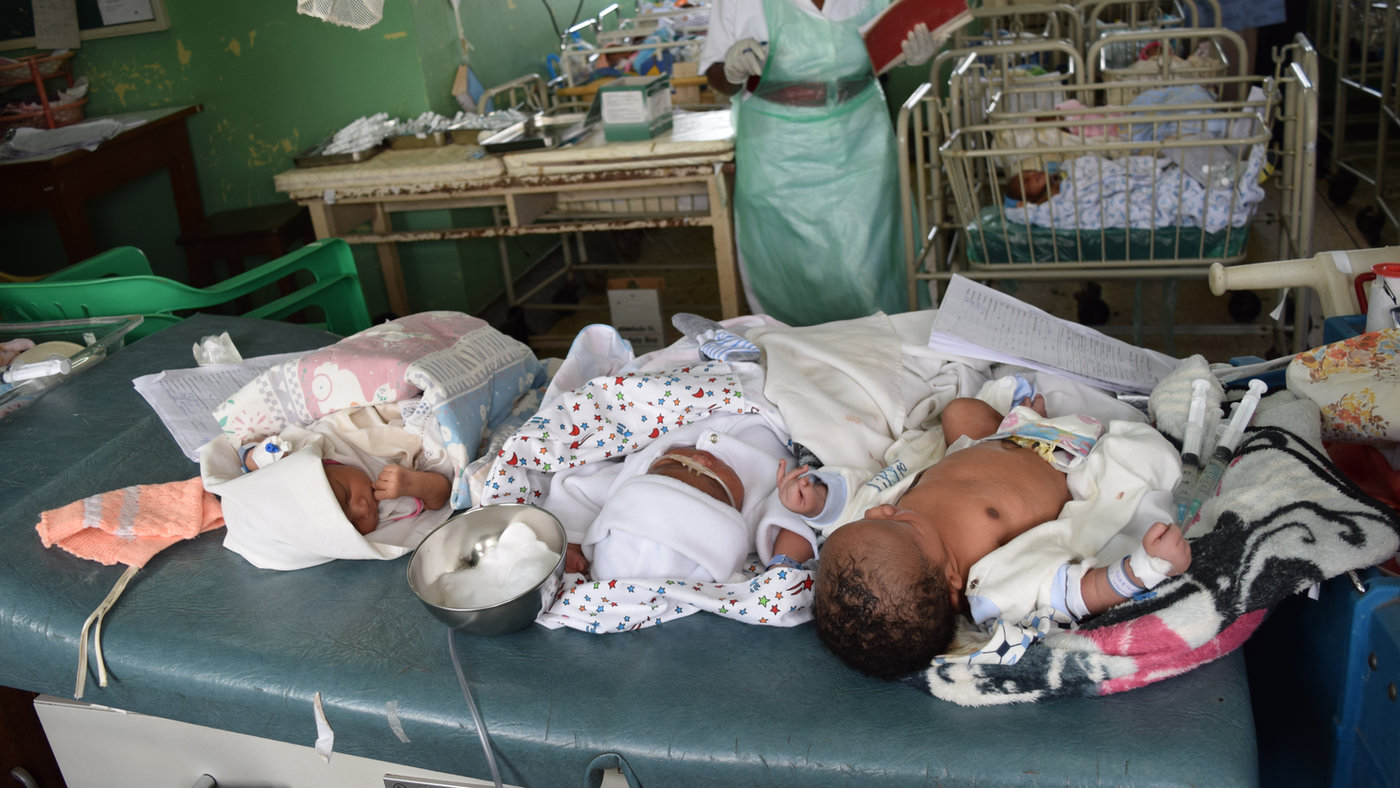
The two Columbia biomedical engineering graduate students had come with a neonatal-monitoring idea and a $10,000 competition prize. They left with a sharper problem. In crowded wards, nurses might be responsible for many critically ill newborns while relying on intermittent manual checks. A baby could deteriorate between rounds. The monitor did not merely need to measure correctly. It had to keep working through power cuts, make sense at a glance, survive cleaning and reuse, and fit a budget that did not have room for a Western bedside machine.
That field trip became Neopenda, a Delaware public benefit corporation headquartered in Chicago. Its flagship product, neoGuard, is a forehead-worn device that continuously measures pulse rate, respiratory rate, blood oxygen saturation and temperature. The readings travel wirelessly to a tablet dashboard, where one clinician can see up to 15 patients and hear or see an alert when a measurement crosses a preset threshold.
The product brief was written by the constraints
NeoGuard is easy to mistake for a sensor story. It is really a workflow story. Conventional patient monitors are usually tethered to one bed, power outlet and bundle of cables. Handheld pulse oximeters are cheaper, but a spot check is a photograph, not a movie. Neopenda tries to sit between those options: medical-grade, multiparameter and continuous, but wearable, rechargeable and shared through one dashboard.
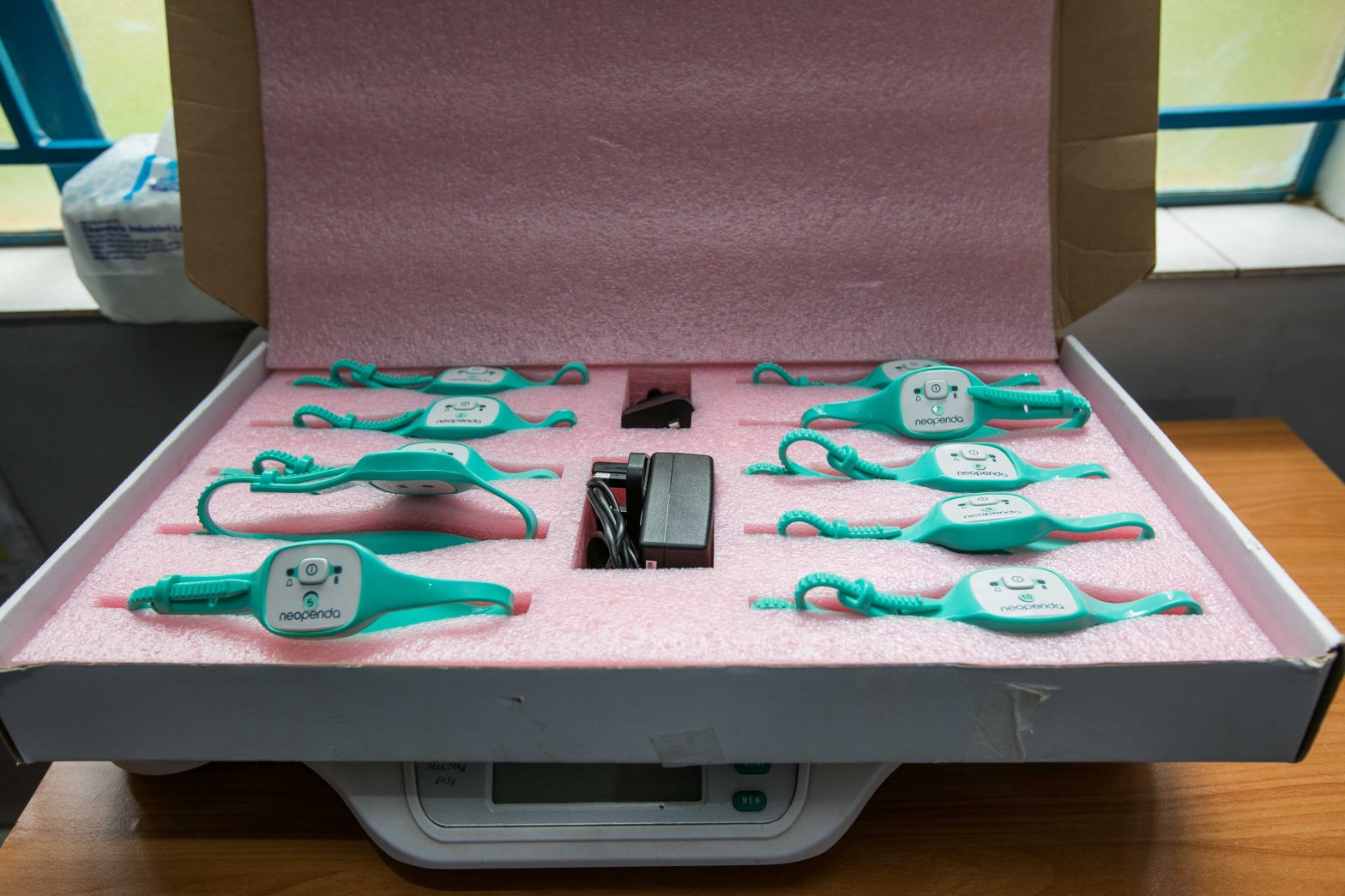
The device does not need continuous internet, and its battery is designed for interrupted power. The sensors are reusable. The central display is not there to impress a hospital tour; it is there to answer the night-shift question: who needs me first? That distinction is Neopenda's edge against both full-size multiparameter monitors and simple spot-check tools.
What failed first
The prototype did not glide from classroom to clinic. In pilot studies conducted from late 2018 to late 2019, the early device produced variable accuracy between patients. It was sensitive to movement and placement. The hardware was too large, and the headband design was inadequate. These are small-sounding defects with a large consequence: a monitor that cries wolf or depends on perfect positioning becomes one more task for an overloaded nurse.
Neopenda recalibrated sensor settings, refined its algorithms to filter noisy signals and redesigned the hardware. The enclosure shrank by more than 60 percent. The company says it consulted more than 400 health workers, primarily in Uganda, over four years. Before launch, it made more than 80 hospital visits and spoke with health officials, implementation partners and distributors across East Africa.
“How can we design something that actually works here?”Sona Shah, co-founder and CEO
That question changed more than the object. It changed who counted as a product expert. Nurses shaped usability. Parents and clinicians participated in feasibility studies. Distributors explained imports and support. Regulators determined which claims could travel with the product. The buyer, meanwhile, was often not the user. A nurse could want continuous monitoring while a hospital administrator, NGO or county government held the purchase order.
The price is part of the engineering
Public pricing has moved with bundle and market, but the rough comparison is useful. A 2022 global technology landscape listed ten neoGuard devices plus the operating tablet at $3,000 to $3,800. A later innovation-fund report described neoGuard at around $300 per device and conventional patient monitors at roughly $3,500. Those are historical reference points, not a current quote, but they explain the design target.
Indicative hardware cost
Historical figures reported in 2022-2023. Bundles, procurement volume, geography and support can change pricing.
Cheap alone would be a trap. A broken $300 monitor is infinitely expensive per useful reading. Neopenda pursued EU CE marking, an ISO 13485 quality system, country registrations and peer-reviewed testing. A completed comparison study at Jinja Regional Referral Hospital in Uganda evaluated neoGuard against an Edan bedside monitor. Later studies examined feasibility and acceptability in Kenya and parents' perceptions in Nigeria.


The business is a device sale wrapped in trust
Neopenda sells devices and accessories to healthcare facilities, governments, NGOs and local distribution partners, then provides installation, clinician training and support. Current Kenyan county purchases are described as one-time capital costs without mandatory monthly subscriptions, license fees or frequent refills. That matters because buyers can use infrastructure-improvement budgets instead of finding a new recurring expense line.
The path to a sale is still slow. Shah has said Neopenda learned that clinical use and commercial adoption are different. A clinician may love the tool, but a public buyer must align priorities, budget, specifications, approvals and procurement. Grand Challenges Canada reported that Neopenda's typical journey from entering a Kenyan county to a purchase had taken 18 to 24 months. A structured program that brought county stakeholders together cut that time by at least half for recent orders.
That is why the company's partnerships matter. The Uganda Pediatrics Association helped with early clinical relationships. Jinja Regional Referral Hospital hosted an accuracy study. Efficiency for Access supported testing and commercialization. Mediquip Global Supplies became a Kenyan distributor. Grand Challenges Canada supplied a milestone-based CAD $1 million Transition to Scale grant and helped create the purchasing pathway that led Kenyan counties to place orders.
A market between the bedside machine and the finger clip
Neopenda occupies the missing middle of patient monitoring. At one end sit expensive multiparameter systems from established manufacturers, powerful but demanding of space, infrastructure and maintenance. At the other are handheld pulse oximeters and condition-specific spot checks. neoGuard combines four continuous measurements, multi-patient visibility and local alerts in a package designed for facilities where the nurse-to-patient ratio is the defining constraint.
The company entered through neonatal wards, where missed deterioration is especially dangerous and evidence standards are demanding. Its stated expansion path runs into pediatric, maternity and general wards. The hardware also creates a continuous clinical-data layer that could eventually support system-level insights. For now, however, Neopenda's disclosed revenue still comes from devices, accessories, training and support. Subscription and data products remain a future possibility, not a mature business line.
By its 2026 community-funding campaign, Neopenda reported more than 500 devices sold across 40-plus customer facilities, 5,000-plus patients and 150,000-plus monitoring hours. The commercial footprint centers on Kenya, Uganda and Ghana. Public financials show both traction and fragility: 2024 revenue was $66,381, up from $24,242 in 2023, while the company posted a $586,867 net loss. Grants and investment have carried much of the long, capital-heavy journey from prototype to regulated product.
What another founder can copy
The stealable playbook
- Audit the graveyard. Study why previous solutions stopped being used before designing another one.
- Separate user from buyer. The nurse, hospital administrator, distributor and county procurement officer each need a different proof.
- Treat constraints as features. Power, connectivity, cleaning, consumables and repair belong in the first product brief.
- Fund risks differently. Neopenda used grants for research and regulatory work, then investment and revenue to push commercial growth.
- Sell the implementation. Training, installation and support determine whether hardware becomes routine care or shelf decoration.
The least glamorous item is the most portable: do not call a pilot a market. A study can show accuracy. A ward trial can show acceptability. Neither proves that a buyer can find a budget, complete a tender, import the product, train staff and replace a damaged unit. Neopenda's decade is a catalogue of those separate proofs.
Where this playbook breaks
It will not work when local clinical partners are absent, regulation is treated as paperwork, after-sales support is remote, or the buyer depends on short-lived donor money. It also fails if continuous monitoring creates alarms without staffing, treatment capacity or protocols to act on them. Visibility is useful only when a health system can respond.
The hard part now is ordinary on purpose
Neopenda has passed the stage where the main question is whether two graduate students can make a wearable sensor. It has a regulated product, manufacturing experience, clinical publications and local commercial teams. The remaining questions are more prosaic and more consequential: Can gross margins improve? Can county orders repeat without years of cultivation? Can training quality survive scale? Can a grant-assisted sales motion become a durable company?
Recent public orders in Kakamega, Migori and Kericho suggest one answer. Hospitals with existing installations gave other officials somewhere to visit. Certification lowered perceived risk. A one-time price fit the funding mechanism. Local teams were present. In other words, the company did not win because someone finally understood the pitch. It won when product, proof, people and procurement arrived in the same room.
The equipment graveyard remains the cleanest summary of Neopenda's argument. Medical technology can be clinically impressive and operationally useless. neoGuard's wager is that the better machine is the one a nurse can keep charged, understand, clean, trust and persuade someone to purchase. Ten years in, that sounds less like a hardware slogan than a very demanding checklist.
Meet Neopenda