Neal Wilson’s family had a considerable investment in education before he had any investment in finance. Both his parents were schoolteachers. Three of his four grandparents were schoolteachers, too. At fifteen, he recalled, buying a stock was outside his experience. The family business, broadly speaking, was explaining things. Wall Street would have to wait.
It did, and then arrived by an indirect route. Wilson studied at Columbia and Penn Law, entered securities law, and worked on the initial public offering of Friedman, Billings, Ramsey. That assignment introduced him to Manny Friedman. Years later, the two would run an investment firm together. In Wilson’s telling, the encounter was a piece of luck rather than the execution of a boyhood master plan.
His career has since become an extended examination of how money finds its destination. At EJF Capital, the firm he co-founded in 2005, that examination often begins with regulation. A rule changes. A financial institution adjusts. An investment becomes possible, or an existing one needs another look. For a securities lawyer, the footnotes can be unusually lively company.
Five schoolteachers and one securities lawyer
Wilson’s early professional life took him through the U.S. Securities and Exchange Commission’s Division of Enforcement, where he was a branch chief, and Dechert, where he was a senior securities attorney. He later became a senior managing director in FBR’s Alternative Asset Investments and Private Wealth Management groups. It was a progression through the institutions that police, interpret and deploy capital.
The sequence helps explain the subject matter of his later work. Securities have issuers, investors, contractual terms and regulatory obligations. A bank has its own constraints. Understanding the business means understanding the relationships among those pieces. The legal training belongs within the investment story because the instruments themselves carry legal architecture.
When Wilson discussed his background with Mike Milken in 2020, he gave Friedman credit for helping him see the possibilities of capital markets. The opportunity to work on FBR’s IPO had brought him into that orbit. His account retained something modest about its beginnings: an education, a professional assignment, a consequential introduction.
“My epiphany was much more mundane than Manny’s.”
Neal Wilson, in conversation with Mike Milken, 2020
A career biography can make each step look inevitable once it has been neatly typeset. Wilson’s own explanation leaves room for contingency. Someone has to meet someone. A lawyer has to look beyond the transaction in front of him. The significance of the assignment may emerge long after the prospectus has been filed.
A partnership with a long memory
Wilson and Emanuel Friedman founded EJF in 2005. Wilson served as chief operating officer before becoming co-chief executive officer in September 2019. The appointment accompanied a strategic minority investment from Kudu Investment Management, a provider of permanent capital to asset and wealth managers. Friedman remained alongside him as co-CEO.
The announcement described a partnership intended to support EJF’s expansion over time. It also marked a change in the formal expression of an existing relationship. Fourteen years after the founding, Wilson’s responsibilities acquired another title. The firm was adding long-term capital while recognizing the co-founder who had helped operate it.
Today, the titles are numerous enough to need their own line break. Wilson is co-CEO, co-CIO of EJF’s private-markets products, and CFO, overseeing accounting and finance. He also leads EJF Investments Manager, which manages a London-listed closed-end fund, and sits on EJF’s risk and valuation committees. Leadership here includes the arithmetic and the machinery behind the investments.
EJF firm assets under management at March 31, 2026, including $2.9 billion in CDO assets through affiliates. A measure of the firm, not Wilson’s personal wealth.
EJF is based in Arlington, Virginia, with a research office in London. Its stated approach combines fundamental security analysis with attention to the regulatory environment. The locations place it near two centers of financial policymaking. Its chosen image is a pendulum: regulation, deregulation, and movement back again.
That metaphor has a useful implication. An investment firm following a pendulum has to keep watching. A rule that matters this year may be interpreted differently later. The task is to consider how institutions will respond, then examine whether the price of a security reflects that response. The policy announcement is the beginning of the calculation.
An envelope from the Federal Reserve
One concrete episode in Wilson’s working life survives as a letter addressed to him by the Federal Reserve Board. Dated October 17, 2018, it concerned EJF’s investments in HomeBancorp and the commitments EJF had made to avoid exercising a controlling influence over the bank under the Bank Holding Company Act.
The investment had changed form. EJF acquired preferred shares and warrants in 2013. Home redeemed the preferred shares in 2016, when EJF purchased $8 million of subordinated debt. First Citizens later acquired Home in April 2018. EJF received cash for its warrants; First Citizens assumed the debt.
The Board granted relief from the earlier commitments. A transaction, a redemption and a merger had altered the relevant circumstances. This is a small, specific glimpse of the regulatory world around Wilson’s work: ownership thresholds, control, debt and the afterlife of an investment when its original issuer disappears into another institution.
It lacks the glamour usually assigned to finance. There is no champagne in the letter. There is a careful discussion of relationships, representations and what constitutes control. For someone whose firm studies regulation, those details are part of the terrain on which decisions have to hold up.
The bank behind the borrower
Wilson’s public arguments about community finance have focused on the institutions doing the lending. In his 2022 writing, he supported the Emergency Capital Investment Program and emphasized the importance of permanent capital for banks serving communities with limited access to finance. His ambition was for that capital to support economic opportunity through lending and employment.
His earlier conversation with Milken and Friedman also addressed mentoring and the relationship between an investor and a bank. The desired arrangement joined the investor’s interest in returns to the institution’s success. Capital and a useful network would give the bank resources to develop, rather than leave it dependent on occasional gestures of support.
“The critical thing is getting capital married to opportunity.”
Neal Wilson, 2020
The language is practical. Opportunity needs a financing structure; an investor needs a reason to participate. A bank must be able to use the resources productively. Wilson’s argument brings those interests into the same discussion. It asks how access to capital can become a continuing relationship with the market.
Another bank problem occupied his 2024 paper, The Bad, the Good and the Ugly. Banks faced pressure to build capital buffers while raising equity or debt could be expensive. Wilson examined credit risk transfer as an alternative tool. The title borrowed a little cinema; the subject remained resolutely on the balance sheet.
In the structure he described, a bank identifies a pool of loans and transfers a defined portion of its credit risk to outside investors. The bank can obtain regulatory capital relief while retaining the loans. Investors receive compensation for taking the agreed risk. The appeal depends on the terms, the loans and how the transaction is recognized.
Identifies a reference pool of loans.
Transfers a specified layer of credit risk.
Receives payment and bears the agreed exposure.
Conceptual sequence, not a return forecast. The loans can remain with the bank; the risk arrangement changes.
That distinction matters to the story. The lending relationship can stay in place while the financial structure changes around it. Wilson’s work returns to such questions because banks operate with constraints that influence their choices. In December 2025, he discussed the CRT and significant risk transfer markets with SCI’s Simon Boughey, extending the same subject into a specialist conversation.
Hamilton visits the payments desk
Wilson’s interest in financial technology follows a related path. In September 2023, EJF announced that its venture fund had closed with approximately $104 million in commitments. Since its January 2022 inception, the fund had invested in twelve early-stage companies across the United States, United Kingdom and Israel.
The announcement emphasized infrastructure: payments, bank technology, risk management and software for capital markets. Wilson described a mission of modernizing financial services. The current EJF Ventures strategy continues to focus on early-stage business-to-business fintech, including technology for banks and wealth managers, blockchain infrastructure and other enterprise software.
It is a part of technology with a substantial appetite for ordinary work. Money needs to move. Data needs to agree. Institutions need systems they can operate. The venture strategy’s proximity to banking gives the word innovation a particular setting: a product must find its way into an organization that already has customers, obligations and habits.
In 2026, Wilson brought a much older figure into this discussion. His essay The “Hamilton Blessing” of the 2025 GENIUS Act connected Alexander Hamilton’s approach to federal debt with Wilson’s view of regulated payment stablecoins. He argued that the newer system could strengthen the dollar’s position through its relationship with U.S. Treasury securities.
This is Wilson’s thesis about a developing market, with future outcomes still open. What makes it revealing as a piece of his biography is the combination of history, regulation and financial structure. The software may be new; questions about confidence, collateral and institutional authority have a long paper trail.
The school connection continues
Education also remained part of Wilson’s public service. He spent nine years on Hood College’s board, chairing its endowment investment committee throughout that tenure. He served five years as a Sidwell Friends trustee and more than a decade on its endowment investment committee. His nine years on the Montgomery County public-school employee pension board ended in 2013; the county recognized his contributions in 2014.
These roles carry a quieter kind of financial responsibility. Endowments and pensions have beneficiaries and purposes beyond the next market quotation. In a career that began among teachers, the school connection continued through the stewardship of institutional money. The resemblance requires no invented family philosophy. The appointments themselves make the connection.
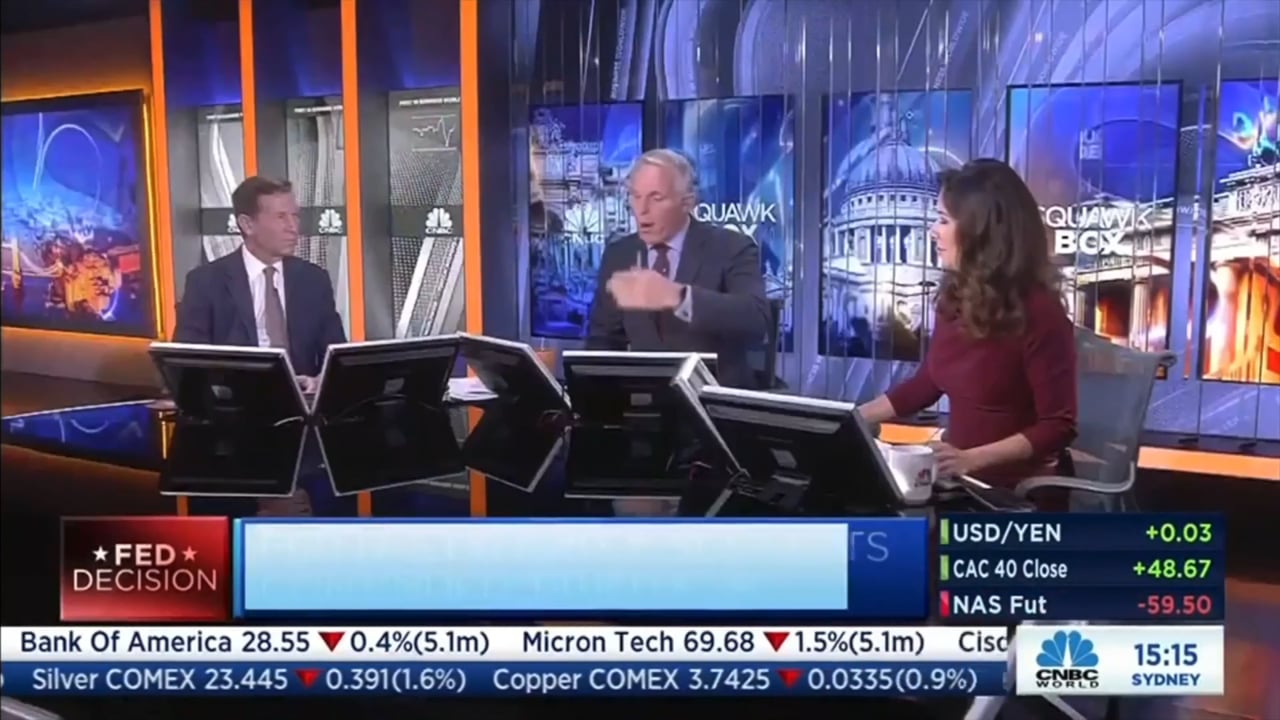
His current public conversations move with the news. An interview posted by EJF on October 1, 2026 covered inflation, interest rates, political pressures on Federal Reserve decisions and lending linked to the data-center build-out at smaller banks. Two decades after EJF’s founding, the subject still connects broad economic developments to the institutions through which money travels.
Wilson’s story began without a teenage stock portfolio and acquired direction through law, work and a meeting. It now includes bank capital, venture investments, endowments and an occasional visit from Hamilton. Across those subjects, he keeps returning to the arrangements that let money do something. The family’s investment in explaining things has found a rather technical field of application.