A doctor can know a patient for years and still miss a fact about them. The fact may be sitting in a scanned specialist letter, a lab result with an unhelpful file name, or a claim that never became a neat line in the electronic record. The appointment, meanwhile, is already moving. Navina was built for this rather ordinary collision: a growing medical history and a shrinking window in which to understand it.
- Navina sells clinical AI to physician groups and other value-based care organizations.
- It assembles patient records into a readable portrait and flags possible diagnoses or care gaps with links to evidence.
- Its strongest product choice is placement: insights appear within the clinical workflow, including supported EHRs.
- Navina’s published figures show broad use; its customer case studies show what happened in particular deployments.
The company calls its software a clinician copilot. That phrase is broad enough to fit almost anything with a text box. Navina’s version is narrower and more demanding. It takes structured data, free-text notes, scanned documents, claims and other fragments, then reconciles them into a patient portrait. It suggests conditions to review, highlights preventive care gaps, and shows the source material behind an insight. The doctor is meant to make the decision. The machine is meant to bring the relevant page to the desk.
The first patient is the chart
Ronen Lavi and Shay Perera founded Navina in 2018. Lavi, its chief executive, had spent years in Israeli intelligence and led an AI lab there. Perera, the chief technology officer, also worked in intelligence units and studied machine learning. The useful part of that background is not intrigue. It is experience trying to turn messy, incomplete inputs into a judgment someone can use.


An electronic health record is often treated as if it were a complete account. In practice, much of what matters arrives as prose or a scan. Someone has to read it, decide whether it still applies, and connect it to the visit in front of them. That used to mean manual chart hunting. Navina’s first important move was to make that search a product: clinical summaries, document search, and recommendations that can point back to their source. If a suspected condition has no traceable evidence, it is harder to trust and harder to defend.
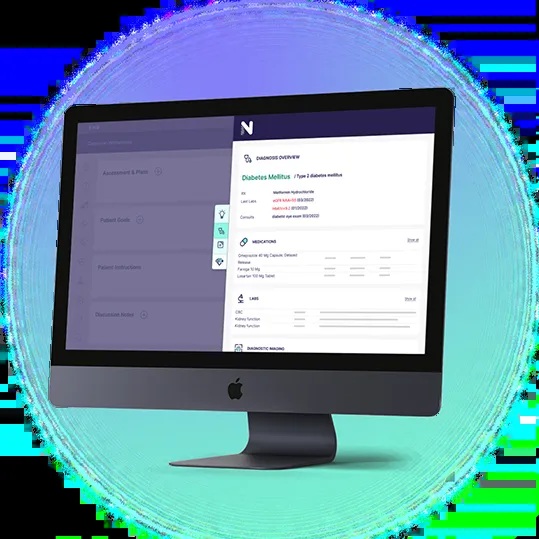
The company then had to solve a second problem: where the answer appears. A separate AI dashboard can be clever and still go unused. At NOMS Healthcare, a longtime customer, Navina followed the group when it moved to Epic in 2024. Its diagnosis suggestions appeared in Epic’s Best Practice Advisory with a link to the supporting record. NOMS’s chief executive said keeping the insights inside the EHR workflow helped adoption. The lesson is plain enough to copy: put a useful answer where the work is already happening.
EHR, claims, labs, notes and scanned records
Reconcile history and flag a condition or care gap
Show the insight in the workflow, with a path back to source
THE PRODUCT IN THREE MOVES. The last step is the test: will the clinician act on the insight?
A useful suggestion needs a witness
Navina’s customers are not patients shopping for an app. They are medical groups, accountable care organizations, health systems and other groups responsible for care quality and, often, the economics of value-based contracts. In those arrangements, finding an undocumented chronic condition can improve both the clinical picture and the accuracy of risk adjustment. Finding a missed screening can change a quality measure. Those two goals can pull against each other if software simply chases codes; Navina’s answer is to tie suggestions to clinical evidence that a physician can inspect.
“It backs up every insight and diagnosis with clinical evidence presented at the time of a patient visit.”Dr. Keith Fernandez, chief clinical officer, Privia Health
The product has grown beyond chart review. Its risk adjustment workflow helps clinicians and coders assess HCC suggestions. Its quality platform searches for care gaps and evidence of closure, including information buried in unstructured files. Analytics show groups how those workflows are being used. This is enterprise software sold through direct conversations rather than a posted monthly price; the company asks prospective buyers to book a strategy call.
There are figures worth reading carefully. In a published AAFP Innovation Lab evaluation across clinics with 1,800 providers and nearly 700,000 encounters, Navina says users saw 30 percent less chart-review burden, a 23 percent decrease in burnout, and an 84 percent acceptance rate for diagnosis suggestions. In an early rollout of the quality platform, the company reported increases of 7 to 24 percent for selected HEDIS measures. These describe the studied settings, not a guaranteed result for every practice.
THREE DIFFERENT MEASURES. The first two come from the AAFP evaluation; the third comes from a Navina case study of Privia Health. They should not be treated as one trial.
The market is full of assistants. This one reads yesterday.
Navina lives between familiar categories: EHR software, population-health analytics, risk adjustment tools, and clinical AI. Some vendors specialize in producing a note from today’s conversation. Others help administrators study a patient population after visits have happened. Navina’s pitch begins earlier, with the longitudinal record a physician needs before and during the encounter. The distinction is useful rather than absolute. In 2025, Navina partnered with ambient documentation company Nabla to combine historical context with live visit audio. The partnership makes the point neatly: a perfect transcript of today does not know what was buried in last year’s scan.
Its customer list offers a second map of the market. Privia Health announced a partnership in 2023. agilon health said Navina would integrate with its existing platform in 2024. NOMS used it across an EHR change. Summit Health announced a deployment in 2026. Navina says its site now reaches more than 20,000 clinicians and care team members and more than 3.5 million patient lives. Those are company figures, and they are best read alongside the narrower customer examples, where usage can be observed rather than merely promised.
Privia’s published case study is especially revealing. It says more than 800 clinicians came onto Navina in the first year after a lean training program that took under an hour per physician, with 87 percent weekly active use. The headline is not that software can be installed quickly. It is that a new tool found a place in an old routine. That is the difficulty most healthcare technology encounters first, and many never get past.
What the investment buys
Navina raised $15 million in a 2021 Series A, $22 million in a 2022 Series B, and $55 million in a 2025 Series C led by Growth Equity at Goldman Sachs Alternatives. Its Series C announcement put total funding at $100 million. It won the 2025 Best in KLAS award for Clinician Digital Workflow, with a reported score of 94.6. Awards and capital can open doors. Neither makes a bad suggestion clinically sound. The company’s more durable advantage, if it earns one, will be the mundane discipline of combining data, showing evidence and fitting into the next appointment.
That discipline also marks the limit of the approach. A practice with poor access to outside records will have less for Navina to reconcile. A team that treats every AI suggestion as a diagnosis would misuse the product. And organizations that cannot spare time to redesign workflow may struggle to reproduce Privia’s adoption. The copyable idea is smaller than the software: link every recommendation to inspectable evidence, place it at the decision point, and measure whether busy people return after the first week.
Healthcare often asks its clinicians to remember everything and find it instantly. Neither is reasonable. Navina’s wager is that a machine can do the hunting while a person still does the deciding. The proof will not be a perfect answer on a screen. It will be the detail a physician notices in time to ask one better question.
Keep the thread
- Explore Navina’s platform and its customer case studies.
- Read about the NOMS Epic integration and the Nabla partnership.
- Follow Navina on LinkedIn, X, Facebook or YouTube.