BREAKING Navier delivers first N30 Pioneer Edition at St. Francis Yacht Club 100 electric hydrofoils headed to the Maldives Stripe employees board a flying boat to work 75 nautical mile range. Zero gallons of diesel. Elon Musk takes a ride on the Bay Sergey Brin, Joe Montana, GFC all in BREAKING Navier delivers first N30 Pioneer Edition at St. Francis Yacht Club 100 electric hydrofoils headed to the Maldives Stripe employees board a flying boat to work 75 nautical mile range. Zero gallons of diesel. Elon Musk takes a ride on the Bay Sergey Brin, Joe Montana, GFC all in
Issue No. 030 · San Francisco · Maritime

NAVIER

The boat decided gravity was negotiable.

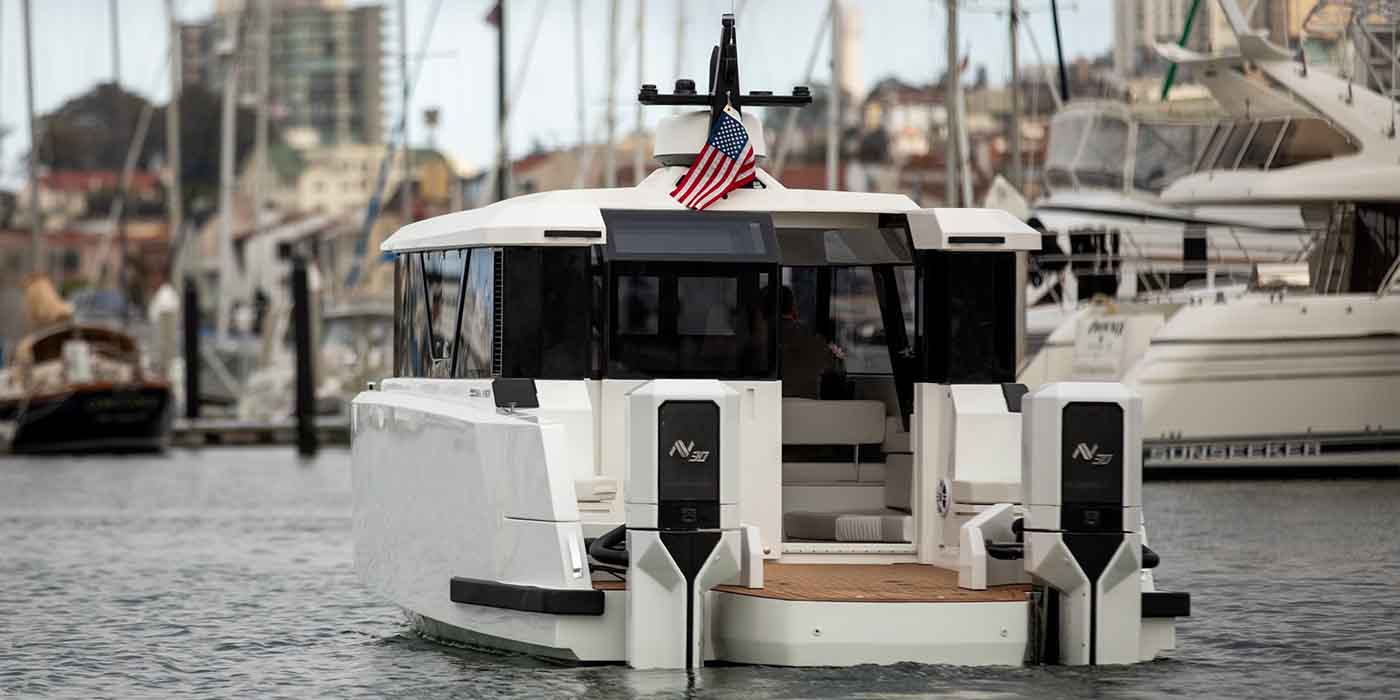
NAVIER, 2026. A 30-foot vessel lifting four feet above the chop on three carbon foils. Twin electric motors humming where a diesel used to roar. The water below stays troubled. The deck above stays still.
Navier N30 electric hydrofoiling boat foiling above the water
N30 PIONEER EDITION · OCTOBER 2024 · SAN FRANCISCO BAY · PHOTO VIA ELECTREK
The Opening Scene

A boat lifts off in the Bay.

It is a Tuesday morning, somewhere off Treasure Island. A 30-foot vessel pushes away from the dock. For a moment it behaves like every other boat ever built - hull in the water, wake building behind it, the small physics of displacement. Then, at about 18 knots, something rude happens. The hull lifts. The wake collapses. Three carbon foils hidden beneath the boat take the weight, and the entire deck rises about four feet into the air. The engine noise, which was never very loud to begin with, drops to almost nothing. The passengers, who were braced for chop, are not bouncing. They are gliding.

This is the Navier N30. It is the first 100% electric hydrofoiling boat built in America. It is also a quiet rebuke to about a hundred years of boat design.

The Numbers

By the spec sheet.

30 ftLength
75 nmRange at 20 kn
2 × 90 kWTwin Electric Motors
30+ knTop Speed
Why hydrofoils win
N30 range
75 nm
Typical e-boat
~25 nm
N30 wake
minimal
Diesel runabout wake
substantial
The Founder

From MIT robots to American boatbuilding.

Sampriti Bhattacharyya was working on her PhD at MIT when Malaysia Airlines flight 370 vanished over the South China Sea. The disappearance lodged itself somewhere in her engineering brain. The world, it turned out, was full of ocean, and we were terrible at moving through it. She had been building underwater robots. She started building something larger.

Navier was founded in 2019. The early thesis was unfashionable: that boats were due for the kind of clean-sheet reinvention that cars and planes had already begun. Lithium batteries had quietly gotten good enough. Carbon composites had quietly gotten light enough. Control-system software, the kind aerospace people had been writing for decades, was just sitting there, waiting to be aimed at the water.

In 2021 Paul Bieker - the naval architect behind multiple America's Cup campaigns - joined to lead the hydrofoil design. With him came a particular pedigree of obsession: foiling is, mechanically, the most efficient way to push a hull through water, and it is also the most demanding thing to control. Get it wrong and the boat slams. Get it right and it flies.

Navier got it right.

The Trick

Aerospace software, applied to a boat.

Hydrofoils are not new. Engineers have been bolting wings to the bottoms of boats since the 1900s. What is new is the brain. Navier's active foil control system continuously adjusts the geometry of its three foils, dozens of times a second, based on what it senses in the water below. The result is a deck that stays level even when the bay does not.

3

Carbon foils

Two main foils and a rudder foil, all carbon composite. They take the weight at speed and the hull stops touching the water.

0

Gallons of diesel

Twin 90 kW electric motors. Silent operation. Zero local emissions. The marine engine, but politer.

1

Joystick

The N30 docks itself. Joystick maneuvering moves the boat sideways or spins it in place. The marina cringe ends here.

It's a boat and a plane. Sampriti Bhattacharyya, founder & CEO
Who It's For

What you can actually do with one.

Commute over water

Stripe signed on as the inaugural partner for a Bay Area commuter pilot - employees taking a quiet, zero-emission shuttle across water that has been there the whole time, mostly unused.

Tender for a superyacht

The N30 is small enough to function as a chase boat or tender for larger vessels, and quiet enough that the people on the larger vessel will not hate it.

Resort transit

An agreement with JIH Global Investment will deploy up to 100 N30s across the Maldives over three years, replacing combustion ferries between islands.

Defense and utility

The U.S. Navy has taken a look. A foiling, quiet, electric craft has uses that have nothing to do with day-cruising the bay.

The Receipts

Six years, condensed.

2019
Navier founded in San Francisco by Sampriti Bhattacharyya.
2021
Naval architect Paul Bieker joins to lead hydrofoil design.
February 2022
$7.2M seed round co-led by Global Founders Capital and Treble.
December 2022
N30 unveiled - America's first 100% electric hydrofoiling boat.
October 2023
Elon Musk test-rides the prototype on San Francisco Bay.
2024
Stripe commuter pilot announced. First N30 Pioneer Edition delivered at St. Francis Yacht Club.
2025
First commercial deliveries. JIH agreement for 100 boats in the Maldives.
2026
Initial Maldives fleet of five N30s begins service.
The Cap Table

Who is paying for this.

Navier has raised roughly $17M+ in disclosed seed capital across early and 2022 rounds. The list of names is, charitably, unusual for a boat company.

Sergey Brin

Google co-founder. Early backer.

Liquid 2 Ventures

Joe Montana's fund. Yes, the quarterback.

Global Founders Capital

Co-lead on the 2022 seed round.

Rich Miner

Android co-founder. Hardware sympathizer.

NextView Ventures

Seed-stage tech investor.

Primavera Capital

Global growth investor.

Watch It Move

The boat, in motion.

Words can only do so much for a vessel whose entire trick is what happens at 18 knots. The video below is more useful than another paragraph.

The Closing Scene

Back to Treasure Island.

Return to that Tuesday morning. The boat has now reached the other side of the bay. It begins to slow. The foils retract their lift. The hull settles, gently, back onto the water - the kind of landing that does not feel like landing. The passengers step off. There is no smell of fuel. There is no slick on the water where the engine has been. The wake the boat leaves behind it is, generously, a ripple.

The marina, which has heard combustion engines all morning, gets a few seconds of unusual quiet. Then the next boat starts up - diesel, loud, displacing water the old way. For a moment the contrast is almost embarrassing. The Navier N30 has not solved waterborne transportation. It has just shown, in a fairly specific 30-foot way, what solved would look like.

Five more N30s are about to start service in the Maldives. A pilot fleet is moving Stripe employees across the bay. The Navy has taken notes. Somewhere in San Francisco, the next boat is being built. The water, which has been the same for a very long time, is about to be used differently.
Pass it on.

Share Navier with someone who still thinks all boats need diesel.