On a football Sunday, the National Football League looks like controlled disorder: 22 bodies in motion, seven officials reading the collision, coaches talking into headsets and millions of people arguing about the same few inches. Behind that disorder sits a company built to make nearly everything else consistent. The field is standardized. The ball is specified. The schedule is negotiated. The cameras, radios, tablets, replay feeds, commercial breaks and licensed marks all arrive through a system designed to let uncertainty survive in exactly one place - the score.
That is the useful way to understand the NFL. It is not one conventional corporation and it does not own its 32 clubs. It is their organizing layer: rulemaker, rights seller, event producer, technology buyer, subscription service, licensing house and keeper of the shield. The clubs compete locally and cooperate nationally. That tension is the product.
01 / The productA scarcity machine in shoulder pads
Many internet businesses chase abundance. The NFL sells a finite inventory. Each club plays 17 regular-season games, and the weekly rhythm makes a game feel less like another episode in an endless feed than an appointment. A loss cannot be buried under six more games before Friday. A broadcaster cannot manufacture another Cowboys-Eagles Sunday afternoon. Scarcity concentrates attention, and concentrated attention is unusually valuable to advertisers and distributors.
The league packages that attention across CBS, Fox, NBC, ESPN/ABC and Amazon under long-term U.S. agreements largely running through the 2033 season. Other windows now reach Netflix, YouTube and international distributor DAZN. This is not a retreat from television or a simple march toward streaming. It is a distribution portfolio. Free broadcast keeps the top of the funnel wide; pay television and streaming create premium windows; highlights and social video keep the conversation alive between games.
The NFL’s moat is live uncertainty, delivered on a schedule people can memorize.A business built around the one thing a replay cannot reproduce
02 / Who paysOne game, several customers
Fans are the obvious users, but the NFL sells to a layered market. Broadcasters and streamers buy live rights because games gather audiences at the same moment. Sponsors buy association and reach. Licensees put club marks on jerseys, caps, cards, games and collectibles. Stadium crowds buy tickets and hospitality. Bars and restaurants buy commercial access. Fantasy players consume statistics; teams consume tracking data; families and coaches use youth-football resources.
The model solves a coordination problem that individual clubs could not solve as efficiently alone. A national schedule is more useful than 32 disconnected schedules. A common rulebook is more credible than home-team interpretation. A pooled media package gives distributors a full season rather than a patchwork of local negotiations. Revenue sharing then helps preserve competitive balance, which protects the drama every customer is ultimately buying.
The product catalog grows outward from there. NFL Films turns old games into durable stories. The Draft transforms workforce allocation into a three-day television event. The Combine makes job interviews public. RedZone remixes Sunday into a rapid tour of scoring chances, while fantasy football gives viewers a reason to follow players far beyond their favorite club. Tickets and official merchandise convert affiliation into attendance and objects. None of these products replaces the game. Each finds another moment, screen or customer in which the game can matter.
Central scale, local emotion
Illustrative, not an audited split. National media, sponsorship and licensing are pooled; clubs also build ticketing, premium seating and local commercial revenue.03 / Direct to fanNFL+ is a careful kind of disruption
The league’s own subscription product shows how delicately those relationships are managed. NFL+ includes live local and primetime games on phones and tablets in the United States, live audio, out-of-market preseason games, NFL Network, Fantasy+ and library programming. Premium adds RedZone, full and condensed replays, All-22 coaches film and NFL Pro. It gives the league a login, a billing relationship and a place to experiment without simply replacing the partners that finance and distribute the season.
For fans, the practical value is control: follow a live local game away from the television, hear a preferred radio call, replay a condensed game or inspect the wide-angle film normally used by coaches. The limitation is equally instructive. Rights vary by device, geography and game window. The product is a layer in the system, not a universal remote for every NFL broadcast.
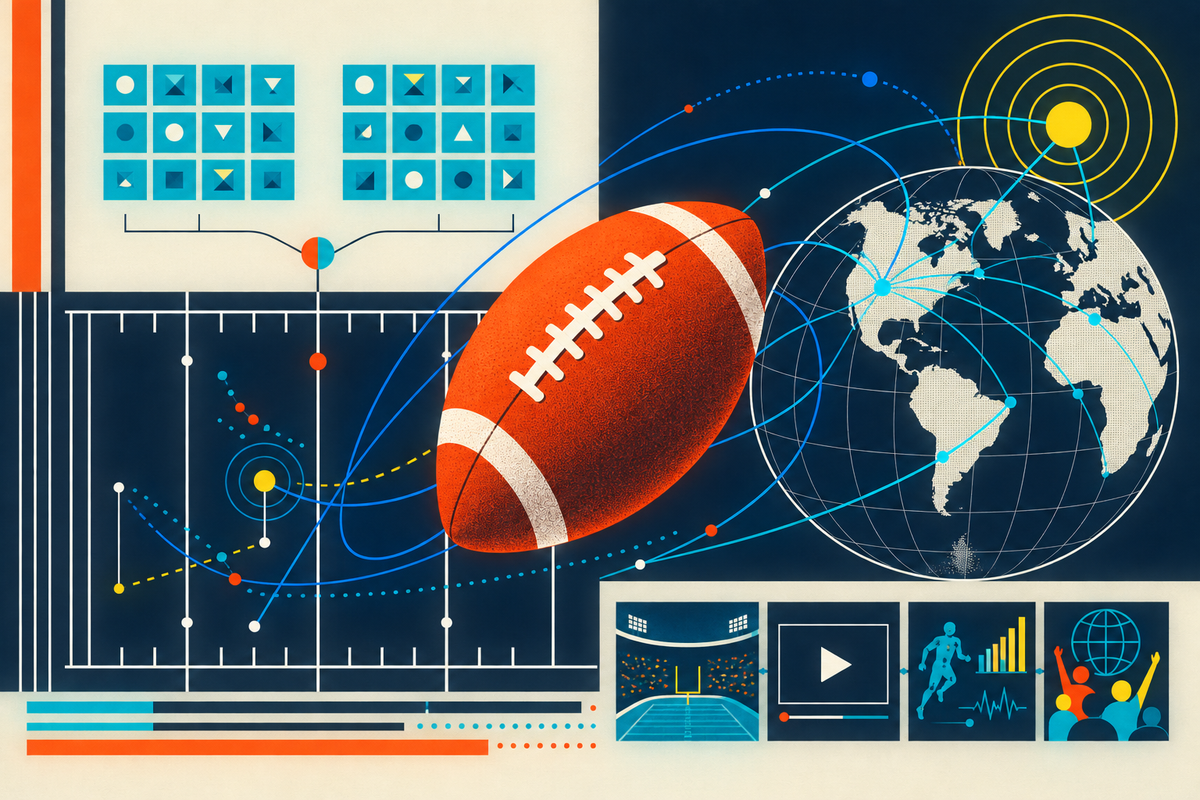
04 / The hidden stackTechnology must be useful before it is visible
The league’s expertise is not primarily inventing consumer electronics or cloud infrastructure. It is translating football’s peculiar constraints into systems partners can build. Equipment must survive weather, contact, radio interference and a stadium full of phones. A replay tool must be fast enough to help without turning the game into litigation. A tracking system must capture movement without interfering with it.
Next Gen Stats is the clearest example. Tags in player equipment and tracking technology in the ball generate location, speed and acceleration data on every play. The system, developed with Zebra Technologies and Wilson and run on Amazon Web Services, serves clubs, broadcasts and fan products. It can explain the separation a receiver created, the probability of a completion or the route a runner actually took instead of the one an analyst imagined.
Microsoft’s sideline relationship follows the same pattern. Black-and-white printouts gave way to ruggedized Surface devices; the 2025 generation brought Copilot+ PCs and faster ways to filter play images. At Art McNally GameDay Central in New York, officiating supervisors can examine feeds across games and communicate with stadium crews. The public sees a referee pause. Behind the pause is a national production system.
Running that system requires a culture closer to event operations than a relaxed entertainment studio. The league describes its employees as stewards and publicly emphasizes knowing the business, building talent and executing. Its offices expect most employees in person five days a week. That posture fits a calendar in which dozens of dependencies must land at kickoff, but it also makes the central office distinct from many hybrid media and technology employers. The work moves between long-range rights strategy and the blunt immediacy of a broken headset on Sunday.
The league standardizes the machinery so clubs can compete on decisions, not access.Same tools, different calls
05 / The hard problemGrowth without loosening the game
The NFL competes with the NBA, Major League Baseball, college football and other live sports, but also with games, creators, streaming series and every other claim on a weekend. Its difference is a century of local allegiance joined to national distribution. No startup can quickly reproduce Green Bay inheritance, a Thanksgiving ritual or a division rivalry passed between generations.
That history can also become ballast. Player health remains the league’s most consequential product problem. Rules, equipment standards, injury research and coaching technique have to make football safer without pretending contact can be removed from tackle football. Officiating technology must improve accuracy without draining spontaneity. New streaming windows must add access without turning fandom into an expensive scavenger hunt.
International growth contains the same tension. The 2026 schedule places nine games across four continents and seven countries, including Australia, Brazil, England, France, Germany, Mexico and Spain. A traveling game creates a spike; a durable market needs youth participation, local media, repeat events and a reason to care after the visiting teams fly home. NFL FLAG matters here as much as a sold-out stadium. It gives children a lower-contact entry point and gives the league something rarer than viewers: players.
The league is also redrawing its own media boundary. In January 2026, ESPN completed a transaction to acquire NFL Network and certain related media assets. The move is revealing: ownership of every channel is less important than controlling the competition, the brand and the terms by which audiences can reach them. For a league that once needed its own network to guarantee shelf space, a deeper platform partnership can be another way to expand distribution while keeping the core rights engine intact.
06 / The long viewFrom a car showroom to a global control room
The organization began in 1920 as the American Professional Football Association, assembled at Ralph Hay’s Hupmobile showroom in Canton, Ohio. Jim Thorpe served as its first president. The early task was basic: bring order to unstable schedules, player movement and disputed championships. The modern tools are different, but the job is recognizable. Establish common rules. Make commitments credible. Turn separate teams into a league worth following.
That is where the NFL fits in the market. It sits upstream of networks and streamers because it creates the live competition they distribute; beside consumer platforms because it operates its own apps and subscriptions; and above individual clubs on matters that need national scale. It is a media company only after it is a standards body, and a technology company only when technology helps the game remain fair, legible and commercially useful.
The shield is therefore less a logo than an interface. Behind it are 32 owners, thousands of employees, players and coaches, dozens of distribution arrangements, sensors, licensing contracts, youth programs and one stubbornly analog promise: on any given play, the plan can still go wrong. The NFL organizes everything around that possibility. Then it sells the right to watch.