On January 5, 2019, Nuseir Yassin reached a number that had occupied nearly three years of his life: 1,000. It was the last day of a promise made in 2016, when he walked away from a software job and decided to publish a one-minute video every day for 1,000 days. The promise sounds almost comically small if measured in minutes. Measured in mornings, border crossings, missed plans, and deadlines, it looks rather different.
The project became Nas Daily. At first it was a Facebook page and a man with a camera. By the final day, his account of the trip included 64 countries, millions of followers, and a recognizable black T-shirt. The videos had a rhythm: an urgent introduction, a person or place worth meeting, a point delivered before the viewer could reach for something else. The clock was always running. So was he.
Yassin’s story is often told as the clean exchange of a comfortable job for a more interesting life. The part that gives it texture is the messy stretch in between. His company’s own history marks Days 217 and 230 as moments when he nearly quit. It marks Day 271 as the point when Facebook’s algorithms began sending him a much larger audience. A good idea, repeated for long enough, met a distribution system that happened to open its doors. Even a daily deadline needs luck.
The boy from Arraba meets a deadline
Yassin grew up in Arraba, in northern Israel, in a Palestinian family. He left for Harvard in 2010 on a scholarship and graduated in 2014 after studying economics and computer science. That route led to Venmo, where he worked as a software developer. There is a certain logic to this sequence: learn to build things, join a technology company, discover that the thing you most want to make is elsewhere.
Before the camera became his work, he tried other online projects. In an interview about his 2019 book, he described multiple failed ventures before Venmo. The job gave him money, experience, and a way to finance a departure. When he did leave, he took a drone, a camera, protein bars, and an unusually specific plan. Many people quit to travel. Far fewer attach a public deliverable to every day of the trip.
The first format was plain enough to be understood by anyone who saw one video. A day would produce a minute; a minute would tell a story. The rule removed a host of daily negotiations. No need to wonder whether this particular day deserved a post. It did. No need to wait for perfect footage. The deadline was tomorrow, then tomorrow again. Such discipline can be absurd, but absurdity has a useful property: it is easy to remember when things get difficult.
“They’re sending a message to the world, and I’m just a messenger with a video camera.”Nuseir Yassin, on the people he met while traveling
In that same interview, Yassin described a collaboration that a follower count cannot capture. When he arrived in a country, people who lived there suggested what he ought to see and whom he ought to meet. He could not become a local in a day. He could, however, listen to locals. The page was a distribution channel, but it was also a tip line with a remarkably large staff.
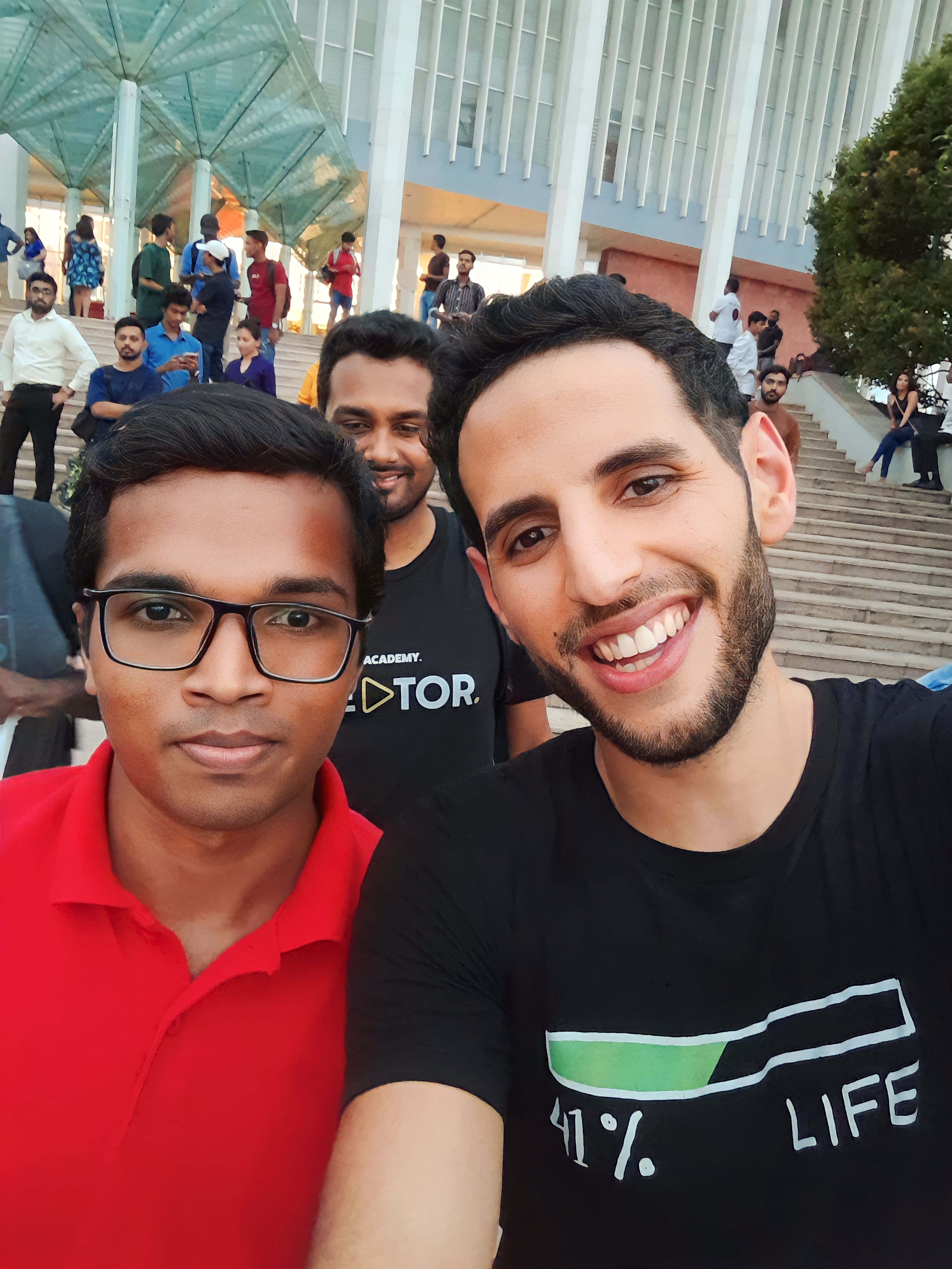
A shirt with a clock on it
For a long time, the black shirt did much of the visual work. It carried a percentage of life, calculated against average life expectancy. The number changed; the reminder did not. Yassin has sold versions of the shirt printed with the buyer’s own percentage. On a creator who made time his medium, the garment was halfway between a uniform and an argument.
It also made him easy to spot in a crowded frame. He could move from a street to a mountain to an airport, but the shirt told viewers whose minute this was. His loud delivery and quick edits did the rest. The videos were engineered for a phone screen, where an introduction has only a few seconds to earn the next few seconds. That pressure can flatten a complicated subject. It can also make someone curious enough to look beyond the screen.
Yassin said the subjects closest to his own history were the hardest to compress. Stories about Israel and Palestine, Jews and Arabs demanded care that a minute could scarcely accommodate. In 2019, his book Around the World in 60 Seconds, written with Bruce Kluger, let him add what the format had forced out: how a story was found, what happened after the camera stopped, and why a particular encounter mattered to him. The book runs 272 pages. It is a long answer to a short-form habit.
A changing percentage made the passage of time visible. Yassin’s daily video rule supplied the next question: what will you do with today’s share?
What came after the last daily video
Finishing Day 1,000 solved the original challenge and created a less cinematic one. How do you keep a project alive when its central promise has expired? Nas Company’s timeline answers in practical steps. Day 1,001 brought a team. Soon came an office in Singapore. Nas Academy offered creator courses; Nas Summit gathered people in person; Nas.io, later Nas.com, offered tools for online businesses. Nas Daily became one part of a larger organization.
The company today presents the collection as an ecosystem of media, experiences, and technology. Its site reports 68 million followers for Nas Daily and says its products reach 300 million people monthly. Those are company figures, useful as a measure of how the business describes its scale. They also mark how far the operation has moved from the original image of one person editing at the end of a day.
A company also carries obligations that a personal challenge does not. In 2021, a planned Nas Academy course with the Indigenous Filipino tattoo artist Apo Whang-Od became a dispute over consent and community rights. The Philippine National Commission on Indigenous Peoples investigated. Its later account says Nas Academy representatives went to Buscalan and apologized to the Butbut community through a customary process. The episode is part of the company’s history, and a reminder that a story about a community belongs to more people than the camera operator.
Yassin has been frank, too, about the limits of the word “influencer.” In one interview he argued that getting someone to click “like” does not mean changing a life. That distinction helps explain his move into courses, gatherings, and products. Whether those efforts succeed is a question for their users. The ambition is clear: make the audience capable of doing something after the video ends.
“My biggest challenge is how to keep it exciting and how to not repeat the same idea twice.”Nuseir Yassin, speaking about the daily format
Another kind of minute
His current LinkedIn profile gives the latest version in two sentences: he is building Nas.com to help businesses grow with intelligence, and he still makes videos. Nas.com now describes AI tools for marketing and customer growth. It is a different product from a travel film, though the underlying habit is recognizable. Find a complicated task, make its next step feel manageable, and bring people along.
There is a small irony in this progression. The daily videos became famous for being brief, but the operation they produced requires patience with long conversations, long contracts, and long product cycles. A course cannot be revised at the speed of a Facebook post. A gathering lasts more than a minute. Software has to work after the host has left the room. Each new format asks Yassin to stretch the skill he first practiced under a strict clock: deciding which human problem deserves attention.
He has also kept one thing from the travel years that does not show up in a dashboard. At a meetup, an audience becomes a group of people with names, accents, and suggestions. The Sri Lanka photograph captures that simple change of scale. A viewer who once appeared as a number on a screen is suddenly close enough to take a picture. That may be the clearest explanation of why a video creator would build places for people to meet.
The most appealing number in the Nas Daily story may still be 230. It sits in the unglamorous middle, when the project had become expensive in time but had not yet become famous. Day 271 and its algorithmic turn had not arrived. Neither had the book, the studio, or the software company. There was only tomorrow’s minute to make.
Yassin made it. Then he made the next one. The result was an archive large enough to contain a career and short enough, one entry at a time, to fit in a pocket. A thousand days later, the deadline ended. The habit did not.
Follow the original one-minute format and the newer stories on the Nas Daily channel.
Watch Nas Daily videos ↗