Before the titles acquired capital letters, before chief marketing officer and vice president, Nai Kanell went prospecting in a place where few teenagers would think to look: anonymous office buildings. She was in high school. She wanted an internship. So she entered buildings without security desks and knocked on doors until a startup agreed to sign the school-credit forms. She reported there after class, then waitressed on weekends for money.
It is a useful first scene because it contains the operating system of her later career. There is the appetite for more, the absence of a supplied route, the practical nerve to ask and the willingness to do the unglamorous work once somebody says yes. Kanell has since marketed bank services, packaging systems, workplace software, compliance tools and plant-floor technology. The categories changed. The habit did not: walk into an unfamiliar operation, learn its language and make its value intelligible.
Today Kanell is chief marketing officer of SafetyChain Software, where she leads brand, demand generation, communications and partner marketing. The company’s customers make food and beverages. Their concerns are less Madison Avenue than factory Monday morning: quality, throughput, compliance, wasted material, audit readiness and whether useful information arrives before a line problem becomes an expensive one. Kanell’s job is to translate that machinery into a reason to act.
A map borrowed, then redrawn
Kanell describes herself as a first-generation refugee. Her parents assembled medical devices in a factory. A 25-cent raise for her mother registered as a real family success, and the combined household income stayed below $50,000. Her parents believed in college and professional work, but they could not proofread a résumé or explain the signals that universities and employers expected. Kanell had to locate those instructions elsewhere.
Guidance counselors helped. Older siblings helped. Mentors arrived later. A Clara Abbott Foundation scholarship, available through her mother’s workplace, made the University of Utah possible. There she studied business marketing, made the Dean’s List six semesters in a row and reported a 3.7 GPA. Membership in Golden Key and Phi Kappa Phi followed. None of this makes the route sound easy. It makes visible the people and institutions that turned effort into traction.
A high-school teacher had supplied the first useful definition of the craft: marketing could be an engine for company growth. At 18, Kanell imagined using it at Coca-Cola or Procter & Gamble. Fate, as she puts it, delivered B2B instead. It proved a good fit. Consumer marketing gets the cereal box; B2B marketing gets the production line that fills it, the quality record that clears it and the software that tells a manager what happened overnight.
“Fate brought me into the B2B side of marketing, and my career evolved from there.”Nai Kanell, reflecting on where she expected to be at 18
Marketing the machinery behind the work
After early roles at Celtic Bank and AlphaGraphics, Kanell joined Packsize in 2013. She moved from demand generation manager to marketing director for North America, promoting systems that make right-sized packaging on demand. Cox Automotive added dealership software to her vocabulary. At SpaceIQ, beginning in 2017, the subject became how companies plan, measure and use the workplace.
The SpaceIQ period put her in the middle of both a market shock and corporate combination. She appeared on the Power of the Workplace podcast to discuss the budget and expectations surrounding the return to offices after remote work had proved viable. She also helped steer a brand project uniting three workplace-management software companies on a 90-day clock. Her assessment of the finished system emphasized consensus: the brand had to create a house in which several acquired identities could live.
That is a different marketing muscle from buying attention. It is part diplomacy, part taxonomy and part deadline. A name must tell employees what they now belong to, tell customers what has and has not changed, and give salespeople a coherent sentence before rumor writes a worse one. Kanell’s public career repeatedly lands at those junctions, where the product is technical and the company story needs rebuilding without losing its load-bearing beams.
At MedTrainer, where she became CMO in 2022, she led another rebrand. Chief executive Steve Gallion later recalled being skeptical when she proposed remaking the brand and website. His skepticism yielded to a clearly argued project and a fast delivery. Kanell, true to a marketer’s eye for the tangible detail, celebrated the new identity and joked that its swag colors would look better on her.
The boss who kept the rough draft
Executive biographies preserve triumph and misplace friction. Kanell has chosen, at least once, to keep the rough draft. Hosting SafetyChain Summit’s first women’s leadership panel, she took a question about how not to become somebody’s worst manager. Her answer began with an admission: in her early twenties, that worst manager may have been her.
She called her younger self the “dragon lady” - tough, demanding and unaware of how she came across. Experience taught her that other people do not work as she does. Adjusting the delivery to the person, she said, did not mean surrendering the standard. It meant leading with understanding. The line she arrived at is cleaner than most management books: “I’m still demanding, but I’ve learned to deliver differently.”
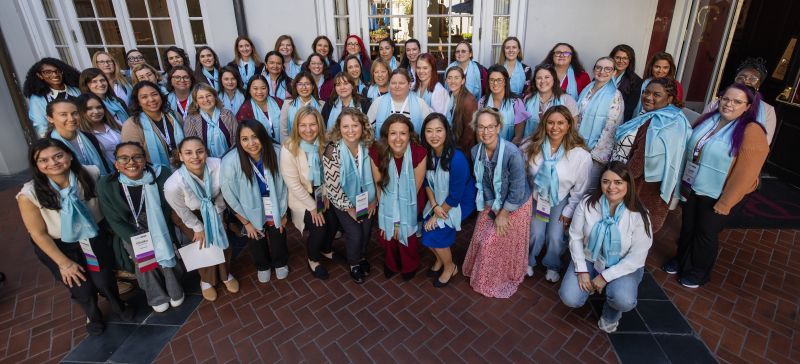
The panel itself brought more than 70 women together to discuss barriers, mentorship, empathy, resilience and credibility in a male-dominated industry. Kanell shared the stage with Meghan Stevenson, Rita Harkless, Sharon Birkett and Tracy McConnell. The session received a five-star participant score. More tellingly, Kanell described the event as a table to keep building, with more chairs to pull up.
High expectation + one default delivery style = heat without reliable transmission.
High expectation + person-specific communication = accountability people can act on.
Colleagues’ recommendations echo the revision. They describe a leader who joins compassion to accountability, gives unusually direct feedback and treats management as mentorship. There is no need to sand away the demanding part. The interesting achievement is learning that rigor travels further when the recipient can hear it.
Lemon bars and human checkpoints
Kanell’s preferred philosophy arrives from the kitchen. She likes cooking as an expression of care. When guests need different things from a meal, asking them to accept exclusion is efficient but inhospitable. She would rather spend the energy to find something everyone enjoys. In business language, it is a win-win. In Kanell language, when life supplies lemons, improve on lemonade. Make lemon bars. A little sweeter for everybody.
The metaphor works because her industries are full of trade-offs that can be made less crude. Software should give the company better information and give an employee back time. A new brand should make the business clearer without erasing the people who built its earlier identity. An automation should move work faster without quietly lowering the standard.
On artificial intelligence, Kanell has argued for restless experiment bounded by human judgment. She taught herself new products, took prompt-engineering courses and asked her team to keep testing. She wants hires who are AI-forward and curious. Yet her stated operating model retains human checkpoints to protect brand quality. The point is not novelty. The point is to remove time-consuming work while keeping someone answerable for what reaches the world.
Her marketing eye does not shut down outside the office. In one recent dispatch, a Walmart cereal aisle became a field report: protein claims flexed across boxes while Korean fusion products claimed nearby shelves. She read the arrangement as two cultural trends colliding in center store. It was observant, lightly comic and entirely on duty. Some people shop for cereal. A CMO also shops for evidence.
The career’s recurring move is simple to describe and hard to fake: ask, learn, translate, adjust.Four verbs across five operational industries
Back to the factory
SafetyChain closes a circle without making it too tidy. Kanell grew up in a household supported by factory work. Now she markets software intended to help factories see themselves more clearly. She is not running the line her parents knew, and food production is not medical-device assembly. The connection is not technical. It is respect for operational labor and an understanding that small improvements can matter materially to a working family.
The formal brief is growth: expand SafetyChain’s footprint, sharpen its brand and place the company inside the larger shift toward digital plants. Her personal brief appears broader. Keep building teams that can learn a complicated industry. Keep making room for women in manufacturing leadership. Keep applying new tools without outsourcing judgment. Keep turning obscure operational value into a sentence a customer can repeat.
And keep the door open. The teenager who knocked because nobody had given her the proper introduction eventually found the counselors, siblings, teachers, scholarship committees and mentors who helped her through. The executive she became speaks plainly about the debt and the mistakes. That candor is more useful than a polished origin myth. It shows a career not as a staircase, but as a series of rooms entered, studied and made easier for the next person to navigate.