Musheer Ahmed entered graduate school with a security problem and left with a company. The route between those two points ran through electronic medical records, stolen identities, suspicious claims, Washington conversations, industry conferences, a patent, and the slow discovery that an academic question had acquired a commercial address.
He had already spent his undergraduate years at Georgia Tech, earning a computer science degree in 2009. He went straight into the institute’s doctoral program and chose healthcare security as his specialty. The timing mattered. Medical records were moving from folders to screens, encouraged by a federal push toward digitization. The promised efficiencies were easy to see. Ahmed became interested in what would happen when the information escaped its intended boundaries.
His line of inquiry was almost grimly economical: stolen data has value only when someone can turn it into money. In healthcare, one route runs through fraudulent billing. He began following that route, away from guarding information alone and toward recognizing what bad actors did with it. The cybersecurity student found himself studying claims.
A moving target refuses to sit for a rules engine
Traditional detection systems often depend on fixed rules. A rule can flag a known combination of codes, an implausible frequency, or a pattern investigators have already encountered. Its competence is historical. Once a scheme changes shape, the rule may keep guarding yesterday’s door.
Ahmed saw the resemblance to cybersecurity, where attackers study defenses and adapt. He focused his dissertation on AI that could examine behavior across a provider’s claims history and surface anomalies that no analyst had explicitly described in advance. The work produced patented technology. A federal scientific advisory group, JASON, later recognized the research as addressing structural problems in the emerging health data infrastructure.
The research did not remain sealed inside a dissertation. Ahmed attended industry conferences, met health plans and spoke with government agencies. Each conversation made the gap more concrete: investigators needed to spot new patterns earlier, without drowning in false positives. He was invited to Washington to discuss patient-data security. The wider the audience became, the less the work looked like a purely academic exercise.
“I didn’t start with the intention of starting a company.”Musheer Ahmed
He also had something first-time founders are often advised to find and rarely know how to use: a mentor with relevant scar tissue. His academic adviser had commercialized university research before and could explain the distance between an elegant model and a functioning business. That adviser, Georgia Tech professor Mustaque Ahamad, became a co-founder.
The early pitch was a test, not a prophecy
Ahmed founded the business in 2017 under the name FraudScope. He has been candid that he brought no prior entrepreneurial experience. He brought the technology, a network of guides, and a willingness to ask prospective customers for a comparison.
The proposition was unusually falsifiable for an enterprise sales meeting: give the new system part of the claims data and compare what it finds with the incumbent tools. Ahmed has said those early trials uncovered millions, sometimes tens of millions, of dollars in suspicious activity that existing approaches had missed. A lecture about AI might open a door. A result could keep it open.
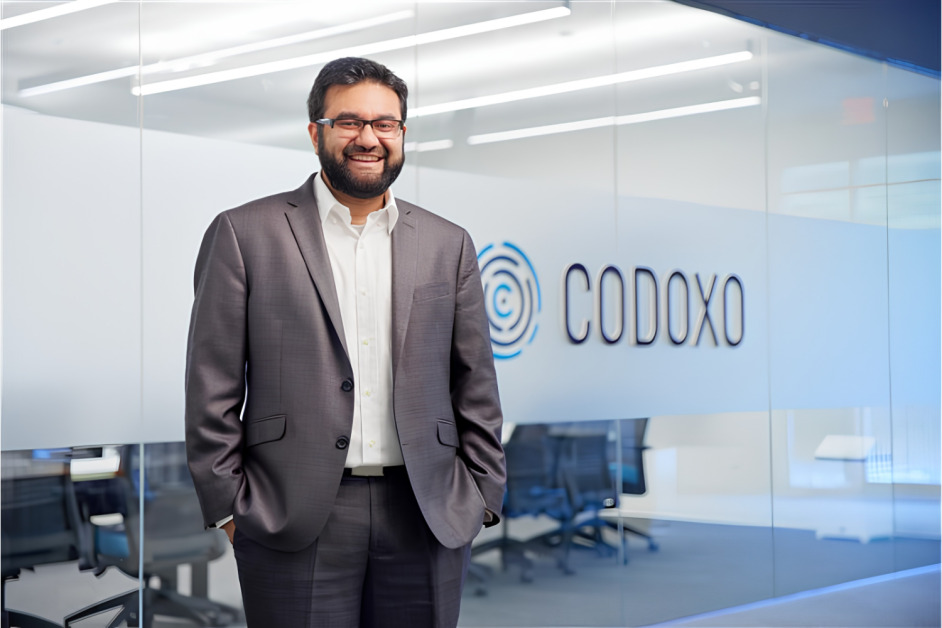
Those comparisons also taught the young company what a laboratory could not. Healthcare data is unruly. Contracts vary. Medical documentation changes the meaning of a claim. Decisions may be time-sensitive and incomplete. A false alarm carries a different cost than a declined credit-card purchase. Payment can affect a provider’s cash flow, an insurer’s workload, and the friction between them.
Codoxo therefore grew around more than a clever detector. The platform added investigation workflows, data mining, provider communication, audit support, policy compliance, and tools for reviewing records. FraudScope became Codoxo in 2020, a less literal name for a wider remit. The mission stayed legible: preserve scarce healthcare dollars for their intended purpose.
The useful place for intelligence is one decision earlier
The payment-integrity business has traditionally sounded like law enforcement performed by spreadsheet. A claim arrives. Software or an analyst identifies a possible issue. The payer edits, denies, audits, or pays and later tries to recover the money. Industry shorthand supplies the bleak little rhyme: pay and chase.
Ahmed’s newer argument is about timing. Prepay review is earlier than recovery, but it still arrives after the claim has been assembled. By then, someone has chosen codes, completed documentation, and invested administrative effort. A correction can set off a chain of resubmission, denial, appeal, and outreach. Even an accurate intervention is late enough to be expensive.
Codoxo calls its upstream approach Point Zero Payment Integrity. The aim is to identify which providers need guidance, interpret coding and policy changes, and communicate before a claim is created. Instead of treating every discrepancy as a contest between payer and provider, the system tries to improve first-time accuracy. Prevention becomes a workflow, not a poster in the break room.
The cost of being late
Conceptual workflow: effort and friction accumulate as a claim travels downstream
The idea has an agreeable neatness, but enterprise healthcare does not reward neatness alone. Software must fit policy, privacy, and operational constraints. It has to distinguish a useful signal from an accusation. It has to show its work to people whose judgment remains consequential. Ahmed’s cybersecurity background helps explain his insistence that systems look for emerging patterns, while his years with payers explain the later emphasis on how those findings enter human workflows.
Generative AI has widened the product canvas. Codoxo has introduced tools for extracting information from medical records, developing claim leads, translating policy into usable checks, and validating incoming data. Yet Ahmed’s public argument remains disciplined around sequence: use the technology at the earliest practical point, then reserve investigators and clinical experts for decisions that deserve them.
“The future of healthcare payments will not be defined by how efficiently inaccuracies are corrected, but by how effectively they are prevented.”Musheer Ahmed
A company grows, and the founder’s vocabulary changes
In Codoxo’s early years, Ahmed says he had to explain what AI was and why a health plan might want it. Later, buyers began treating AI capability as table stakes. The founder’s task moved from introducing the category to defining its next boundary.
Capital followed the evidence. Codoxo announced a $20 million Series B in 2022. In December 2025, it closed a $35 million Series C led by CVS Health Ventures, bringing total reported funding to more than $75 million. The company said customers using its platform covered more than 80 million lives. It also appeared on the Inc. 5000 for a third consecutive year in 2025.
The personal recognition has remained close to the origin story. Georgia Tech Alumni named Ahmed to its 2023 40 Under 40 class. He noted that the award felt meaningful because Codoxo’s patented technology had begun in his dissertation. By then, the company said its platform had contributed to more than $500 million in savings. An institution had watched a student’s research leave campus and return as an operating result.
Ahmed’s visible network also tells the story of translation. Ahamad connects the company to its academic roots. Investors such as QED, Sands Capital, Brewer Lane, CVS Health Ventures, and Echo Health Ventures connect it to scale. Health plans, government agencies, pharmacy benefit managers, and now Optum Serve supply the complicated environments in which the thesis has to survive.
He keeps returning to the same sentence
Across interviews separated by years and product launches, Ahmed repeatedly returns to making healthcare more affordable and effective. Repetition can become wallpaper in corporate speech. Here, it functions more like a test. Does a new detector find unfamiliar waste earlier? Does an agent reduce months of data cleanup? Does provider education prevent an error without creating another quarrel? The mission is broad, but the questions are inspectable.
His advice to founders is similarly free of ornamental bravery. Find mentors and peers who believe in the vision. Listen to customer feedback. Keep innovating as the company learns. “You can’t go it alone,” he has said. This is not the lone-genius version of a university spinout. It is a story of an engineer who noticed a chain of consequences, then accumulated enough collaborators to intervene in it.
There is a playful irony in the trajectory. Ahmed began by worrying about what would happen after medical information was stolen. His company now wants to act before another kind of mistake is made. The work has moved steadily toward the left edge of the timeline: before an unfamiliar pattern becomes a loss, before a coding issue becomes a denial, before a payment becomes a recovery case.
For a founder trained to study adversaries, prevention is an ambitious destination. It is also a modest daily practice. Find the signal. Put it in front of the right person. Arrive while the decision can still be changed.