There is a peculiar kind of waste in American healthcare: everyone can see it, whole departments exist to chase it, and much of the hunt begins after the expensive thing has already happened. A claim has been written. A payment has gone out. An investigator is staring at an alert generated by a rule somebody wrote to catch last year's trick. Codoxo, an enterprise AI company outside Atlanta, built its business in that gap between money moving and somebody noticing.
The company sells software and expert services to the institutions that pay healthcare claims - health plans, pharmacy benefit managers and government agencies. Its system combs claims, provider behavior, medical records and policy data for patterns that suggest fraud, waste, coding mistakes or payment leakage. A suspicious provider can be compared with peers. An investigator can trace evidence and manage a case. An auditor can review a chart. A payment team can test a reimbursement idea. Increasingly, a provider can be warned about a likely coding problem before submitting anything at all.
A dissertation finds a very large invoice
Codoxo did not begin with a prompt box or a fashionable AI wrapper. Musheer Ahmed was studying computer science at Georgia Tech when he started researching how to protect sensitive medical information. Conversations with federal officials and health plans led him toward a related problem: once data is stolen, criminals monetize it, while payers struggle to keep up with schemes that change faster than static controls.
Ahmed's doctoral work became patented behavioral technology. In 2017 he and Georgia Tech professor Mustaque Ahamad co-founded FraudScope, named for the first product. The young company had already won the 2016 Atlanta Startup Battle. A $1.5 million seed round followed, co-led by Spider Capital and GRA Venture Fund, with backing from TechSquare Labs, Mosley Ventures and others. The pitch was crisp: stop teaching software only what known fraud looks like. Teach it to notice when claims and provider behavior look unlike their peers.

That distinction matters. Traditional rules are useful when a payer knows the prohibited pattern. They are less useful when a scheme is new, or when a legitimate provider merely looks odd for a good reason. Harvard Pilgrim Health Care had used a rules-based system for years and grew frustrated with what its SIU director described as layers of false positives. The plan built reports internally, evaluated AI vendors, then ran Codoxo alongside its own analytics to flag coding practices and behavior outside the norm.
Just being able to identify the behavior that is outside the norm is massive for us.Brian Robinson · Harvard Pilgrim Health Care
What failed first: the rear-view mirror
The first failure in Codoxo's story was not a crashed model. It was the industry's prior workflow: known rules, noisy queues, manual reviews and recovery after payment. Even a successful recovery costs time and irritates providers. A denied claim can trigger reconsideration, appeal and resubmission. Each handoff adds labor to both sides, and honest providers get swept into systems designed to catch dishonest behavior.
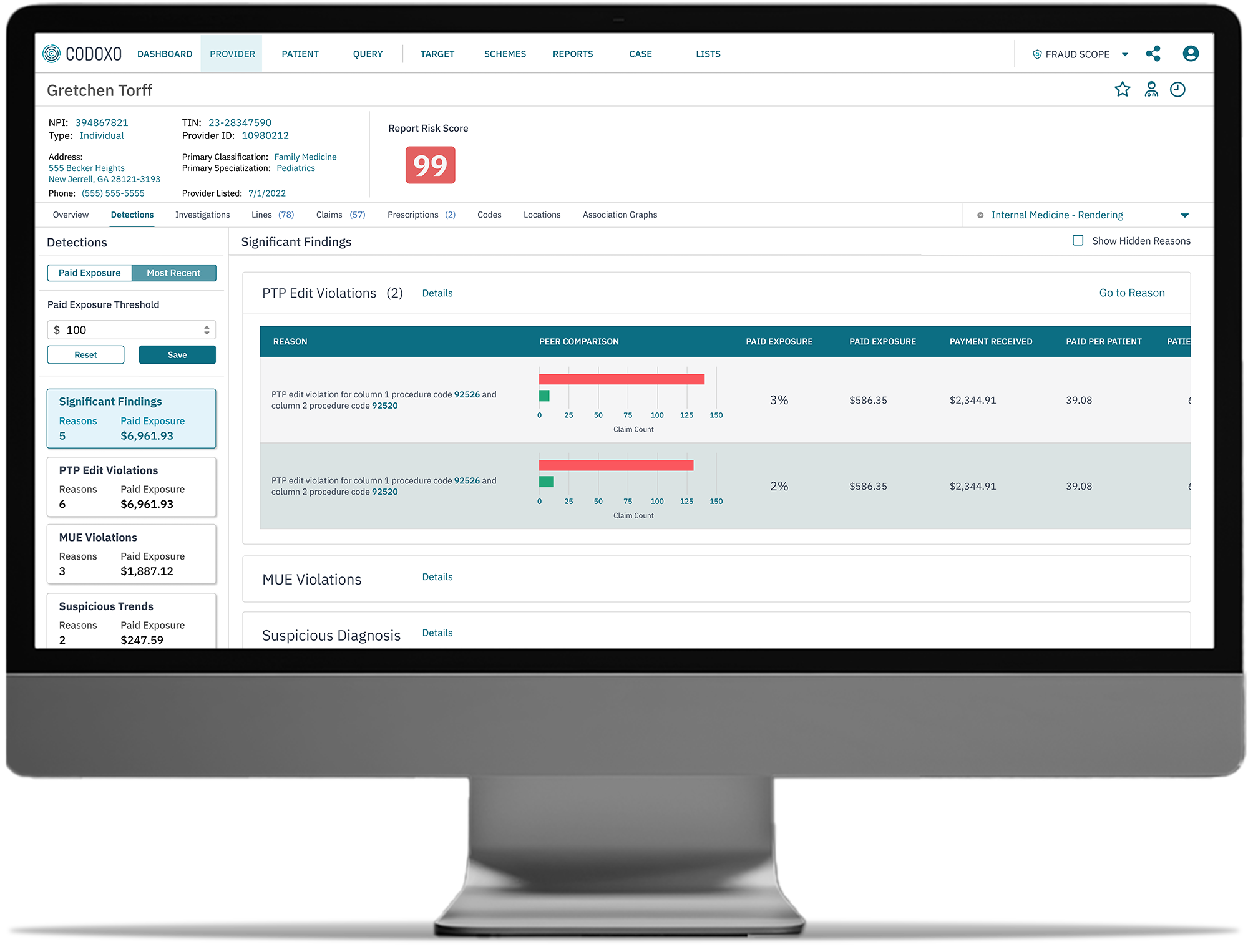
Codoxo's early product attacked the detective work. Fraud Scope ranks risk, surfaces outliers, links provider and patient behavior, supports natural-language exploration and keeps the evidence inside a case workflow. In one Highmark example, the software highlighted unusual psychiatric billing. An audit found a processing issue, and the discovery led not only to recovery but to broader contracting and claims-system improvements. Codoxo said its platform contributed to Highmark's reported $220 million in fraud, waste and abuse savings in 2020. The exact portion attributable to Codoxo was not disclosed, which is an important distinction.
The customer changed the company
What changed Codoxo's mind about being a fraud-detection company was success. Ahmed has said that once FraudScope's insights proved useful, other departments inside health plans began asking for them. Payment integrity wanted claim review. Network teams wanted provider comparisons. Clinical teams wanted smarter authorization and chart review. Provider-education teams wanted to correct billing behavior upstream. In 2020, FraudScope became Codoxo and the single product became a Healthcare Integrity Suite.
The current lineup reads like a tour through the payer back office. Fraud Scope handles fraud, waste and abuse. Provider Scope identifies coding outliers and supports targeted outreach. Payment Scope works across prepay and postpay review. Audit Scope manages cases and workflow. ClaimPilot uses generative AI for policy concepts, compliance and clinical chart review. Services teams perform data mining, complex record review and virtual SIU work. The common engine is the defensible part: the same claims intelligence can travel across departments without becoming seven disconnected point solutions.
Educate before submission
Review before money moves
Find errors after payment
Audit, appeal, collect
The business model is enterprise SaaS plus expert services. Buyers request a demo; there is no public price card. That means nobody outside a deal room can responsibly say what a Codoxo contract costs. The public cost we can count is the capital: $7 million in Series A funding in 2020, $20 million in a QED Investors-led Series B in 2022 and $35 million in a CVS Health Ventures-led Series C in December 2025. Codoxo said the last round brought total funding above $75 million and that customers then covered more than 80 million lives.
Point Zero is a timing argument
The most interesting product decision arrived in 2025. Codoxo named an earlier stage in the claim lifecycle "Point Zero" - before a claim has been created. Its software helps payer teams find payment-policy gaps, test reimbursement concepts through a no-code interface, educate providers about upcoming policy changes and spot recurring coding inaccuracies. The aim is first-time accuracy instead of downstream correction.
This is less cinematic than catching a criminal and potentially more valuable. A prevented error requires no denial, appeal, recovery letter or awkward conversation months later. Codoxo says customers using Point Zero have recorded $12 to $16 per member per year in savings across the approach, up to a 40 percent reduction in overpayments and 20-to-30-times efficiency gains for some teams. Those are company-reported outcomes, not universal guarantees.
The cheapest bad claim is the one no one has to submit, deny, appeal, audit or claw back.The operating idea behind Point Zero
When the clever idea does not work
Prevention depends on timely, clean claims history; policies that can be translated into reliable guidance; providers willing to read and act; and payer teams able to change workflows. Sparse data, unusual specialties, poor integrations or indiscriminate outreach can turn a smart model into fresh noise. AI also does not decide intent. A behavioral outlier may be fraud, an error, a contract quirk or simply good medicine delivered to an unusual population. Human review remains part of the product, not an embarrassing exception to it.
The arms race reaches the chart
Generative AI complicates the story nicely. Codoxo uses it to extract medical records, accelerate audits and let analysts ask questions in ordinary language. Fraudsters can use the same class of technology to fabricate progress notes, clinical narratives and diagnostic images. In March 2026, Codoxo launched Deepfake Detection, designed to flag cloned records, partially generated documents and manipulated images, then cross-check them against claim history and provider behavior. Health plans were already deploying it at launch, according to the company.
That move illustrates where Codoxo fits in the market. It is not a consumer health app. It is not a claims processor. It sits in the control layer between raw claims data and the people deciding what deserves payment, education, audit or investigation. Its alternatives include a payer's homegrown analytics, manual review, legacy rules and established payment-integrity vendors such as Cotiviti, Optum, EXL, Machinify and ClarisHealth. Codoxo's argument is that behavioral detection, generative-AI workflow and prevention belong on one platform.
The bit a builder can steal
Codoxo's early go-to-market lesson is refreshingly unmagical. Ahmed has described using pilots to win early adopters, show ROI and create credible references. Once the company had enough recognizable customers and live results, it stopped offering pilots. Prospects could speak with users instead. The sequence is worth copying in any high-trust enterprise market: choose one painful workflow, make the result measurable, let a small customer cohort teach you, and turn their proof into a sales asset.
The second lesson is to watch where the output travels. Codoxo did not invent seven departments and force a suite upon them. Its fraud insights were already being pulled into adjacent teams. The rebrand and platform expansion followed that demand. The test is whether those teams share data, decisions and a budget story. If they do not, "platform" is merely a larger word printed on the same brochure.
There is evidence the expansion has traction: a strategic partnership with HealthEdge in 2024, three straight Inc. 5000 appearances through 2025, an oversubscribed Series C and reported customer coverage above 80 million lives. There is also plenty left to prove. Enterprise healthcare implementation is slow. Savings claims depend on baseline and scope. Provider trust can be damaged by a badly aimed alert just as easily as by a denial. And competitors possess deep data, distribution and payer relationships.
Still, Codoxo has found a sharp way to frame an old market. Fraud detection asks who did something wrong. Payment integrity asks whether the money should move. Point Zero asks why everyone waited for the claim. In a system famous for treating paperwork as destiny, moving the question one step earlier may be the most useful feature of all.
Keep digging