Try spelling a film title with a television remote. Somewhere between the second letter and the third trip across an on-screen alphabet, the evening begins to acquire administrative duties. This was the sort of inconvenience Murali Aravamudan built a company around: a vast supply of things to watch, attached to a remarkably awkward way of asking for them.
Aravamudan is now co-founder and chief executive of nference. Earlier, he co-founded Veveo, whose work on search and conversational interfaces addressed the gap between what a device could offer and what a person could conveniently request. Look back through those products and an engineer’s career becomes unusually tangible. You can hold one of its central problems in your hand.
There is a useful way to read that career: follow the effort being moved away from the user. At different points, the work involved telephone networks, a few characters typed into a mobile phone, or a television interface that could keep track of a conversation. The machinery changed. The question of how to make it useful kept turning up.
Before the search box, the switch
His formal training included a master’s degree in Electrical Communication Engineering from the Indian Institute of Science in Bengaluru, completed in 1989. At Bell Laboratories he headed communications software research; at Lucent Technologies he became a vice president and chief technology officer in the communications software business. His work included the development of softswitch technology for telephone networks based on internet protocols.
That background placed him inside the machinery of communication before he began working on how people searched their screens. In 2000, he and Shamim Naqvi co-founded Winphoria Networks. Aravamudan served as chief technology officer. The company built packet-based mobile switching infrastructure, equipment intended for the networks carrying other people’s conversations.
Motorola agreed to market and distribute Winphoria’s switching products in 2002. In April 2003 it announced an agreement to acquire the company and bring it into its Global Telecom Solutions Sector. The attraction was practical: software-driven switching that could be upgraded and enhanced, with a smaller operating burden for network operators. Aravamudan subsequently became vice president and general manager of Motorola’s Winphoria division.
It was an early demonstration of a recurring feature of his work: a company could be built around a difficult piece of infrastructure, then find its place inside a much larger business. There would be another version of that sequence, this time involving the considerably less solemn business of deciding what to watch.
- 1989Master’s degree
Indian Institute of Science - 2000Winphoria
Co-founder & CTO - 2007vTap
Mobile video search - 2014Veveo
Rovi acquisition agreement
A video, whenever the thought occurred
By September 2007, Aravamudan was demonstrating vTap, Veveo’s web video search service, in an online interview. The setting belongs to a recognizably earlier internet. The first iPhone was new. Windows Mobile was part of the conversation. Making web video available across different handsets still required an explanation, a demonstration and some faith in the connection.
vTap’s launch offered access to web videos beyond a single destination. Support for more Java-enabled phones was on the way. The proposition was to let people find and play material across the web from a device that was hardly generous with either screen space or typing room. A phone could contain the promise of the internet and still make an ordinary request feel laborious.
In a follow-up interview, Aravamudan described mobile video consumption as an impromptu activity, a process of discovery. That is an interesting detail in a search company’s pitch. Search often assumes a customer who knows precisely what to ask for. Browsing makes room for someone whose curiosity has arrived before the wording of the query.
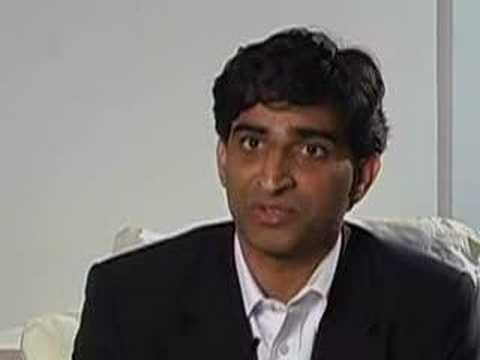
By May 2008, he was describing vTap as a search engine with “a lot of clever algorithms”. Predictive text let a user enter numbers corresponding to letters and have the system work toward the intended term, including proper names. Less typing was the visible benefit. The invisible assignment was to resolve ambiguity well enough that the shortcut remained helpful.
The work also had to contend with waiting. A Veveo patent application naming Aravamudan as a co-inventor addresses using local caching and predictive fetching to offset network delays during incremental search. In ordinary terms, the device could prepare for what might be needed next. The interface had to make good use of both the characters already entered and the time before the next ones arrived.
The early product also found an audience through television. In August 2008, Veveo reported that it had powered 170 million searches for FiOS television customers in June. That was a company-reported measure of searches, rather than a count of individual viewers. Still, it puts the work in a different setting from a founder demonstrating software in an interview: repeated use inside an existing service, where the search tool becomes part of somebody else’s evening routine.
The work was in Bengaluru, too
Aravamudan’s account of vTap included a detail that puts people back into the software. In 2008, he said 95 percent of the core engineering and coding had been done in India, by a team of about 40 engineers in Bengaluru. The product might be demonstrated by its chief executive, but its construction occupied many other desks.
The team Aravamudan credited in 2008 with 95% of vTap’s core engineering and coding.
There was a precedent at Winphoria. Its Indian operations had begun in 2002, and a Bengaluru product development centre was inaugurated in February 2003. Aravamudan described responsibilities that included software features, testing and worldwide customer support. Even in that earlier venture, the geography of the work was more complicated than the address on the company’s letterhead.
His company-building history also has identifiable collaborators. Naqvi was a co-founder at Winphoria. Ajit Rajasekharan co-founded Veveo with him. Venky Soundararajan later became his co-founder at nference. Put the names alongside the products and the familiar solitary-founder story becomes less convincing. These were organizations built around shared technical work, with different expertise needed at different stages.
When the television joined the conversation
In November 2012, Veveo announced voice and natural language capabilities for television and video discovery. Operators and device manufacturers could try them, with commercial availability planned for the Reveal 3.0 release in early 2013. Aravamudan described the intended experience as getting to programs “rather than complicated guides and menus”. Anyone who had spent an evening inside a television guide could supply the motivation.
Speech alone would only move part of the work. A conversational system also needed to preserve context, so a viewer could clarify a request without beginning again. Veveo’s design combined knowledge about content with personalization and awareness of the conversation’s state. The product ambition was to accommodate an exchange, including the untidiness of a person refining what they wanted.
“rather than complicated guides and menus”
Murali Aravamudan on Veveo’s intended viewing experience, 2012
A patent application published in February 2014 makes that concern explicit. Aravamudan is among the inventors named on work about disambiguating user intent in conversational information retrieval. Its discussion considers how a system carries entities and intentions across exchanges. The vocabulary is formal; the everyday expectation is straightforward. When people continue a conversation, they expect the previous part to count.
That gives Veveo’s work a particular place in the history of interfaces. The company was trying to make conversations useful in a specific setting, with programs to find and viewers to satisfy. The test was concrete. Could someone reach a suitable result with less effort, and could the system remain helpful when the first request needed adjusting?
The earlier vTap experience supplies another useful view of that ambition. In November 2007, a reviewer tried the service on a Nokia 6120 Classic and described being able to choose a download speed or take just the audio. Those choices acknowledged the circumstances of watching something on a phone. The device, the connection and the person’s immediate purpose all affected what made a result useful. A product promising access had to pay attention to what happened after the search as well.
The arithmetic of an exit
On February 24, 2014, Rovi announced its agreement to acquire Veveo. The terms specified approximately $62 million in net cash at closing and up to $7 million in further payments tied to agreed milestones. The distinction matters: a contingent payment is a possibility attached to a condition, rather than money already paid.
Rovi brought entertainment metadata, search and recommendation capabilities. Veveo brought personalization, contextual search and natural language technology. Put together, those assets offered a way to connect a larger description of what was available with a better interpretation of what a viewer might want. Rajasekharan spoke for Veveo in the announcement, another reminder that the acquisition carried the work of a team.
For Aravamudan, it added a second acquisition chapter after Motorola and Winphoria. Those transactions are convenient landmarks, but they only partly explain the career. Between founding a company and selling one lie the ordinary product decisions: what to remember, what to predict, what to show, and how much patience to ask of someone holding a remote.
A career with the interface left open
Aravamudan now leads nference, which he co-founded with Soundararajan. His working history joins corporate research, startup engineering and executive responsibility. Its earlier chapters also preserve something easily lost in a founder’s biography: the shape of the original inconvenience. A constrained keyboard. A long guide. A request whose meaning depends on the sentence before it.
Read through that lens, his career offers an invitation to look closely at where a product spends its user’s effort. There may be a company in reducing it. There will certainly be engineering involved. The person trying to choose a film, meanwhile, has a modest preference: to finish choosing while there is still time to watch it.
Keep the conversation going
Explore the work, the early demonstrations and the people behind it.