The office task was gloriously ordinary: collect feedback from shops, work out what kept going wrong with store layouts, and brief the senior team. In a September 2026 Multiverse case study, a retail employee used Excel, Microsoft Copilot and a reusable prompt to shrink the job from two hours to 15 minutes. A human still checked the findings. Nobody needed to invent a new language model.
That is the useful end of Multiverse’s sales pitch. The London company teaches people to get more out of technology at work, using a mixture of apprenticeships, human coaching, an online platform and its own AI guide. The output might be a dashboard, a better forecast or an automated report. Ideally, something a colleague would miss if it disappeared.
For employers staring at their AI bills, the proposition has appeal. Buying access is straightforward. Changing routines across a workforce takes longer. Multiverse wants to sell that second part, and its evolution says something about where the AI economy is heading: towards the difficult business of making the purchases useful.
105 minutes reclaimed per round. Company-reported retail example, September 2026; individual results vary.
The university challenger grows up
Euan Blair and Sophie Adelman founded the business in 2016 as WhiteHat. Its opening argument was about opportunity: talented school leavers should have a credible route into professional work without passing through university. Adelman, who had worked in recruitment, described an ambition to create a path with comparable prestige and career prospects.
WhiteHat became Multiverse in 2021, alongside a $44 million Series B and a New York launch. The name allowed room for more than one accepted route to a career. By June 2022, a $220 million Series D valued the company at $1.7 billion. Apprenticeships had acquired the sort of venture backing usually associated with software.
The audience subsequently widened. Today, an apprentice can be an experienced employee learning to analyse data or automate departmental work. Multiverse’s group accounts attribute much of its FY2025 growth to rising demand for AI and data skills. The commercial logic is clear: companies need to develop the people they already employ, alongside recruiting new talent.
That shift also changes the question a buyer asks. A school leaver wants a route in. An employer wants a workforce capable of using the tools it has bought. Multiverse’s current mission, equipping the workforce for the AI era, gives the company permission to serve both.

The job becomes the assignment
Multiverse starts by assessing an organisation’s goals and its employees’ skills, then recommends learning pathways. Its MAGE framework stands for Measured, Applied, Guided and Equitable. Beneath the acronym is a sensible insistence: learning should connect to real work, receive support and produce evidence of progress.
The catalogue ranges from practical AI use to data analysis and engineering. AI-Powered Productivity covers tools such as Copilot and Gemini, including responsible use, prompting and workflow improvement. Data Fellowship moves into SQL, visualisation, statistics and machine learning. AI Solutions Builder targets employees who can develop departmental assistants and automated workflows.
The platform provides milestones, recordings and progress tracking. Learners have human coaches, live sessions and access to specialist instructors. This makes Multiverse a training provider with software woven through delivery. The employer is buying a programme and its support system, rather than simply handing staff a library of videos.
There are capable alternatives. QA offers AI apprenticeships and incorporates Copilot training; Corndel has an AI academy and applied programmes. Multiverse’s case rests on its particular combination of skills diagnosis, coaching technology and workplace impact measurement. Those features need to work together. An AI label alone provides little distinction in this market.
- 01Find a costly task
- 02Learn the missing skill
- 03Apply it with support
- 04Measure what changed
The £13,000 question
The prices are more concrete than the phrase “upskilling platform” suggests. Multiverse lists AI-Powered Productivity at £13,000, Data Fellowship at £15,000 and AI Solutions Builder at £18,000. The first specifies 13 months of delivery plus three months of assessment; the other two list 13 months of delivery.
Training prices checked September 2026. Eligible levy funding can cover the fee.
England’s apprenticeship funding system helps explain the business model. Employers can direct levy funds towards eligible training and assessment. That makes a substantial programme accessible through a budget already allocated to skills. Employees do not receive a conventional university tuition bill for their apprenticeship.
Funding comes with conditions. Under the rules for new starts from August 2026, levy-paying employers that exhaust their funds generally face a 25% contribution for apprentices aged 25 and over. Non-levy employers generally contribute 5% for that age group. Government support covers eligible younger apprentices more fully. The provider’s price and the employer’s cash payment can therefore differ considerably.
Time belongs in the calculation, too. AI Solutions Builder describes roughly seven to eight hours a week, combining structured learning with application in the role. A manager who approves a place but leaves no room in the week has undermined the purchase before the first module. This is sustained training, with workplace participation built into the design.
Atlas learns when to stop asking questions
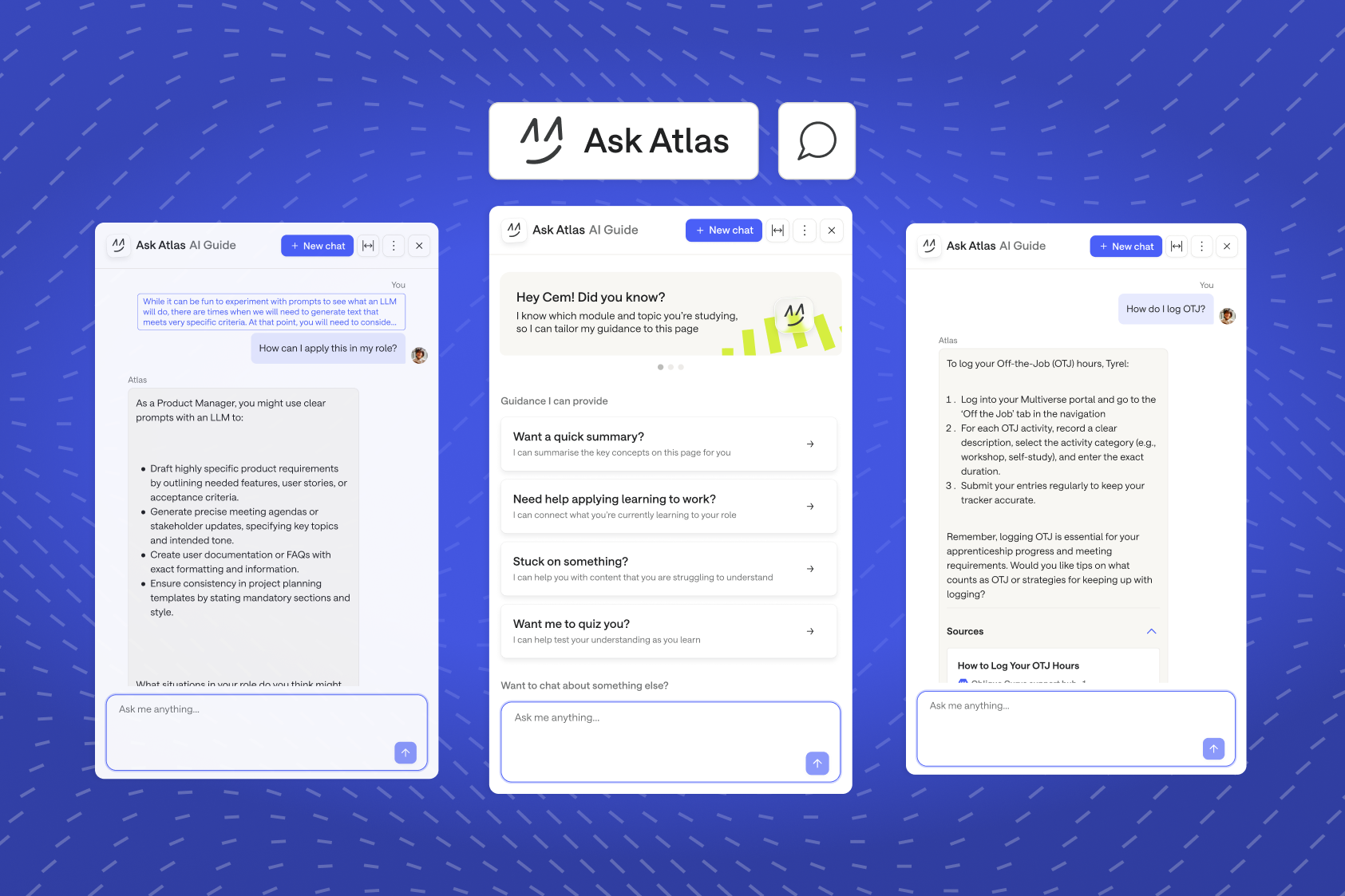
Multiverse’s AI guide, Atlas, launched in 2024 with a Socratic approach: help learners think their way through a problem. The original coaching prompt went through more than 100 iterations over three months. That detail is revealing. A useful educational assistant needs a teaching method, not just a friendly tone.
Then ordinary support needs intruded. Someone asking where to log their hours does not necessarily want a philosophical exchange. In December 2025, Multiverse described expanding Atlas to recognise different intentions: tutoring, project brainstorming and practical support. It reported that the updated system resolved 88.3% of inbound support queries following a pilot.
The current guide can use the learner’s course context, suggest relevant project ideas and help interpret requirements. Questions needing human judgement can move to a coach or support specialist. The design lesson is transferable: decide which questions deserve exploration, which need a direct answer and which should reach a person.
The customers with no time for busywork
Multiverse’s customer relationships span companies such as Mars and John Lewis Partnership, alongside public bodies. Its 2026 Impact Hub reports more than 40,000 learners and 1,600 employer partners to date, including StackFuel learners in Germany. These are cumulative figures, rather than a count of people currently studying.
The NHS offers a particularly legible example of the problem. In Multiverse’s account of its work with NICE, training began with a skills-gap analysis across divisions. The organisation already had data and tools; staff needed greater capability to use them. Elsewhere, a Barts Health learner built a dashboard that reduced the work of producing data packs and ad-hoc reports.
A November 2025 partnership with Palantir takes that logic into infrastructure. The companies announced apprenticeship programmes tailored to the NHS Federated Data Platform. Software and training become complementary purchases: one provides the system, the other helps staff use it in their roles.
In August 2026, Speedy Services announced an initial cohort of 21 employees for AI-Powered Productivity. Purchase-order approvals and repetitive administration were among the targets. The equipment-hire business wanted staff spending more time helping customers with machinery. Its broader ambition to halve revenue leakage was a goal, not an outcome already delivered by the course.
“Many companies buy AI tools and hope adoption follows.”
Jay Richman / Multiverse / August 2026
Customer savings are not company profits
Multiverse’s impact reporting is central to its pitch. Its 2026 hub distinguishes confirmed customer ROI from projected benefits, and says some submitted projects remain at the opportunity stage. That distinction matters. A cost avoided, extra revenue and an hour released are useful measures, but they are not interchangeable with cash deposited in an employer’s bank account.
The provider’s finances tell a separate story. Group revenue reached £79.6 million in the year to March 2025, up from £58.4 million. Yet the pre-tax loss was £63.3 million, and the accounts described investment in making delivery more scalable. Stronger demand had not produced an annual profit.
The early international plan also encountered limits. Reporting accompanying Mike Butcher’s February 2026 interview with Blair describes the US as an expansion market that did not work out. Europe now carries more weight. In January, Multiverse acquired Berlin-based StackFuel, gaining local training expertise and customers, with a joint ambition to teach AI skills to 100,000 German workers.
May brought $70 million in fresh funding led by Schroders Capital at a $2.1 billion valuation. Multiverse also reported its first cash-positive quarter, covering January to March 2026. That is progress on a different measure from annual accounting profit. Investors are financing the next stage while the company works on the economics of delivery.

Start with the task everyone postpones
The most copyable part of Multiverse’s approach is the project discipline. Pick a recurring task, establish how long it takes and agree what a better result would look like. Give the learner access to the relevant tools and a manager who can unblock the work. Review the output before counting the saving.
This approach needs a suitable job context. Without usable data, permission to change a process or time to practise, an apprenticeship cannot deliver its intended workplace application. A short course may fit someone who only needs an introduction. A broader systems problem may require engineering work or organisational change alongside training.
Multiverse applies the people argument internally, too. Its published culture commitments include staff access to apprenticeships, AI training and clearer progression systems. Those are sensible commitments for a company asking employers to invest in learning. Their value, like the customer promise, depends on daily practice.
The retail employee’s saved 105 minutes provides a useful standard. A defined task changed, and someone still checked the result. Multiply that kind of improvement across an organisation and the case becomes interesting. Multiverse’s future depends on making it repeatable.
Keep exploring
Explore Multiverse, its programmes, news and blog, and customer stories.