Euan Blair arrived at Morgan Stanley with a degree in ancient history and a master’s in international relations. The job involved corporate debt and derivatives. Rome had supplied many useful things to posterity; a working knowledge of an investment bank’s products was a rather specific omission. Blair learned the work by doing it. So, he noticed, did the other graduates around him.
That bothered him. The recruits had passed through similar institutions and came from similarly privileged backgrounds. The university names had helped sort the applicants, but the practical education began after admission. If the job could be learned there, why did so many people need such an expensive ticket to get through the door?
It is an awkward question to inherit when your father is Tony Blair, whose government made widening university participation a defining ambition. It is an even more interesting question to ask after Bristol and Yale have waved you through. Euan Blair has spent the past decade turning that awkwardness into a business. Multiverse began by helping young people earn and learn through apprenticeships. It now sells employers a way to teach their existing workers how to use data and AI.
The family name supplies an easy introduction. The harder story concerns what happens after somebody gets hired. Blair’s own career gave him a reason to ask whether education could move closer to the work itself. Building a company around that idea has brought investment, expansion and an uncomfortable examination of how well the lessons actually land.
The graduate who questioned the entrance exam
Born in London in 1984, Blair was thirteen when his father became prime minister. Public attention arrived long before he had a profession to attach to it. He attended the London Oratory School, graduated from Bristol in 2005 and completed his Yale master’s in 2008. His early experience included work in the US Congress. Politics was available as a subject, an environment and an inescapable conversation starter.
He chose finance. Five years at Morgan Stanley gave him experience of how businesses work and capital moves. His next move took him into employment and training at Sarina Russo Group, where he became UK chief executive. The people he was trying to help into jobs had a much less accommodating relationship with the labour market than his banking cohort.
Getting someone a wage was valuable. Blair became dissatisfied with how often those jobs offered little security or progression. A placement could count as a success while leaving the longer story largely unchanged. That distinction matters to the business he eventually founded: access to work and access to a career are different achievements.
He also had doubts about his own classroom experience. “I didn’t love studying for studying’s sake,” he said in 2024. There is a pleasing lack of grandeur in the admission. A person can collect distinguished qualifications and still suspect that the timetable was designed for somebody else.
“I didn’t love studying for studying’s sake.”
Euan Blair, 2024
A WhiteHat, two graduates, a different route
In 2016 Blair co-founded WhiteHat with Sophie Adelman. Their proposition brought apprenticeships into office careers: earn a salary, receive coaching and learn skills while using them. The alternative to university needed employers willing to hire, as well as applicants willing to ignore a fairly loud chorus about the proper next step after school.
Neither founder had personally taken that alternative. Adelman had studied at Cambridge and Stanford. In their early years they joked about whose degree was less useful. Blair, who had enjoyed gaming when younger, said he would have considered a computer programming apprenticeship if the opportunity had existed. University had been the expected destination.
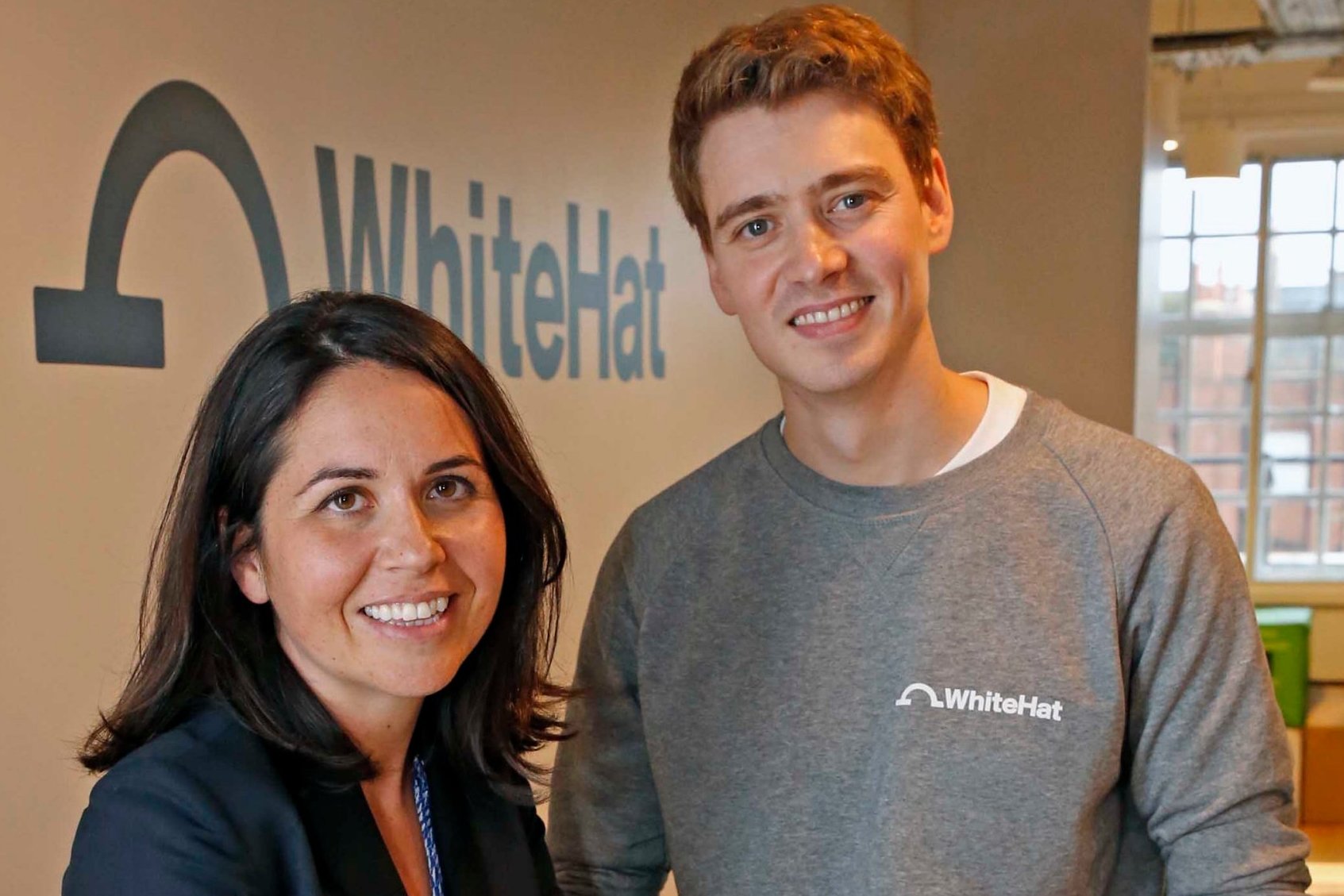
By October 2018, WhiteHat had about 550 apprentice placements and 43 staff. Its clients included Google, BP and Yoox Net-a-Porter. These were useful names to have when explaining to a parent that an apprenticeship could lead somewhere other than the familiar occupations they already associated with the word.
The challenge was partly cultural. Families buy a sense of belonging along with an education. A paid job with training has to compete with the identity, friendships and confidence attached to university. Coaching and an apprentice community were therefore part of the proposition. The company was trying to make another route feel like a destination someone might actively choose.
When the alternative can award the degree
WhiteHat became Multiverse in 2021, the year it entered the US. Venture investment accelerated the expansion. In June 2022 a $220 million funding round valued the company at $1.7 billion. That valuation belonged to the business; the more useful question for an apprentice was still whether the training would help them do their job.
The same year, Blair received an MBE for services to education. Multiverse also gained degree awarding powers. Its first announced degree cohort comprised 170 apprentices, studying through programmes in advanced data and technology consulting. A company presented as an alternative to university could now offer the qualification that helped make university so attractive.
There is a small institutional joke here. Britain takes certificates seriously enough that an argument for learning differently eventually acquires its own certificates. But the practical combination was meaningful: employment, a salary and a degree, with learning assessed through its application at work.
American expansion proved harder than exporting the sales pitch. By early 2024, the company had cut US staff after missing revenue targets. Blair described the task of explaining apprenticeships in a market with less familiarity with them. Employers had to understand what they were buying; candidates and families had to understand what they were joining. A strong British argument still needed translation.
The mission grows up, and gets questioned
As Multiverse grew, training people already in work became the larger business. That shift made commercial sense: employers had workers who understood their organisations but needed new technical skills. It also complicated the original story about school leavers finding a way into professional life.
In 2023, early-career programmes accounted for just 20 per cent of revenue. Some former employees argued that the company had drifted from the mission that attracted them. Blair defended a broader purpose spanning different stages of working life. He acknowledged the demands of venture backing and the need to deliver returns.
That tension is central to understanding him. Widening opportunity gives the company a purpose. An employer’s willingness to pay gives it a business. Those interests can align, but alignment has to be demonstrated learner by learner. A successful project, a promotion and a completed qualification tell related stories; none automatically proves all the others.
Blair’s commercial approach also explains his focus on productivity. The person approving a training budget needs a reason to keep approving it. An employee who can solve a recurring problem with data makes a more durable case than a brochure promising transformation. The difficult managerial work is ensuring that the apprentice has enough time, support and suitable work to make that promise real.
A report card for the education challenger
In February 2026, Ofsted inspected Multiverse under its new report card framework. The published findings graded leadership and governance, achievement, curriculum and teaching, and participation and development as needing attention. Inclusion met the expected standard. Inspectors found skilled teachers and worthwhile workplace projects alongside inconsistent experiences, courses poorly matched to some jobs and too many learners leaving before completion.
For a founder who argues that education should prove itself in practice, this was a consequential assessment. The company’s response promised more coaches, wider careers guidance and better engagement with line managers. It said it had hired more than 40 coaches and instructors in the preceding quarter. These are delivery commitments whose value depends on what changes for the next learner.
Blair had already acknowledged shortcomings in an April essay, including an assumption that experienced employees would not need formal careers advice. His argument remained that workers facing changing jobs needed more access to training. The inspection made the companion requirement plain: an expanding system must give people a good chance of finishing what they start.
AI arrives at the apprentice’s desk
Blair now describes Multiverse as an “AI adoption layer”. His argument concerns the distance between buying technology and being able to use it. A company can own the software while its employees continue with familiar routines. Learning has to reach the task sitting in front of them.
In January 2026 Multiverse acquired Berlin-based StackFuel, setting a joint goal of training 100,000 German workers in AI skills. In May it announced $70 million in funding led by Schroders Capital at a $2.1 billion valuation. The company also reported 50 per cent annual revenue growth and its first cash-positive quarter, from January to March. A quarter is a useful financial milestone, with a deliberately shorter horizon than a promise about permanent profitability.
German workers targeted for AI training following the StackFuel acquisition. An announced goal, not a completed learner count.
Career starters remain in the picture. In June, Blair announced plans for an AI-first early talent apprenticeship, aiming to create 2,000 opportunities annually. The proposal connected workplace readiness, practical data skills and responsible AI use. It brought the company’s original question about getting started into its newer argument about keeping up.
On 14 October, Multiverse unveiled Mastry, a platform designed to identify skills gaps, guide learning inside everyday work and show employers the results. Access initially went through a waitlist for eligible development partners, with a full launch planned for early 2027. Human coaches would continue delivering its apprenticeships alongside the software.
The ancient history graduate has ended up with an old method and a new set of tools. Apprentices learn while working; the work keeps changing. Blair’s next examination will happen in the ordinary places his business is meant to improve: a manager’s project, an employee’s working day, a course someone sees through to the end. He has made a career of questioning the entrance requirements. He is now responsible for what happens inside.