An industrial robot can be a very expensive way to discover that the hard part is the software. The arm works. Teaching it a useful job, integrating it with other equipment, and keeping it from colliding with something are another matter. When Moxxie Ventures announced its first robotics investment in July 2024, this was the problem that interested it. Jacobi Robotics wanted programming a robot to feel more like building an ordinary application.
That investment offers a useful introduction to Moxxie. The firm likes ambitious technical work, but its enthusiasm gets specific quickly. Who needs this? What is blocking adoption? Can the founders remove that obstacle without consuming an industrial fortune?
- Pre-seed and seed capital for technically strong founding teams.
- A published $500,000-$2 million check range and a 10% ownership target.
- Operator support, with investments spanning software, healthcare, climate and robotics.
The investor who needed a co-founder
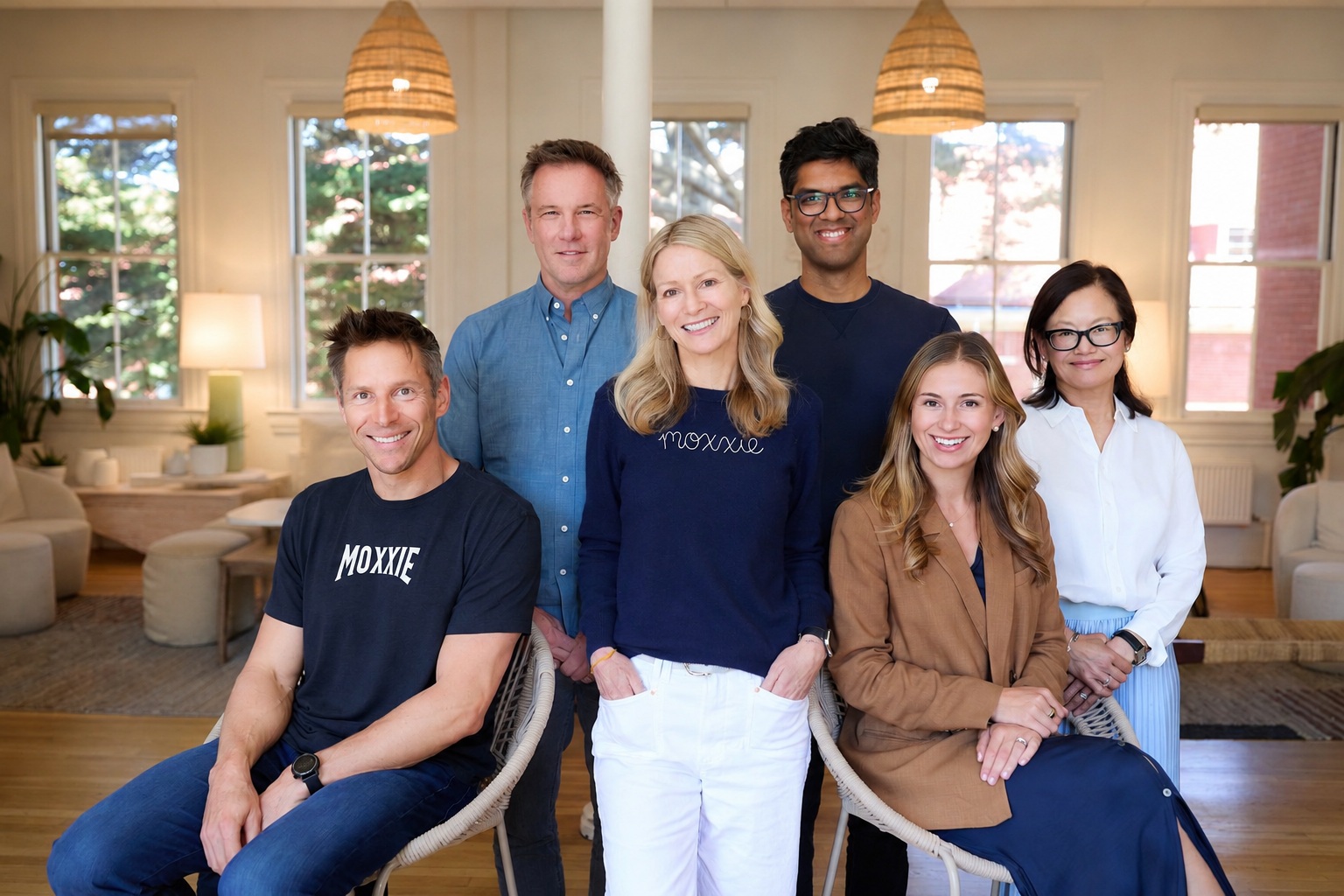
Katie Jacobs Stanton founded Moxxie in 2019. Before that, she had worked inside Google, Twitter, Yahoo and Color, and served in the Obama administration. Her apprenticeship in investing included scouting and the #Angels collective. By the time she considered doing it full time, she had a plausible plan: join a big venture firm and keep learning.
In a 2025 Invested interview, she described friends challenging her to find the courage to start her own. Recruiting a partner proved harder. Alex Roetter, a longtime Google and Twitter colleague, was busy building electric aircraft. Stanton started alone; he joined as an equal general partner for Fund II in 2021.
Their shared history was unusually long. They met at Google in 2003, then both joined Twitter in 2010. In her second-fund announcement, Stanton presented Roetter's arrival as something founders would recognize: she finally had a technical co-founder of her own.
Courage has a denominator
The fund grew from $25 million in 2019 to $85 million in 2021, followed by a $95 million third fund announced in July 2024. Across those three vehicles, that is $205 million committed to the investment strategy. It is capital to invest, rather than sales booked by an operating business.
Moxxie's published sweet spot makes its economics legible: $1.5 million at a $15 million post-money valuation. Divide the investment by the valuation and you get 10%. For a founder, that is the simple ownership trade at that price, before subsequent financing changes the picture.
The firm prefers $2 million-$4 million rounds and is sensitive to valuation. A proposal that requires a large advertising budget before proving demand is harder to square with those preferences. The useful constraint is that founders must explain what the money will establish.
More capital. Still early.
The work behind the wire
Moxxie serves two constituencies. Founders get financing and access to experienced operators. Limited partners supply the investment capital and participate in the funds' financial results. The familiar venture model combines management fees with a share of investment profits; that describes the industry model, rather than a claim about Moxxie's particular fee schedule.
The third fund brought backing from institutions including Cendana, Accolade Partners, Children's Health and The Nature Conservancy. Moxxie said half its capital came from female-led investing teams and half from BIPOC-led teams. Those categories can overlap. They are descriptions of the capital providers, not portfolio performance.
By that July 2024 announcement, Moxxie said it had backed more than 50 seed-stage companies, with roughly half subsequently raising more capital. Follow-on financing is evidence that other investors became interested. It does not, by itself, establish a profitable outcome.
“We invest in founders and their vision for the future, not ours.”
Moxxie Ventures, December 2024
A bus is also a financing problem
Consider BasiGo, whose seed investment Moxxie announced in January 2022. Electric buses faced several obstacles in East Africa: upfront cost, charging, maintenance and getting the vehicle right for local roads. A cleaner motor alone would leave most of those problems intact.
BasiGo separated the battery economics from the bus purchase, using a mileage-based subscription for the battery, charging and maintenance. In its investment memo, Moxxie described expected operator savings of approximately 10%-15% against diesel. That was the firm's contemporary investment case, rather than a universal saving for every bus route.
The lesson travels beyond transport: adoption often depends on the payment structure surrounding a product. A customer can want the technology and still be unable to buy it.
The point where the evidence changes
Jacobi supplies the other half of that lesson. Moxxie's robotics memo described longstanding obstacles: development cost, complicated programming and inflexible systems. The firm argued that improving hardware had shifted the opportunity toward software. Conversations with prospective customers then reinforced its confidence. Moxxie led the seed round alongside participants including Foothill Ventures, Humba Ventures and The House Fund.
Healthcare offers another test. In May 2026, portfolio company Dandelion Health announced a $14 million Series A, with Moxxie participating as an existing investor. Dandelion's platform combines clinical records with material such as imaging and physiological signals for life-sciences research. Its announced network covered 73 hospitals and more than 15 million patients.
These are businesses where integration, reliability and institutional buying matter. A persuasive demonstration starts the conversation; practical deployment determines whether the conversation becomes a business.
Bring a product. Bring the arithmetic.
For a founder assessing Moxxie, the practical preparation is straightforward: demonstrate what works, identify the buyer, explain the technical advantage, and connect the round size to a measurable next step. Its stated requirement for a technical founder and preference for product evidence make a working prototype more useful than an elaborate forecast.
The fit gets weaker when a business needs substantial physical infrastructure or marketing expenditure before it can learn much from customers. Moxxie primarily invests in North America, although BasiGo illustrates the reach of its interests. Other early investors, including Precursor and First Round, offer founders alternatives with their own approaches.
Moxxie's distinctive proposition is the combination: operating experience, explicit investment constraints and a willingness to examine unfamiliar problems. The question for a founder is whether those constraints help the company reach its next piece of evidence. An investor's enthusiasm becomes useful when it improves that answer.