Motti Nisani had a practical suggestion for anyone hoping to be taken seriously: dress smartly, and give your presentation the same courtesy. In 2011, explaining the software company he had co-founded, he reached for the wardrobe rather than the laboratory. “I always compare it to dress code,” he said. An idea might be sound. It still had to arrive looking as though someone had expected company.
There is a small comedy in asking an engineer to solve this problem. The speaker knows the business. The audience knows where the exits are. Between them sits a slide whose bullet points have acquired their own bullet points. Nisani’s answer was to give software some of the work usually left to the person desperately adjusting a text box.
A wardrobe for PowerPoint
That company was VisualBee. Its premise was straightforward: people wanted professional-looking presentations without spending the time or money required to produce them. The second version offered more control over styles, images and individual designs. Free access brought people in; paid subscriptions opened larger libraries and company branding. The dress-code comparison fitted the commercial proposition unusually well. Most customers needed something presentable for work, rather than an apprenticeship in tailoring.
In 2010, Nisani described a workflow inside PowerPoint 2007 or 2010. Write or paste the text, then press the enhancement button. VisualBee analyzed the material and assembled images, layouts and styling around it. The output remained an ordinary PowerPoint file. Users could replace an unsuitable picture, change a layout or return to the original design. Automation came with an escape hatch.
That last detail is revealing as a product choice. A person preparing to stand before colleagues needs ownership of what appears on the screen. A machine’s suggestion is easier to accept when it can be corrected. VisualBee also offered branded layouts, including work for Alvarion. Nisani was dealing with both the solitary slide maker and the company that wanted everyone’s slides to resemble members of the same family.
“A good presentation is like a good story.”
Motti Nisani, 2013
The engineer behind the pitch
Nisani brought an engineering education from Tel Aviv University to the task. Before the presentation businesses, he had been CTO at STS, a startup acquired by NICE in 2000. He later served as NICE’s vice president of business development. Emaze’s company biography credits him with taking sales in a new division from zero to $30 million. Those are two rather different kinds of work: making a system function and persuading customers that it belongs in their business.
His co-founders supplied complementary experience. Arie Livshin’s background combined computer-science research, machine learning and usability. Shai Schwartz brought presentation and website design experience, including work for corporate clients. The founding team joined technical implementation, visual judgment and commercial experience. The product needed all three. A clever redesign that nobody wanted to buy would remain a clever redesign.
The engineering also left a more durable trace than a product demonstration. A US patent granted in July 2014 names Nisani, Livshin and Schwartz as inventors of a system for automatically improving electronic presentations. Its history reaches back to 2008. It describes analyzing existing material, selecting imagery, changing layouts and producing an improved presentation.
One illustrated example replaces bullets with images matched to their text. The system can also unify fonts and adjust backgrounds and colors. These are modest-sounding operations until you imagine performing them across a deck by hand. The patent gives a useful glimpse of the founders’ chosen problem: turn a collection of fiddly visual decisions into a repeatable process. Someone still supplies the message. Software helps arrange its appearance.
When every pitch began to look alike
By 2013, Nisani was describing emaze, a browser-based presentation service. He and his fellow founders had spent plenty of time giving presentations themselves. They wanted ordinary users to make slides that could hold attention without mastering a complicated application. “A good presentation is like a good story,” he said. It was a sensible ambition for a product that would often be used by people asking someone else for money, time or belief.
He also told a nicely deflating anecdote. A venture capitalist had complained that every founder seemed to arrive with a Prezi presentation. The novelty had become familiar. A distinctive tool could produce a roomful of presentations with a family resemblance of their own. Emaze offered different settings, including a city whose buildings carried the slides. Even the rooftops could have something to say.
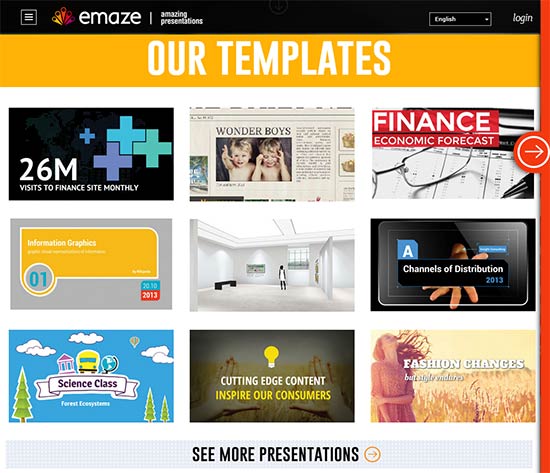
In his June 2013 explanation, Nisani placed emaze between PowerPoint and Prezi. Its HTML5 foundation was intended to carry presentations across computers, tablets and smartphones. Users selected a presentation template, then chose layouts for individual slides and entered their own content. The service could accommodate conventional slides and virtual three-dimensional environments.
“Everything is already made for you,” he said. That promise contains a fairly strict view of what the user should have to do. The software supplies a starting structure. The person brings the material. For someone staring at an empty canvas, a prepared layout can feel like permission to begin. For a software business, it also creates a responsibility: the available choices have to be good enough to trust.
The template gets a little freedom
In November 2014, emaze announced a $2 million Series A led by FirstTime Venture Capital. An earlier $800,000 seed round brought reported financing to $2.8 million. The company said it had registered more than 750,000 users and hosted the creation of more than 3.5 million presentations after emerging from beta that year. Those were historical company figures, a snapshot of the early product finding an audience.
Nisani described using the investment to expand the infrastructure, team and technology, while increasing awareness among educators and small businesses. These audiences made sense for a product concerned with making design easier. A teacher or a small-business owner might have a presentation to deliver without having a designer available to build it.
Later that month, he described a change in emphasis. Emaze wanted users and designers to create custom templates, extending the collection supplied by the company. He also proposed an ecosystem in which designers could sell their services to customers who needed distinctive, branded work. A template could become the beginning of a relationship between a designer and a client.
Here the original promise meets its natural complication. Prepared choices help people get started, but a company eventually wants its own colors, its own arrangement, its own unmistakable face. Nisani’s plan acknowledged both needs. The novice could use what was ready. The customer with a particular brief could seek help making something specific. It is an interesting adjustment for software founded on reducing the number of decisions.
A machine, with designers in the room
In December 2015, Nisani explained Automaze, a feature intended to redesign presentations using machine learning and the company’s accumulated presentation data. The important detail was where the designs came from. Human presentation designers created the layouts; the system worked to understand users’ content and apply those designs. “We turned to machines for help,” he said.
He described an audience ranging from corporate executives to second-grade students. The product had also acquired custom branding, embedded live content, collaboration and audience analytics. The presentation was becoming something a business could distribute, adapt and track. An attractive arrangement was one part of a larger working object.
- 01Your contentThe message enters.
- 02Machine analysisSoftware examines it.
- 03Human-made layoutsDesign supplies the structure.
- 04A redesigned deckThe content gets a setting.
By June 2016, the screen had become another design consideration. Nisani introduced an Android app for watching presentations, sharing them and exploring presentations by topic. He said the motivation came from users and their mobile habits. The app’s described job was consumption and discovery. A presentation made for an audience still had to reach the device that audience was holding.
The audience gets the last word
Nisani’s writing on presenting helps explain the concern behind the tools. In a March 2016 essay, he advised speakers to connect ideas with familiar experiences, use media purposefully, handle repetition carefully and pay attention to beginnings and endings. He cautioned against letting visual and audio embellishments distract from the idea being presented. Coming from a presentation-software CEO, that was a welcome limit on the temptation to make every available feature perform.
He also wrote about protecting marketing content from copying, recommending visible branding and combinations of media that were harder to lift apart. His interest extended beyond making content look right to what happened after it was published. In another 2016 essay, he argued that people and computers could collaborate in art. That position fitted his products’ division of labor.
Emaze now offers presentations alongside websites, training, digital business cards and AI-oriented business content. Those later company offerings belong to the continuing business, rather than a claim that its founding CEO personally built each one.
The recurring question in Nisani’s earlier work remains easy to recognize. How much time should a person spend arranging the packaging of an idea before getting to share it? His products kept offering ways to shorten that interval. The wardrobe analogy survives because it is human-sized. Most people would like to enter the room prepared, say what they came to say, and leave the audience remembering something beyond the unfortunate font.