In late summer 1999, Neil Davidson called Simon Galbraith with a proposal: leave the job, write the software, start the company. Davidson was working for a small software business near Guildford. Galbraith, one of his closest friends, was at Shell in the Netherlands. The proposed product was an online bug tracker. Web collaboration, Davidson thought, had a future. The telephone remained useful for recruiting a co-founder.
The company they established became Redgate. Its name came from a street where Davidson had lived in Florence, a pleasantly personal beginning for a business associated with database comparison. Behind that name sat an ambition about work itself. The two founders wanted to make a technical contribution, do something fulfilling together, and build an employer whose values they could recognize as their own.
There was already a working relationship underneath the friendship. They had met at school, and both went on to Cambridge. Davidson studied mathematics. Long before the business became substantial, Galbraith remembered him selling software while still a schoolboy. The interest in making things had a head start on the job title.
That friendship lasted through the years of sharing a chief executive’s responsibilities. In 2014, Galbraith described its survival through the corrosive pressures of running a company. It is an achievement easily missed beside a revenue figure. A company can replace an accounting system; replacing a trusted friend is a more awkward procurement exercise.
- Start Redgate with Simon Galbraith.
- Build a conference to learn from other founders.
- Put the pricing questions into a book.
- Leave daily management. Make time for study.
The software was listening. Eventually.
Davidson also made SQL Compare, initially to address an irritation of his own: finding the differences between a development database and its production counterpart, then preparing a deployment script. The problem was precise. Anyone responsible for moving database changes into use could understand why removing that labor might be worth paying for.
The founders’ early confidence had limits. Their first products included bug tracking, load testing and profiling tools. In Galbraith’s later account, the company had failed to watch customers use them or listen properly to feedback. Early financial success had made that failure easier to overlook. A product could have promise while its makers misunderstood the people buying it.
In February 2003, ten colleagues tried brainstorming their next move, throwing paper airplanes around the room. No useful new idea emerged. They turned instead to improving SQL Compare. Listening to users led them to discard its original code and rebuild it. Version 3, Galbraith recalled, was 100 times faster than earlier versions and became the business’s cornerstone.
“We were chumps,” was his compact verdict on the earlier approach. The planes make a fine detail because they catch the distance between performing creativity and doing useful work. A customer struggling with an existing product offered a more promising brief than another meeting devoted to invention.
A conference for the things the code could not teach
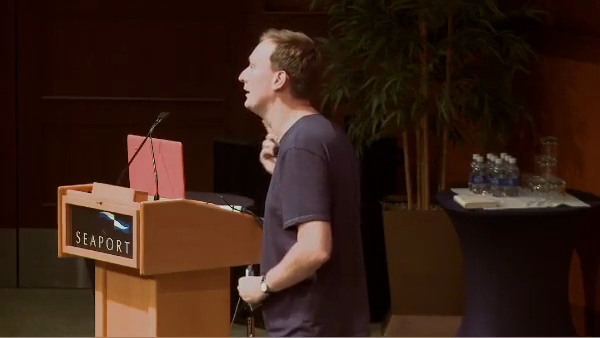
As Redgate grew, Davidson wanted to learn the mechanics of running a business. Business of Software grew out of that need. Its first conference took place in 2007. There were already events for programmers, startups and fundraising. Davidson wanted to hear how people built companies that worked over time.
He assembled a list of people he hoped to learn from and invited them to speak. Geoffrey Moore, Jason Fried and Joel Spolsky were among those who agreed. Mark Littlewood, who knew Davidson from university, later took on running the event. Littlewood’s recollection supplies a useful comic footnote: he had taught Davidson to row, apparently with less success than Davidson achieved elsewhere.
The conference’s value also lived between presentations. Attendee Mark Stephens remembered Davidson persuading him to come in 2008 by talking up the conversations in the hallways and offering to refund the ticket if he was dissatisfied. That is a fairly direct way to put a price on your own confidence.
For Davidson, making a place to ask questions became another thing to build. Founding an event while running a software company might sound like a splendid way to acquire extra administration. It also put people with experience of the same problems within talking distance. The learner had arranged his own classroom.
A room so full nobody got to the question
At the 2007 conference, Michael Pryor held an impromptu session on software pricing. People kept arriving. By the time everyone had introduced themselves, the time available for discussing pricing had gone. Davidson recounted the episode in the introduction to Don’t Just Roll the Dice, his short guide to the subject, dated August 2009.
It is an excellent origin for a handbook: an unanswered question, plus a roomful of evidence that an answer would be useful. Davidson had heard the same question repeatedly from software entrepreneurs and product managers. The book made space for economics, psychology, common mistakes and a checklist, without pretending that one price would suit every product.
Its discussion of value starts wider than the download. Buyers also receive documentation, help, the expectation of future development and someone to turn to when things go wrong. Davidson used accounting software to explain why familiarity and reassurance can matter even when the interface gives users little pleasure. An engineer’s assessment of elegance is only one part of a purchasing decision.
The guide also warns against assuming that another software customer costs nothing. Support, selling, infrastructure and collecting payment all belong in the calculation. By September 2015, Business of Software reported more than 50,000 downloads of the book. A conversation that never properly began had found a rather larger audience.
When the incentive becomes the job
Davidson’s interest in how people behave extended to the sales floor. At Redgate, he found salespeople adapting to the compensation scheme in ways that frustrated its purpose. He changed the scheme; they found new ways to work it. Eventually, he removed sales commissions.
Daniel Pink opened his 2012 Business of Software presentation by crediting Davidson’s email and their subsequent conversations with the idea behind To Sell Is Human. Pink described the commission change as having worked well. The episode brought an unglamorous management problem into a much wider discussion of selling and motivation.
There is a family resemblance between this experiment and Davidson’s pricing work. Both require taking actual human behavior seriously. A spreadsheet can describe a perfectly reasonable incentive. The people receiving it can discover a perfectly reasonable way to earn more while doing something the designer did not intend. They have, after all, been given a problem to solve.
Redgate’s culture attracted attention beyond its founders. Software practitioner Brian Marick described visiting a workplace full of argument, ideas and engagement. He singled out the company’s plainspoken rule against being an asshole. Its appeal lay partly in the absence of ornamental language. A colleague reading it would have little difficulty identifying the behavior under discussion.
“Web-based collaboration was the future, I told him.”
Neil Davidson, recalling his 1999 call to Simon Galbraith
Leaving the company, keeping the curiosity
By December 2012, Redgate had roughly 300 people across three continents. Davidson had already reduced his hours and was mentoring startups, studying with the Open University and learning to draw. He announced that he would leave day-to-day operations at the end of January 2013. He planned to remain a substantial shareholder and sit on the Council of Advisors.
His explanation contained an unusually unpossessive thought for a founder: the management and advisory teams had developed far enough for the business to continue without him. He wanted time off and then full-time university study. Drawing, he admitted, was coming along slowly. The person who helped make software for saving time was willing to spend his own time being a beginner.
That decision makes the earlier conference look less like a side project and more like a recurring preference. Faced with something he wanted to understand, Davidson found ways to study it. At Redgate, other people’s experience helped him learn to manage. Beyond its daily operation, there was room for subjects whose results would arrive at a different pace.
He also backed other founders. Rapportive co-founder Rahul Vohra named him among the company’s investors in an interview recorded after its 2012 acquisition by LinkedIn. Davidson’s Wellfound profile lists an advisory role at CryptoSeal. These connections place him in the exchanges around young software businesses as well as in the history of his own.
The business carried on
Eleven years after Davidson left daily management.
Redgate’s later milestones put the departure in perspective. The company announced $100 million in annual recurring revenue in July 2024, alongside its twenty-fifth anniversary. The figure belongs to the company and the teams who carried it forward. Davidson had stepped away from its daily management more than a decade earlier.
In April 2026, Redgate announced a growth investment from Bregal Sagemount. It described a business employing more than 500 people across six locations and serving over 200,000 professionals worldwide. Jakub Lamik, CEO since 2021, set out a direction toward a platform covering more of the database lifecycle. The organization had continued to acquire responsibilities, products and people.
Davidson’s own board history changed too. Companies House records his resignation as a director of Red Gate Software Group Limited on 8 April 2026. His enduring description is co-founder and former joint CEO. Those words cover both the long commitment and the decision to give its daily demands to others.
The revealing detail remains the drawing. In his departure note, it appeared among the activities he wanted more time for, with no claim of mastery and no promised commercial outcome. He had helped establish a business large enough to go on without him. Then he made room in his life for work he was still learning to do.