The strange thing about MoPub's billion-dollar exit is that the product did not get a long victory lap. AppLovin closed its purchase from Twitter in January 2022. By the end of March, the standalone MoPub service was scheduled to close. Its publishers were sent toward AppLovin MAX; its demand partners and useful features were folded into a larger system. The company had been valuable enough to buy and, apparently, too valuable to leave as it was.
- MoPub helped app makers sell ad space through one dashboard, multiple networks and a real-time marketplace.
- Twitter bought it in 2013, then sold the business to AppLovin for $1.05 billion in cash.
- AppLovin integrated MoPub into MAX and gave publishers a 90-day migration window.
- Its enduring asset was the network of publishers and buyers, rather than the standalone name.
An app publisher's problem sounds simple until the invoices arrive. One network offers a certain price for a banner. Another may pay more for a video. A direct advertiser wants a guaranteed campaign. Some slots go empty. All of this happens in the moment before an ad appears on a person's phone. MoPub built tools to organize that traffic: ad serving, mediation across demand sources, and MoPub Marketplace, where buyers could bid in real time. The publisher gained a control room for inventory that otherwise sat in several places.
A switchboard for the tiny screen
Founded in San Francisco in 2010 by Jim Payne and colleagues with AdMob and Google experience, MoPub arrived when mobile advertising was still being assembled in public. Its earliest proposition was practical: an app developer should be able to choose among direct ads, house promotions, ad networks and exchange bids without rebuilding the app for every buyer. MoPub's SDK and dashboard sat between the developer's inventory and those competing sources of money.
This was neither a consumer app nor a place where people went to browse. Its customers were app publishers, including game makers, trying to earn more from each impression. On the other side were advertisers, agencies and demand-side platforms looking for mobile inventory. MoPub's position between them was its distinction. A publisher could see what a slot earned and route it among demand sources; a buyer could reach inventory spread across many apps. The company earned its place in the market by making that exchange easier to manage.
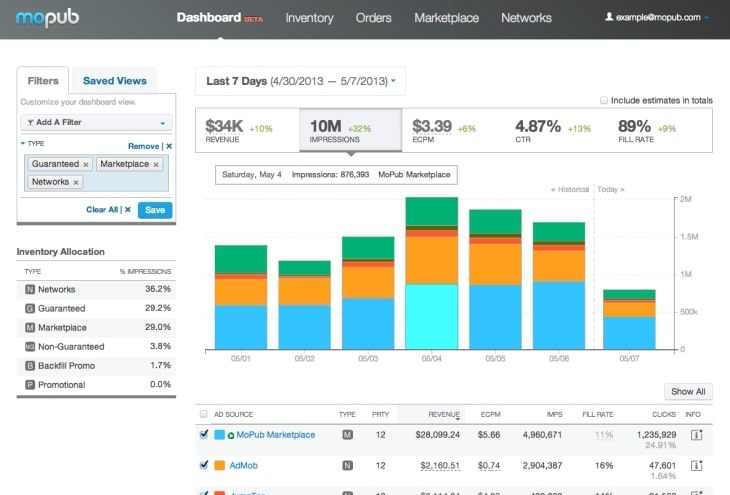
The dashboard is a small history lesson. It does not show an abstract pool called “advertising.” It shows competing pipes: networks, guaranteed orders, the Marketplace, backfill. Each has a different promise and a different price. MoPub's commercial argument was that publishers should see and manage those pipes together. Its business model depended on the activity passing through that ad infrastructure, though a reliable public schedule of MoPub-specific fees is not available.
The useful outcome for a publisher: more demand can compete for the same moment.
Twitter wanted the road. AppLovin wanted the junction.
Twitter's 2013 acquisition made sense in its moment. The social network said mobile use and automated ad buying were converging. MoPub already had an exchange, publisher relationships and a way to sell ads beyond Twitter's own app. Twitter planned to extend native advertising through the exchange and bring real-time bidding into its advertising platform. The reported price was about $350 million.
The numbers later became larger. Twitter said MoPub generated about $188 million in revenue in 2020. AppLovin agreed in October 2021 to pay $1.05 billion in cash for the business. This was no rescue purchase of a business with no buyers. It was a transfer between two owners with different ambitions. Twitter said it wanted to put more effort into ads on its own website and apps, particularly performance advertising, small businesses and commerce. AppLovin, already running MAX for app monetization, saw the value of combining MoPub's publisher base and demand connections with its own platform.
The contrast is instructive. For Twitter, MoPub's off-platform reach had become less central to the work it wanted to prioritize. For AppLovin, that reach was precisely the point. The same asset changed strategic meaning when it changed hands. The acquisition price bought a functioning network of relationships and machinery, not a guarantee that the MoPub name would stay on the screen.
“The sale of MoPub positions us to concentrate more of our efforts on the massive potential for ads on our website and in our apps.”Ned Segal, then Twitter CFO, 2021
The first thing to go was the standalone product
AppLovin moved quickly. At closing, it said more than 150 demand-side platforms had direct access to AppLovin Exchange. It listed MoPub-associated capabilities being added to MAX: universal creative reporting, ad review, native ad support and a built-in GDPR consent flow. A new SDK release was due days after closing. Publishers had a 90-day migration period, with MoPub scheduled to sunset on March 31, 2022.
The migration was a product exercise of its own. AppLovin published a checklist, told developers which SDK to download and offered an import tool for MoPub ad-unit waterfall settings. Developers still had to create MAX accounts, connect networks, check privacy flags and test the resulting integration. Those are not glamorous launch-day tasks. They are the work that decides whether an acquisition's promised network actually survives the move.
“What failed first?” is almost the wrong question. The public record does not show MoPub's exchange failing before the sale. Its independent existence ended by design. The original service was the first casualty of the merger because two mediation platforms would duplicate the job AppLovin wanted MAX to perform. MoPub's features and commercial relationships were meant to live on in that combined product.
The lesson in the wiring
There is a useful tactic here for a company managing a large product migration: identify the routines customers cannot afford to lose, then ship ways to carry them across. AppLovin chose recognizable features, a configuration importer and a documented transition path. MoPub's case also shows the limit of that tactic. It works only when the new platform can support the buyer and publisher connections that gave the old one value. A migration tool cannot invent demand, and an ad auction cannot improve prices if too few bidders show up.
For today's developer, MoPub is a historical product, not a service to sign up for. The practical successor is MAX, where a publisher can set up ad units, connect networks, test mediation and review performance. The broader market still offers other mediation choices, including Google AdMob and Unity LevelPlay. The sensible question for a publisher is less romantic than the deal headline: which platform brings enough compatible demand to the app, gives the team usable controls, and makes the next integration change bearable?
MoPub's story ends with a missing logo on a live dashboard and a familiar mechanism underneath it. The auction survived. That is the peculiarity of infrastructure companies: their work can become more pervasive at the exact moment their name disappears.
Where the machinery lives now
- AppLovin MAX - the current monetization platform.
- MAX developer guide - setup, mediation and testing.
- MoPub to MAX integration - the migration plan.
- MoPub on LinkedIn and archived code on GitHub.