A font file weighs almost nothing. Let it loose inside a multinational company and it can become a surprisingly heavy object. The design team downloads one version. An agency uses another. Legal finds a license that covers print but not an app. A regional office substitutes something close enough. Then the campaign ships in 30 markets, the kerning breaks in Japanese, and nobody can say with confidence who was allowed to do what.
That mess is Monotype's modern business. The company is famous for the shapes - a portfolio and partner network that puts Helvetica, Gotham, Futura, Avenir, Frutiger and thousands of less famous families within reach. Yet the sharper way to see Monotype is as the control room around those shapes. It sells discovery, permission, distribution and governance, with type design sitting at the center.
The product is permission
Monotype serves four people who can sit in the same meeting and mean different things when they say “font.” A designer means expression. IT means executable software. Procurement means a vendor and a renewal. A lawyer means usage rights that change across desktop, web, app, advertising and embedded products. Monotype Fonts tries to make those meanings coexist under one subscription and one workflow.
The platform offers more than 250,000 fonts for search, preview and activation. Teams can build approved lists, sync type into creative applications and track what reaches production. Existing third-party fonts can be imported, so the product can act as a record of the whole collection rather than a velvet rope around Monotype inventory. The licensing layer replaces a pile of end-user agreements with a negotiated commercial allowance for seats, page views, ad impressions and deployed fonts.
Monotype Connect pushes further into operations. It centralizes libraries, adds permissions, reporting, Adobe and office-app integrations, and scans project files for licensing risk. The standard plan is listed at $200 per user annually; Pro is $300. Large teams and agencies get tailored quotes. Most enterprise arrangements are term-based, billed yearly and often run three to five years. This is recurring software revenue built on intellectual property, with custom type projects, MyFonts transactions and embedded-device royalties alongside it.
The first thing that fails is the filing cabinet
The recurring customer story begins without artistic drama. Font files accumulate in downloads folders, shared drives and old agency handoffs. The license usually lives elsewhere, if anyone can find it. That separation is the first failure: the asset is portable, but its permission is not. Growth multiplies the problem across teams, brands, channels and languages.
Kenvue offers the cleanest example. The consumer-health company operates across more than 165 countries and says its brands reach more than a billion consumers a day. Its font environment had grown decentralized and reactive, creating version confusion, legal exposure and weak visibility. Monotype helped turn it into a centrally governed system, with an ongoing team and weekly working sessions. The glamorous outcome was not a new flourish on a letter. It was knowing which letter could safely appear where.
Alibaba's problem was different in detail and identical in shape. Multiple open-source fonts moved across teams, partners and a huge merchant ecosystem. A custom family had to carry a recognizable voice while handling currencies, numerals and global scripts. Monotype began with the characters that mattered commercially, then ran collaborative workshops and designed Alibaba Sans as a shared system. The result could be distributed freely to partners and customers while keeping the brand coherent.
“Type can be a distinctive asset if it's used in the right way. It can be the connective tissue that holds the brand together across languages and markets.”Carrie Roberts, Head of Creative Operations at Kenvue
What changed Monotype's mind
Monotype did not arrive at this product by admiring the size of its archive. The company says research with large customers exposed a recurring truth: enterprises often did not know which fonts they had, who had bought them or whether a current use was covered. Individual e-commerce licenses still worked for occasional buyers. They did not scale cleanly across hundreds of people and thousands of assets.
Even the product name had to lose friction. Monotype Fonts was originally called Mosaic. In November 2020, the company renamed it after finding that font licensing already required enough explanation; introducing a separate brand name added another thing for buyers to decode. It is a wonderfully modest product lesson. When customers are confused, removing a noun can beat adding a feature.
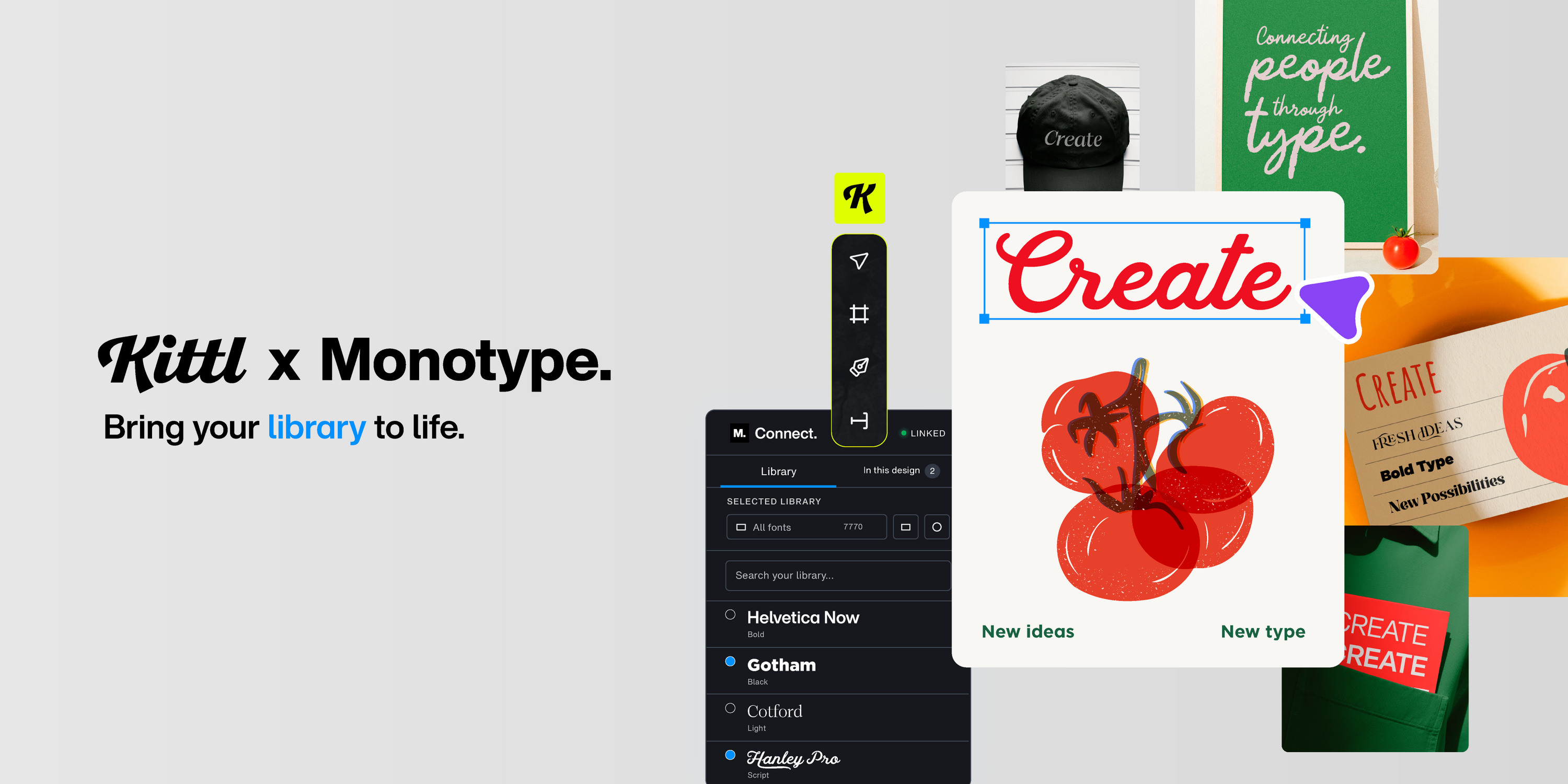
The latest moves follow the same logic. Monotype bought Extensis in 2024, putting a respected font-management product beside its own inventory and licensing platform. In 2025 it added more than 750 typefaces to Adobe Creative Cloud. In 2026 MyFonts arrived inside ChatGPT, Gotham became a variable font, and the Kittl integration let teams reach an approved organizational library without leaving an AI-assisted design tool. The strategy is to meet the creator at the moment of choice, then carry the choice safely into production.
Tolbert Lanston patents a system for composing individual metal types.
Agfa's typographic operations become Agfa Monotype, distinct from the original machine makers.
HGGC pays $19.85 per share to take Monotype private.
Extensis, Adobe, ChatGPT and Kittl moves put inventory, control and creation closer together.
A roll-up with a human taste problem
Monotype Imaging Inc. dates its current corporate form to 1999, while claiming a typographic legacy that begins in 1887 with Lanston's mechanical system. That distinction matters: the modern company is not an uninterrupted Victorian machine shop. It is an acquisitive technology and design group that carries forward the name, expertise and many assets of earlier businesses.
Its collection has grown through Linotype, ITC, Bitstream and MyFonts, FontShop, Fontsmith, URW, Hoefler&Co., Fontworks, Colophon, Berthold, Extensis and other deals. This makes Monotype unusually broad. It can sell a famous family, distribute an independent foundry's work, build a custom multilingual face, and govern the finished system. It also creates an obvious tension. Consolidation gives customers one convenient door while giving the doorkeeper influence over prices, terms and which creators reach the shelf.
The company says foundry partners are paid quarterly from subscription revenue using signals including which fonts customers name, sync and use. The network has grown beyond 4,500 foundries. That marketplace creates the breadth enterprise buyers want, but it has to keep both sides convinced: brands must see less risk and creators must see fair distribution. Software cannot automate that trust away.
The small-team exception
The offer is strongest when complexity is real: multiple brands, agencies, regions, channels, languages or product embeddings. A freelancer who licenses one display face twice a year probably does not need a control plane. A small team committed to Adobe Fonts, Google Fonts or a few direct foundry relationships may prefer the bundle it already pays for, an open-source catalog, or simple internal records. Monotype's subscription also cannot rescue a team that refuses to assign ownership, document approvals or train people. Central software without operating discipline is simply a tidier place to lose track.
This is where comparisons should be honest. The alternative is not always another enterprise platform. It can be Adobe's included library, free Google fonts, direct buying from an independent foundry, a lighter font manager, or a spreadsheet used carefully. Monotype earns its premium when the avoided rework, administrative time and licensing exposure exceed the subscription and switching cost.
What did they do?
Joined a huge font library to discovery, rights, deployment and governance software.
What did it cost?
Connect lists at $200 per user yearly and Pro at $300; enterprise work is quoted.
What failed first?
The link between a portable font file and the license governing its use.
What changed their mind?
Customer research showed a la carte purchasing and extra product vocabulary did not scale.
What can you copy?
Inventory assets, attach permissions, approve a narrow set, integrate it where work happens.
When is it overkill?
When a few people use a few fonts in a few predictable channels.
Copy the operating system, not the shopping habit
The useful Monotype playbook can be borrowed without buying 250,000 options. Start with an inventory, not a mood board. Connect every font file to its source and allowed uses. Create a short approved library for each brand. Put those assets inside the tools where people already design. Give one person authority over exceptions. Review rights before publication, not after a campaign becomes expensive to change.
Then separate experimentation from production. Monotype's subscription is generous during prototyping but treats deployed fonts as a governed choice. That is the practical trick: maximize creative range early, narrow the set when the work leaves the studio, and keep a record of the transition. Freedom and control stop being opponents when they happen at different stages.
Monotype's original machine separated the keyboard from the caster and produced one character at a time. The modern company has performed a stranger inversion. It took the smallest visible ingredient in a brand and built a system around everything that ingredient touches. The letters are still the charming part. The business is making sure the right ones arrive, legally and intact.