Winning an order ought to be the pleasant part of running a business. Somebody wants what you sell. There is paperwork to prove it. The difficulty arrives when the manufacturer expects payment before the customer has paid you. Success has acquired an invoice of its own. Mohamed Alomayyer has built much of his working life around that inconvenient sequence. In Riyadh, the CEO and co-founder of Tameed works on a question that sounds almost too ordinary for a technology company: how does a small supplier pay for the order it has just won?
The question gives his career a useful point of entry. There are founders whose companies require an introduction to an entirely new habit. Alomayyer's business starts with a familiar commercial headache. A government purchase order confirms demand; it does not put money in the supplier's account. Between those two events lies the working capital that buys goods and makes delivery possible. Tameed connects businesses seeking that financing with investors through a digital, Sharia-compliant debt-crowdfunding platform.
The company he founded with Mohammed Al Alshaikh in 2019 takes its name from the purchase order itself. It is an unusually literal name for a startup, and rather a helpful one. The paperwork is the business. Alomayyer's public career turns repeatedly toward the practical details surrounding it: financing speed, customer needs, investor participation and the technology required to make the arrangement work.
California, China, then a Saudi financing problem
Before Tameed, Alomayyer studied business administration at Dominican University of California. He also holds a financial modelling and valuation qualification from the Corporate Finance Institute. His professional biography includes a MENA director role at ARC Capital in China and an equity director role at Manafa Capital in Saudi Arabia. The geography is broader than the market his own company would choose to serve.
Those roles put international finance and Saudi finance in the same career. They also place Tameed after experience inside other organizations. He arrived at entrepreneurship with a business degree and work in finance. The chronology is modestly revealing on its own: study abroad, finance work across countries, then the responsibility of building a financing platform in Riyadh.
His LinkedIn profile lists Arabic and English at native or bilingual proficiency and Chinese at limited proficiency. The distinction is a small, appealing detail in a profession fond of expansive credentials. China appears both in his employment history and in a language he describes with a limit. It supplies texture without requiring a legend about how the company began.
By 2019, Alomayyer and Al Alshaikh had chosen a specific part of business finance. Their customers would be small and medium-sized enterprises with government purchase orders. Their platform would bring investors into the funding process. The ambition was to make a particular transaction possible, repeatedly, in a market they understood. A purchase order was the starting document; delivery was the commercial purpose.
The order is ready. The money has another appointment.
Tameed's explanation of the problem is direct. Resellers need to pay manufacturers upfront while waiting for government payment at maturity. A supplier can therefore have a customer and an order while still lacking the cash to fulfil it. An attractive contract and an uncomfortable bank balance can coexist quite happily, at least from the contract's point of view.
For Alomayyer, that interval is the centre of the company's proposition. The platform pools investor participation to finance purchase orders. A business seeks funding for an identifiable commitment, and investors gain access to financing opportunities through the platform. The digital process brings the two sides together around the transaction. Each side has a different reason to care about the same order.
The model also explains why the business cannot be understood simply by looking at the borrower. The timing of the buyer's payment, the supplier's obligation and the funding process all matter. Tameed describes its offer in terms of government-backed purchase orders and fast access to finance. The usefulness is concrete: funding must arrive while there is still an order to deliver.
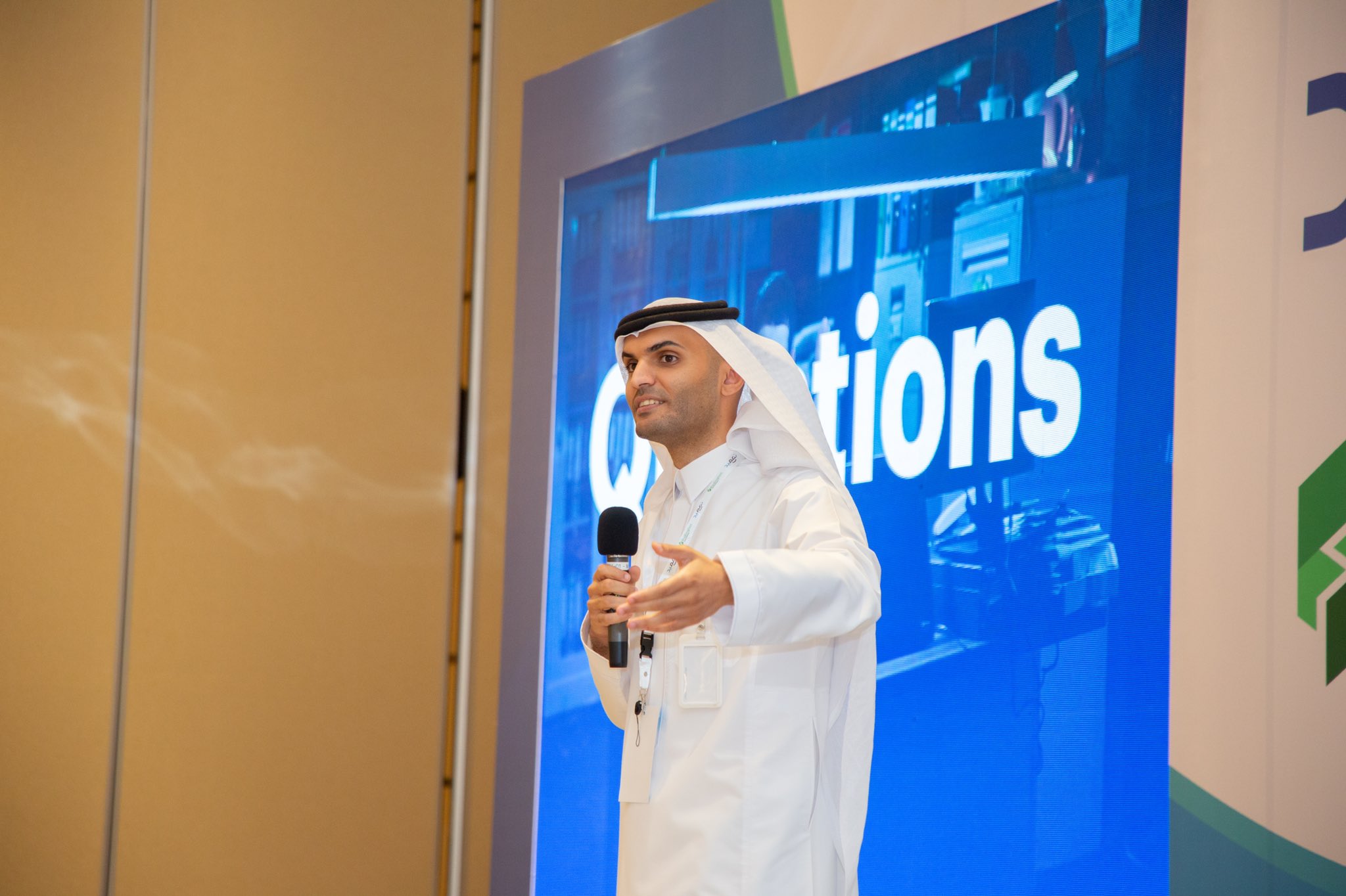
Alomayyer has taken that explanation out of the office. At a workshop organized with Redington, he discussed ease of application, processing speed and flexibility in repayment dates. The session addressed financing challenges and the experience of Redington's customers and suppliers. In the photograph, he holds a microphone with his other hand extended. The subject of the presentation is less glamorous than a product launch, but considerably closer to the daily concerns of a supplier.
A licence before the next chapter
Building a financing company entails another kind of waiting. Tameed operated in the Saudi Central Bank's regulatory sandbox before obtaining a licence for debt-based crowdfunding. On January 23, 2023, the central bank announced that Tameed and Forus had been licensed after successfully testing their solutions in that environment.
For Alomayyer's career, the announcement marks a clear transition. A platform founded in 2019 had passed through testing and reached a formal operating milestone. The central bank placed the decision within its efforts to support innovation and financial inclusion while maintaining supervisory requirements. The company's progress was tied to that process, with the regulator's permission forming part of the work of building the business.
Two days after the announcement, Tameed published an item about Alomayyer's appearance on Al Arabiya to discuss the final licence. That is a telling choice of interview subject. The public moment concerned permission to operate a financing activity, a milestone meaningful to customers and investors alike. A finance founder's news can arrive as a regulatory announcement rather than a new screen in an app.
The year then brought another kind of validation. In December 2023, Tameed closed a SAR 56.75 million Series A round, reported as $15 million, led by Alromaih Investments. The stated purpose was to accelerate growth and meet demand for its digital lending products. Licensing and fundraising belong to the same year here, but they answer different questions: the first concerned authorization; the second supplied capital for the next stage.
The numbers need their dates
Forbes Middle East included Tameed in its 2024 Fintech 50 list. Its account of 2023 described more than $117 million in financing, annual growth of 285% in total financing amount and over 22,800 active investors. It also recorded more than 50,000 app downloads. These are dated measures of the company Alomayyer helped build, rather than measurements of his personal wealth or a forecast of its future.
The investor figure is particularly useful to the story. Debt crowdfunding requires people willing to participate in the financing, alongside businesses seeking it. A platform can make applications easier, but it must also give investors a reason to return. The two sides have to develop together. Alomayyer's work has therefore included the experience of investors as well as the speed promised to suppliers.
In November 2022, Tameed selected Moneythor to provide loyalty and personalization capabilities. The partnership announcement described rewards and recommendations intended to improve customer engagement. Alomayyer singled out three qualities: “innovation, customer experience and reliability.” That last word sits comfortably beside the first two. For a financing platform, a clever feature still has to earn continued use.
The partnership was presented at Seamless Saudi Arabia by Tameed's chief operating officer, Ammar Alsinaidi, and Moneythor's regional sales director, David Sorreluz. The detail brings the organization around the founder into view. There are partners to select, staff to represent the business and systems to put into service. The chief executive is part of that arrangement, even when the photograph or the headline belongs to somebody else.
A thank-you with a useful correction
When Tameed celebrated passing SAR 100 million in purchase-order financing, Alomayyer shared the milestone on LinkedIn and thanked the team. Responding to a congratulatory comment, he wrote: “Thank you Ahmed, it is Ta3meed Team Achievement”. It is a compact line, with the collective credit doing most of the work.
A single comment cannot settle a person's character. It can show how he chose to handle that particular celebration. Alomayyer directed the recognition toward the people building the platform. Beside the fundraising announcements and formal job titles, the exchange gives the career a human scale: someone offered congratulations, and the CEO made room for his colleagues in the reply.
His later public appearances returned to customers' problems. At the fourth International Contracting Conference in 2024, he joined a discussion on financial resilience for contracting companies. He emphasized meeting businesses' needs, strengthening communication and understanding their different financing requirements. The workshop with Redington had addressed another version of the same task: explaining financing to the businesses and suppliers expected to use it.
That repetition matters. The public record of an executive can become a procession of stages and announcements. Here, the topics keep returning to the mechanics of business: getting funding, meeting commitments, listening to requirements. The settings change from a supplier workshop to a contracting conference, while the question of usable working capital remains close by.
“Thank you Ahmed, it is Ta3meed Team Achievement”Mohamed Alomayyer · LinkedIn reply
Making room for the next order
At the Series A announcement, Alomayyer said Tameed had added performance-bond financing to serve a wider range of SMEs and help them participate in major projects. The addition extends the story beyond paying a manufacturer. Companies pursuing contracts can encounter different financing requirements along the way; his stated aspiration was to meet more of those needs as the Saudi economy grew.
The direction is consistent with the company's original focus. An order creates obligations, and completing it takes money at particular moments. Alomayyer's career at Tameed has involved arranging a platform, regulatory permission, investor participation and partnerships around those moments. The milestones cover several parts of running a financing business. Their everyday purpose is easier to grasp: a supplier needs to be able to act on the business it has won.
That is where his story finds its scale. A financing round is measured in millions. An investor base is measured in thousands. A customer faces a more immediate calculation: whether the money needed for delivery will arrive in time. Mohamed Alomayyer has chosen to work in that interval. The purchase order can stay on the desk; the goods, with financing in place, can move.