The first thing to understand about Mitchell Fogelson’s company is that its product begins by disappearing. A solar array that may one day stretch 100 meters must first submit to the dimensions of a rocket fairing. It has to fold small, survive violence, wait patiently and then, where no mechanic can reach it, become enormous without becoming what one of his co-founders calls “a floppy noodle.” Space is full of majestic nouns. Fogelson has built his career around a perilous verb: deploy.
He is the co-founder and CEO of Beyond Reach Labs, the Brooklyn hardware startup building solar-array systems for satellites, commercial stations and other power-hungry machines in orbit. In July 2026, the company announced a $10 million seed round led by Interlagos, with TerraForge Capital, Off-Piste Capital, Y Combinator and Augur VC participating. It also opened a 16,000-square-foot facility in Brooklyn. The factory gives physical form to an idea Fogelson has been refining for years: space infrastructure should eventually be purchased as a dependable component, not reinvented as a heroic one-off for every mission.
That ambition sounds industrial now. Its roots are charmingly academic: a wind-turbine lab, an expressive robot with a projected face, mechanical metamaterials, scissor links, a Zero-G airplane and a doctoral researcher learning that customer interviews can be as clarifying as equations.
The robot with the googly-eyed spirit
At the University of Pennsylvania, Fogelson studied mechanical engineering, added a mathematics minor and graduated magna cum laude in 2017. He stayed for a master’s in robotics, completed in 2018, and spent five years working in the GRASP Laboratory under roboticist Daniel Koditschek. When Penn later asked him for a favorite memory, he did not reach for a trophy. He chose the wind-turbine lab in MEAM 347. He remembered “the playful competition” and an environment where students could safely fail while pressing on their ideas.
That preference for playful machinery followed him to Tokyo. At Rakuten Institute of Technology, he worked on robotics and helped create EMI, an expressive, mobile and interactive robot. EMI rolled on a circular base, projected an animated face and used voice interaction. The research question was social as much as mechanical: when the robot reached the edge of its abilities, could expression make a nearby human more willing to help?
The project sits neatly beside Fogelson’s later work. Intelligence is often treated as something ethereal, a cloud of software hovering above the inconvenient world. His career keeps returning it to the floor. A system’s shape, joints, balance, voice and motion determine what it can do and how people respond. On a 2025 podcast, he described this hardware side of robotics as “physical intelligence.” Before he was engineering arrays to ask sunlight for power, he was engineering a robot to ask an office worker for a hand.
A kilometer is an awkward thing to pack
Fogelson arrived at Carnegie Mellon in 2020 for a PhD in mechanical engineering. Working with Jonathan Cagan and Zac Manchester, he studied simulation, optimization, mechanical metamaterials and structures that could expand far beyond their packed dimensions. The practical problem was deliciously absurd: how do you fit something approaching the scale of a skyscraper into something approaching the scale of a room?
One answer was hierarchy. Fogelson and collaborators developed a pop-up extending truss, then composed versions of it into a larger pattern they called HERDS - Hierarchical Extending and Reorienting Deployable Structures. Their reported prototype reached a 50-times extension ratio. The research described designs capable of supporting much greater stiffness than comparable non-hierarchical deployables when the initial volume was constrained. In plain English, careful geometry allowed a compact bundle to become long without surrendering its backbone.
Deployment is not merely a folding puzzle. Linkages can jam. Flexible structures can vibrate. A mechanism that behaves politely in terrestrial tests may develop fresh opinions in microgravity. Fogelson’s work therefore included digital-twin and simulation methods for linkage analysis, attempting to narrow the treacherous gap between the model and the hardware. A spacecraft may carry redundant electronics. It cannot carry a technician to nudge a reluctant hinge.
In 2025, that work left the lab aboard a NASA-supported Flight Opportunities campaign with Zero-G. Fogelson, Manchester and their collaborators tested deployable mechanisms during parabolic flight. Preparation demanded months of design and assembly, including what Fogelson described as roughly 1,000 stickers and scissor links. Then gravity loosened its grip and the structure had its examination.
“Watching months of design come to life in zero gravity was truly unforgettable,” he wrote afterward. The sentence is emotional but also exact. Deep-tech work spends a long time as anticipation. A calculation predicts. A prototype suggests. For a few floating seconds, the machine answers.
Customer discovery meets celestial mechanics
Beyond Reach Labs began in 2023 while Fogelson was still pursuing his PhD. Its technology grew from NASA-backed work on large space structures, but research does not arrive with a market attached. Through Carnegie Mellon’s Project Olympus, an NSF I-Corps cohort and the Innovation Commercialization Fellows program, he began interviewing potential customers and learning the less elegant mechanics of incorporation, fundraising and technology transfer.
He has said that customer discovery solidified his decision to launch a company. It also widened the menu of possible applications. Compact deployable structures could become communications infrastructure after disasters, or temporary capacity for giant events that swamp local networks. The technology was promiscuously useful, which is a flattering way for a startup to become distracted.
Fogelson had to choose a first act. Beyond Reach Labs joined Y Combinator’s Winter 2026 batch and narrowed its immediate focus to orbital solar power. The choice followed the constraint. Larger spacecraft, stations and proposed orbital data centers need more electricity. More electricity requires more collecting area. Rockets remain stingy about volume and mass. Every grand space plan eventually meets a rather practical square-footage problem.
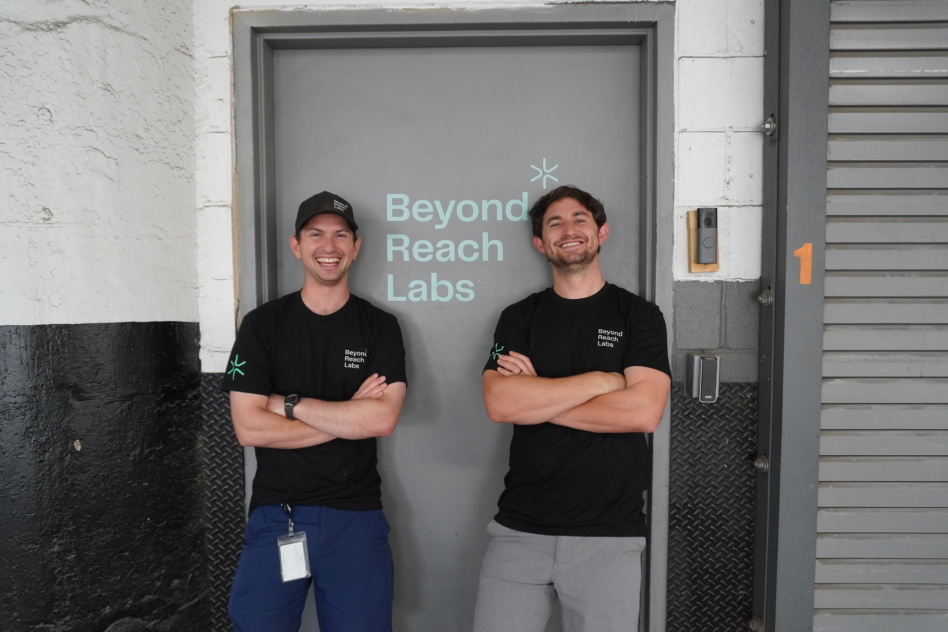
The partnership at the center of the company is older than the company. Fogelson and CTO Pele Collins worked together on engineering problem sets and projects at Penn, then split into different apprenticeships. Fogelson went to research robots and deployable structures. Collins spent seven years at SpaceX, including leading work on Dragon parachute systems. They reunited with complementary varieties of anxiety: one steeped in novel geometry and simulation, the other in human-rated mechanisms that must perform on schedule.
Their reunion also says something unfashionable about networks. The useful connection may not be the person met at a crowded conference last Thursday. It may be the classmate who already knows how you behave when the problem set is due, the model is wrong and dinner is getting cold.
The factory is the second invention
The July 2026 financing changed the scale of the promise. Beyond Reach Labs reported paid pilots in progress and $342.6 million in letters of intent. It aimed to flight-qualify its system by the end of 2026. Its Brooklyn facility was meant to support a longer manufacturing goal: producing more than ten units a day by the end of 2027.
Ten a day is the quietest and most revealing figure in the story. Universities are good at proving that one difficult object can exist. Space programs are good at commissioning exquisite objects in small numbers. A production line asks different questions. Can technicians assemble the mechanism consistently? Can inspection catch the tiny error that becomes a large error at 100 meters? Can a supplier meet a schedule without turning every delivery into a legend?
Fogelson’s stated destination is a power source customers can plug into their plans. He wants deployable arrays to feel like valves or motors: understood, trusted, available. There is wit in building an astonishing object so successfully that nobody needs to be astonished by it. Reliability is wonder with the surprise removed.
Power is the opening product, not the final boundary. Fogelson has spoken about deployable radiators and structures, and about becoming an architect of the next generation of large space systems. The company’s shorthand has been “IKEA for space infrastructure,” a phrase that makes orbital construction sound pleasantly flat-packed. The analogy works only up to a point. IKEA supplies a tiny wrench and permits a second attempt. Orbit supplies neither.
- 2013-2018 / PhiladelphiaMechanical engineering, mathematics and robotics at Penn; research in GRASP Lab.
- 2018-2020 / TokyoRobotics research at Rakuten Institute of Technology; co-development of EMI.
- 2020-2025 / PittsburghCarnegie Mellon PhD; deployable structures, simulation and microgravity testing.
- 2023-2026 / Pittsburgh to New YorkBeyond Reach Labs founded, accepted to YC W26 and moved into Brooklyn production.
Fogelson’s path is easy to tidy after the fact: robots led to mechanisms, mechanisms led to space structures, structures led to solar arrays. Lived forward, it was surely messier. It crossed laboratories and countries, wandered through a podcast about scientific questions, collected publications and prototypes, and required a founder to learn that a fascinating platform still needs a specific customer.
The line running through it is not space. It is the belief that physical systems can be made clever through design. A friendly robot can express its limits. A compact lattice can become a rigid beam. A solar array can hide in a rocket and emerge large enough to feed a new class of spacecraft. Even a university project can unfold into a factory, provided somebody understands where to put the hinges.