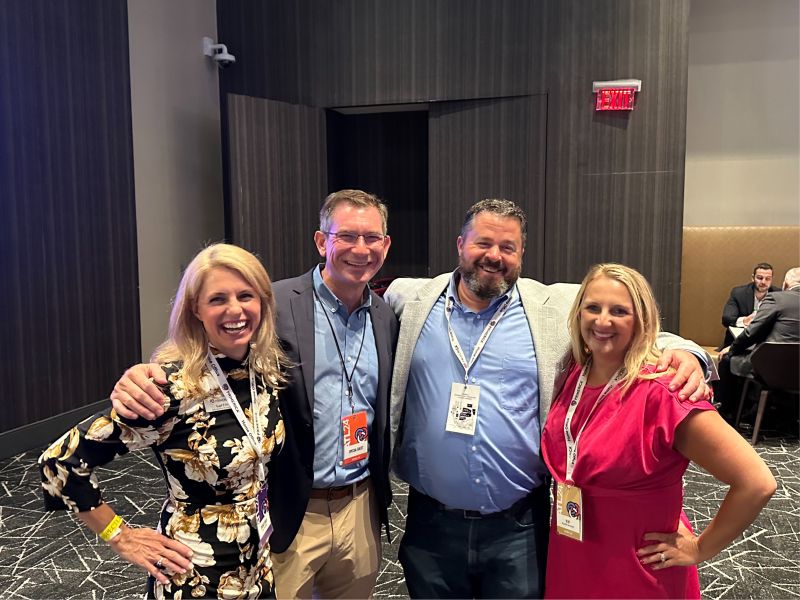
At Primerica’s 2024 convention, Misty Sutton had more than one reason to pay attention. Her teams were putting new technology in front of the people who would use it. Business partners were getting a closer look at the company. Her husband was there. And her daughter was experiencing the convention for the first time.
In her account afterward, those things belonged on the same list. The work, the relationships and the family occasion shared the billing. A corporate convention can be an elaborate exercise in looking forward; Sutton also found herself looking sideways, seeing a familiar institution through her daughter’s eyes.
That is a useful place to begin with an executive whose career has involved changing how an established financial services business works. Transformation is a word that arrives wearing an expensive suit. In practice, it can mean finding a document, assigning a case or getting a signature without making three people wait.
Sutton’s record contains all of those less glamorous verbs. It also now contains a different kind of responsibility: president, director and chief executive officer of PFS Investments, with a position start date of April 2026. The route to that office runs through the machinery that keeps a business moving.
Fifteen minutes to find a piece of paper
Consider an insurance record in 2016. Sutton estimated that retrieving one from Primerica’s microfilm collection took about fifteen minutes. Someone had to locate the reel, put it on a reader, find the document, produce the copy and put everything back. Multiply that by hundreds of daily requests and the archive begins to resemble a very busy departure lounge.
By May 2021, after a digitization project involving more than 60,000 rolls of microfilm, retrieval took seconds. Sutton was then senior vice president for business relationship management at Primerica Life Insurance. She described the difference digital access made to serving clients and representatives.
Average record retrieval before and after archive digitization, as described by Sutton in the May 2021 project account.
The project required coordination between scanning staff and the people who still needed the original records for daily work. The archive could not simply close for renovation. That detail gives the achievement its texture: a company has to improve tomorrow’s service while answering today’s requests.
There is an appealing lack of ceremony to the result. A person asks for a record; another person can get it. Nobody needs to admire the scanner. For a financial services executive, that can be a perfectly respectable definition of progress.
A career spent between departments
Sutton joined Primerica in 2001. Her education includes a bachelor’s degree in finance and international business from the University of Georgia that year, followed by a master’s in finance and accounting from Georgia State University in 2003. Her subsequent roles included vice president of project management and senior vice president of project management and automation.
The titles describe a career at the junction of financial operations and technology. One side has obligations, customers and established procedures. The other has tools that promise to make those procedures easier. Getting the two to agree requires considerably more than buying the tools.
In 2021, Atlanta Technology Professionals named Sutton among its Emerging Leader Award finalists, identifying her as Primerica’s senior vice president of automation. It was recognition from a technology community for an executive whose academic training began in finance. Her work crossed those professional boundaries well before enterprise transformation became part of her title.
By 2024, Women in Technology described her as executive vice president of transformation. Its account connected her work to new life insurance products, enterprise platforms and contact center modernization. Those are different projects with a shared practical problem: helping a large organization change its habits without losing track of the people depending on it.
The case that stops getting lost
One earlier workflow project offers a closer view. Primerica’s operations teams had relied on spreadsheets and reports to sort and distribute work. They lacked the ability to assign it by employee skills and adjust priorities according to business value. Even finding out where a case stood could be a task of its own.
The project management and automation team used Pega to redesign those workflows. The aim included giving employees the screens and information relevant to the decision in front of them. The implementation reported an approximately 20% reduction in case processing time, alongside easier work management and better collaboration between business and technology teams.
Sutton emphasized the value of an application that different groups could use intuitively. Her colleague Michael Adams described the new visibility managers gained over outstanding cases, their status and the employees handling them. The improvement made work easier to see as well as easier to move.
For anyone who has ever sent a polite follow-up email into the void, the appeal requires little translation. A case has a location. Someone is responsible for it. The next step can be identified. Administrative clarity rarely gets a standing ovation, but it has a devoted audience among people waiting for an answer.

The signature is only the beginning
Primerica’s Docusign work brought the same concerns to applications and agreements. The company already had an internally developed electronic signature tool, while paper disclosures and forms continued to complicate the process. The next step involved connecting signing more closely to the systems around it.
“Our goal was to simplify processes,” Sutton said. Her explanation also emphasized saving time and improving security. Signed documents and their data could pass into the insurance administration system, reducing manual handling. For clients, completing the paperwork became part of a more connected transaction.
By 2023, Primerica had received Docusign’s Customer Experience Excellence award. Sutton accepted it at the Momentum conference and thanked the company’s partners. The recognition belonged to Primerica; her public response placed it within an ongoing business relationship.
“Our goal was to simplify processes”
Misty Sutton · on Primerica’s digital applications
A later chapter arrived in 2025, when Primerica received the Innovation in Action award for Docusign On Demand. The enterprise tool selected agreement types, generated and routed documents, connected with internal systems and made progress visible. It allowed the salesforce to use the process without needing direct Docusign access.
- 01 Select the agreement
- 02 Generate & route
- 03 Connect the systems
- 04 See its progress
A simplified view of Primerica’s Docusign On Demand process.
Product development leader Ronni Carthron accepted that award and identified Sutton as her boss and leader, joining the project team in New York to celebrate. Carthron also credited colleagues in information technology. It is an especially useful glimpse of how such work gets done: several people, several specialties and a result that belongs to the group.
Four hours, offered one at a time
There is another way to measure an executive’s availability. At the 2024 Women in Technology Connect auction, Sutton offered four individual, hour-long mentoring sessions. The package was explicit about its purpose: mentorship was not to be used as a sales pitch.
Four hours is a modest unit beside an enterprise program, and a substantial one when it consists of someone’s undivided attention. The format made room for a conversation that could develop over multiple meetings, rather than a single introduction followed by an exchange of business cards.
A year earlier, the organization had advertised a rather different Primerica executive experience: an evening of axe-throwing. Sutton appeared in the participating technology leadership lineup alongside Dale Tuck, Lael Ellis, Amy Norton and Shanthala Rao. The offer supplies an unexpectedly sporting footnote to a career associated with process control. It was an auction package, so it would be unwise to turn it into a claim about anyone’s aim.
The next date on her calendar
In her convention reflection, Sutton looked ahead to July 7, 2027, when Primerica would mark fifty years. She connected that future to the company’s work with communities across North America. Her anticipation encompassed what the teams had delivered and what the organization might become.
The family detail gives that forward-looking passage a more personal scale. A daughter’s first convention sits beside a company’s approaching anniversary. The institution has its calendar; the family has its own. For a few days, the two overlap.
Her 2026 responsibilities add another marker. Alongside the PFS Investments leadership position, an April 27 regulatory record identifies her as director, CEO and president of Primerica Shareholder Services. That year’s InsurTech America Symposium speaker lineup also lists her in enterprise transformation at Primerica.
Read together, the roles trace a move from improving particular processes toward responsibility for the organizations that run them. The earlier work remains instructive. Records need to be retrievable. Cases need an owner. Agreements need to reach the right people.
These are ordinary expectations, which makes their absence so irritating and their fulfillment so easy to overlook. Sutton’s career gives them a place in the story of corporate change. Sometimes the revealing measure is a quarter-century at one company. Sometimes it is the interval between asking for a document and having it in your hands.