Two chief executives sounds like the opening of an office joke. Who gets the last word? Who takes the awkward telephone call? Who discovers that the other has already promised something expensive? Rick Williams spent 15 years making that arrangement into an ordinary working fact. At Primerica, he and John Addison shared the top job from 1999 through March 2015. The partnership survived changes in corporate ownership, a financial crisis and the business’s arrival on the New York Stock Exchange. Eventually, it survived the more delicate business of handing the job to somebody else.
Williams is now Primerica’s non-executive chairman. In corporate records he appears as D. Richard Williams; in the company’s story, he is usually Rick. His career offers a useful complication to the familiar picture of the chief executive as a solitary figure. Here was a finance executive who reached the top alongside a colleague with a very different professional vocabulary. One could work a crowd. The other could work through the numbers. Both had to live with the result.
Before the corner office, the acquisition file
Williams earned a bachelor’s degree at the Wharton School of the University of Pennsylvania in 1978, followed by an MBA in 1979. He joined American Can that same year. His route into financial services ran through the machinery of corporate strategy: acquisitions, development and decisions about which businesses belonged together. He eventually headed American Can’s acquisition and development area for financial services and participated in the team responsible for acquiring Primerica.
That beginning matters. A business looks different from the acquisition desk than it does from a sales meeting. The questions are about ownership, financing and what an organization can support over time. Williams encountered Primerica through that side of the enterprise before moving into its day-to-day leadership. By 1989, he was in Atlanta as chief financial officer. His subsequent roles also included chief operating officer.
His early résumé therefore contains an interesting reversal. He helped with the work of bringing a business into a larger organization. Years later, as co-CEO, he helped it establish a public identity outside Citigroup. The same career stretches across both sides of the ownership question: how to put a company inside a group, and how to give it a future beyond one.
A partnership with two different tempos
Addison’s description of Williams was wonderfully practical: “He’s very methodical; he goes through the facts and digs through the numbers.” That is a colleague describing a working habit, rather than a slogan on a conference-room wall. Addison identified himself with marketing and instinct. Williams brought the financial half. Their responsibilities differed, but each consulted the other before making decisions in his own domain.
The relationship predated the matching titles. Before becoming co-CEOs, they had worked together as marketing and finance executives. They already knew how the other approached a problem. By the time the arrangement acquired its unusual name, the collaboration itself was familiar. The shared office at the top formalized a relationship that had been developing for years.
“He’s very methodical”John Addison, describing Rick Williams in 2005
There is a modest comedy in the idea that two executives might make fewer decisions alone after being promoted. Yet that was the discipline Addison described. Division of labor did not mean freedom from consultation. Each had an area of strength; each still needed the other’s judgment. The arrangement gave disagreement somewhere useful to go before it became a company decision.
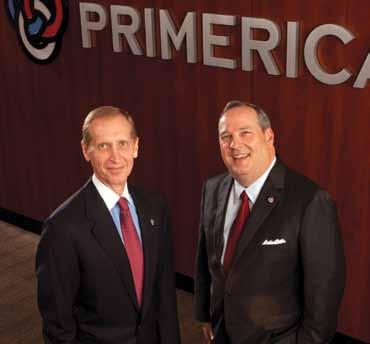
The company behind the partnership
Primerica’s business gave that collaboration a particular setting. It distributed financial products to middle-income households across North America through independent representatives. At the time of a September 2010 investor-conference announcement, the network numbered approximately 100,000 licensed representatives. Its offerings included term life insurance, mutual funds and variable annuities. This was a financial business with a large human distribution system attached.
For a leader with Williams’s background, that created several audiences at once. Representatives needed a business they could explain to clients. Employees needed systems that could process its work. Investors needed to understand how the enterprise earned money. The company’s stated mission was to help middle-income families make informed financial decisions and work toward financial independence. Turning that mission into a durable institution required considerably more than a good speech.
The 2010 prospectus described a senior management team whose members averaged 23 years at Primerica. That longevity helps explain the setting in which Williams and Addison operated. The organization was preparing for life as a public company with executives who knew its existing habits. A new listing would change its ownership and obligations, while much of the accumulated knowledge would stay in the building.
April 1, with very little room for fooling
Primerica began trading on the New York Stock Exchange on April 1, 2010. For a financial executive, the date offered an unfortunate supply of easy jokes. The transaction itself was precise. The public offering comprised 21.36 million shares at $15 each. Those shares were being sold by a Citigroup subsidiary. The offering’s $320.4 million public value should not be confused with new cash going into Primerica: the prospectus expressly said the company would receive none of those sale proceeds.
That distinction suits Williams’s part of the story. A bell-ringing photograph conveys arrival. A prospectus explains the plumbing. Becoming public involved establishing the financial and ownership arrangements under which the business could operate. The celebration was real, and so were the details that made the celebration possible. Williams had spent much of his career in precisely the territory between the announcement and the machinery underneath it.
Looking back a year later, he remembered the excitement on the exchange floor. He also described the preparation as “several years of stops and starts.” Those six words put a useful wrinkle in the smooth anniversary picture. The company’s public debut was the endpoint of repeated attempts to arrive at an IPO structure and business model that would work.
Addison’s later recollection makes the frustration more personal. Writing in April 2025, he recalled a point in the exit negotiations when the work appeared to have fallen apart. He described his own temptation to abandon the effort, followed by the decision to try another route with Williams. It is Addison’s account of his feelings, but the shared predicament is clear: two executives had to keep pursuing a transaction after an earlier effort failed.
There is no need to turn that episode into a tidy motivational formula. A failed negotiation does not guarantee a successful offering. In this case, another attempt did lead to a listing. Williams’s anniversary description and Addison’s recollection meet at that narrower, more interesting fact: the day everyone remembered depended on a series of days when the outcome remained unsettled.
A time capsule is a demanding business plan
In 2013, Primerica opened its new headquarters in Duluth. At the opening, executives buried a time capsule intended for the company’s centenary in 2077. Founder Art Williams attended. Rick Williams and Addison were leading a business that was putting down a physical marker for people who would inherit it decades later. A quarterly results presentation usually asks for patience in smaller quantities.
The capsule makes a good companion to the IPO. One event concerned a change in ownership and a public market for the shares. The other imagined an institution outlasting the people running it. Neither event, by itself, proves how the future will turn out. Together, they show the timescales the leadership was asking the organization to consider.
Making room for a successor
On January 4, 2015, Primerica announced that president Glenn J. Williams would become chief executive on April 1. Rick Williams would become non-executive chairman, while Addison would become non-executive chairman of Primerica Distribution. Peter Schneider would become president. The date put the leadership transition exactly five years after the first day of public trading.
Rick’s explanation emphasized Glenn’s preparation. He had worked closely with the co-CEOs for a decade, understood the sales force and had experience leading Canadian operations and the management team. The succession placed a longtime colleague in charge. For Rick, the change meant moving from operating responsibility into board leadership while remaining connected to the company he had served since 1989.
His work extended to other boards. Crawford & Company elected him a director in February 2016, citing his governance experience and knowledge of finance and accounting. That tenure ended in May 2025. Primerica’s 2026 board materials continue to identify him as chairman and chair of its executive committee. The financial operator had become a continuing presence in the institution’s oversight.
In his endorsement of Addison’s book Real Leadership, Williams referred to their 15 years as co-CEOs through good times and bad. Addison’s acknowledgments, in turn, addressed Williams as a friend and business partner. Those are fitting final details for a career chapter built around collaboration. The titles changed in 2015. The years of working together remained part of what each had to say about the other.
Keep reading
The people, the partnership and the paperwork.