He named an AI infrastructure company Cake. The promise hides in the word: assemble it the hard way, or have it - and eat it too.
Most AI advice assumes you are either a hobbyist or a hyperscaler. Misha Herscu builds for everyone in between.
Cake, the New York company he co-founded in 2022 with CTO Skyler Thomas, exists for a specific kind of frustrated team: ambitious enough that an off-the-shelf product can't carry them, but without the army of platform engineers that a hyper-capitalized lab takes for granted. For those teams the hard part of AI was never a single tool. It was the sprawl - dozens of open-source components across a rich, fast-moving ecosystem, each needing to be wired together, secured, monitored, and kept current.
Cake bundles more than 100 of those components - data adapters, ingestion tools, labeling platforms, vector databases, model training and monitoring - into one managed, Kubernetes-based stack. Herscu's phrase for it is tidy: "the control of a build with the ease of a buy." Customers, he says, reach production six to twelve months faster than they planned, at roughly 80% under the budget they had braced for.
In December 2024 the company stepped out of stealth with a $13M seed round led by Gradient, Google's early-stage AI fund, with Primary Venture Partners and Alumni Ventures along for the ride. Early customers included the AI bioscience startup Altis Labs and the data-intelligence insurtech Ping. Herscu, never one to wait, was already talking about a Series A by mid-2025.
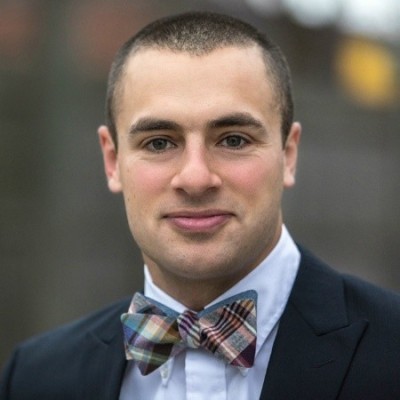
Herscu's insight from 200 discovery calls: nobody is blocked by setting up a single vector database. They're blocked by the hundred things around it. Cake's answer is to own the messy middle.
Kubernetes-based infrastructure with security, cost optimization, and monitoring handled.
Curated open-source AI/ML components, wired together and continuously updated.
A modular, open-source stack you can customize for the last-mile problems that matter.
Herscu graduated from Harvard College in 2013 with honors in physics - a discipline that rewards staring at messy systems until the underlying structure shows itself. He didn't sprint straight to startups. He spent about eighteen months in consulting at Altman Vilandrie to learn how businesses actually work, then took an analyst seat at BookBub.
The pivot was deliberate. He enrolled in General Assembly's Web Development Immersive and came out the other side a full-stack engineer - TypeScript, JavaScript, Python, React, Node, the works. His earliest public GitHub repositories are exactly what you'd expect from someone learning in the open: a React tic-tac-toe game, a "togetherness" Rails-and-Ember app. Charming, and a long way from orchestrating enterprise AI.
In 2016 he founded McCoy Medical Technologies, aimed at threading AI into the daily workflow of physicians. It became EnvoyAI, a marketplace for AI in medical imaging, and in 2018 TeraRecon acquired it - the kind of outcome that recalibrates what a person thinks is possible. The venture was recognized as an AuntMinnie Best New Vendor.
Then a stretch as a software engineer at Tone, and a role that quietly set up everything since: Operator in Residence at Primary Venture Partners. There he ran more than 200 customer-discovery calls, asking teams the same blunt question over and over - what is your biggest bottleneck? The pattern that emerged became the thesis for Cake.
Graduates Harvard with honors in Physics.
Consulting at Altman Vilandrie; analyst at BookBub.
Codes up at General Assembly; founds McCoy Medical Technologies.
EnvoyAI acquired by TeraRecon. AuntMinnie Best New Vendor.
Engineer at Tone; Operator in Residence at Primary.
Co-founds Cake with Skyler Thomas.
$13M seed led by Gradient. Out of stealth.
Two hundred conversations before committing to a product. The discipline of asking rather than assuming is rare enough to be a moat.
"Our sweet spot is definitely when companies are going beyond what you can do with a simple, off-the-shelf product."
"It is actually easier for us if we can control the cloud." Counterintuitive, until you've felt the pain of supporting every config.
Herscu personally led an early healthcare partnership that went from concept to live in under three weeks.
"The biggest problem wasn't a single part of the stack. It was that there are a ton of different components across a very rich ecosystem."
"From a traction standpoint, we look more like a Series A company already."
"I did over 200 customer discovery calls, asking what their biggest pain points and bottlenecks are."
"We do run the gamut, but our sweet spot is when companies go beyond what an off-the-shelf product can do."
"It is actually easier for us if we can control the cloud."
"We haven't been super secretive; we've just been building."