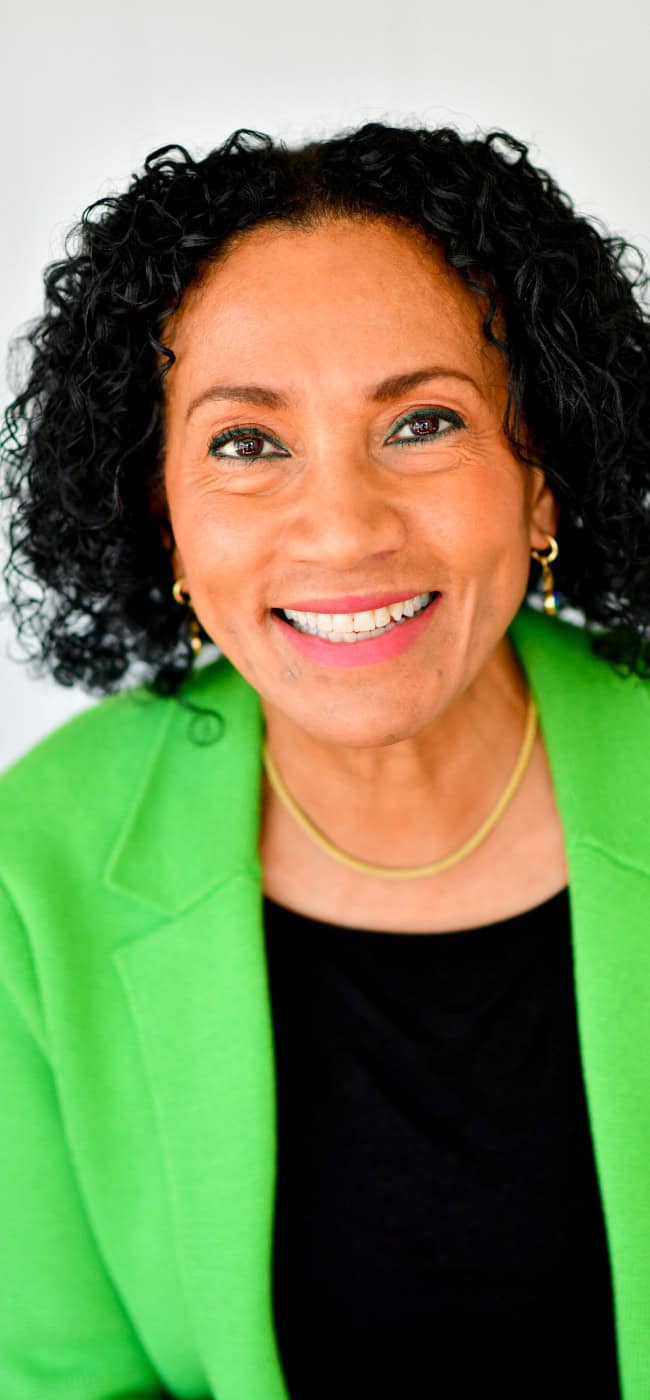
The list of people who have worked alongside Larry Page and Sergey Brin in Google's
earliest days, then walked away from the General Counsel role, then co-founded a
seed-stage VC firm that backed Palantir before most people could
spell it - that list has exactly one name on it.
Miriam Rivera grew up speaking Spanish first, picking crops in upstate New York with
parents who had migrated from Puerto Rico. Her family eventually settled in Chicago's
inner city so she and her sister could attend school consistently. Sesame Street
taught her English. She was identified as gifted in middle school, shipped off to
Phillips Exeter Academy on scholarship, earned an AB in Sociology at Stanford,
then came back for a master's in Spanish and Caribbean literature because she
was going to be a professor.
Then she changed her mind. Again. Then again.
"People who hunger to be successful for more than just themselves are almost always in a better spot than somebody who is just thinking of Number One."
- Miriam Rivera
The detour through Accenture, then a JD/MBA at Stanford Law and Business simultaneously,
then Brobeck Phleger as an associate, then co-founding a startup with the man who would
become her husband - Clint Korver - then Ariba, and finally a cold call into Google
as its second attorney ever hired. The year was 2001. Google had
about $85 million in revenue. Rivera left in 2006 when the number was $10 billion.
The Google Chapter: Rules, Scale, and a Maternity Leave Policy
Inside Google, Rivera ran an unconventional legal operation. She eventually
built a team of roughly 150 people - 50% of them women, a ratio that felt
almost radical in the Valley at the time. She designed what she called
"revenue velocity" - a systematic approach to contracts that helped scale
Google's self-service advertising and syndication engines. The number she
was responsible for: $14 billion in revenue.
There is a policy at Google today around extended maternity leave. It did
not start as company policy. It started when Rivera quietly offered up to six
months' leave to new mothers on her own legal team - twice the standard three
months the company offered. She tracked the retention data. She brought it
upstairs. Google formalized the policy company-wide. The detail that lingers:
she was not asked to do this. She just did it and proved the math.
In 2006 she was offered the Google General Counsel role. She turned it down.
Most people do not turn down the Google General Counsel role. She took personal
time instead, and then asked herself what she actually wanted to build.
"My career advanced most quickly after I became a mother."
- Miriam Rivera
Why "Ulu"
In 2008, Rivera and Korver co-founded Ulu Ventures in Palo Alto. The name is
Hawaiian for breadfruit - it also carries the meaning "to grow, to inspire,
to be possessed as if by a spirit or god." The couple had fond memories of
Hawaii. The name stuck.
The thesis was simple, if not easy to execute: most VC decisions are soaked
in cognitive bias. Ulu would build a data-driven, rules-based investment model
to reduce that bias systematically. Not as charity, not as diversity theater,
but as competitive advantage. If you remove the filters that
eliminate great founders before anyone meets them, you see more of the market
than your competitors.
The early days were not smooth. When Rivera was raising capital for Fund I,
a seasoned VC told her that venture capital was "a young man's game" when she
asked for a limited partner referral. She has spoken publicly about that
moment - not bitterly, but as evidence of precisely the bias she was setting
out to defeat with math.
The Unicorn Ledger
Ulu Ventures Fund I returned 5x to its investors. That number is not a
coincidence. The portfolio includes ten companies that reached unicorn
status: Palantir (now in the S&P 500), Guild Education, SoFi, BetterUp,
Figure, Provenance, ZUM, HomeLight, Everlaw, and Krux - acquired by Salesforce
for $700 million. Blue River Technology, acquired by John Deere for more than
$300 million, adds to the exit column.
These were seed-stage bets. Not late-stage, not series B where the pattern
is already obvious. Rivera was in the room before the narrative crystallized.
"We're not sacrificing anything by investing in women and minorities. Our ability to look at startups objectively and pick the ones with great potential makes us a top-performing fund."
- Miriam Rivera
The Portfolio as Argument
About 80% of Ulu's portfolio companies have a founder who is an immigrant,
a woman, or from a minority group. This is not a marketing statistic. It is
the direct output of a process designed to evaluate founders without the
filters that traditionally narrow who Silicon Valley is willing to back.
Thirty-eight percent women CEOs. Twenty-nine percent minority CEOs.
Nineteen percent immigrant CEOs. The performance data is the argument.
In February 2025, Ulu Ventures announced Fund IV at $208 million, doubling
total AUM to roughly $400 million. The firm is no longer proving a thesis.
It is running a playbook that works.
The Full-Circle Moment Nobody Writes About
A Puerto Rican girl in Chicago learned to speak English by watching Sesame Street.
In 2022, Miriam Rivera joined the Sesame Workshop board of directors and took the
chair of its HR and Compensation Committee. There is no cleaner narrative arc in
Silicon Valley, and Rivera does not over-explain it.
She is also a Stanford University Trustee, holds the Stanford Medal (awarded
to fewer than 1% of alumni), co-founded Stanford Angels and Entrepreneurs,
and sits on the Kauffman Foundation board. She has four Stanford degrees across
several decades, including a simultaneous JD/MBA - a detail that reads less as
achievement-stacking and more as the logical result of someone who kept changing
her mind about what to do next.
She and Korver also designed Ulu's rules-based investment process partly to
prevent disagreements from spilling into their marriage. The fund is, among
other things, a functional prenuptial agreement for founders.
"When you see those opportunities, jump on for the ride, get involved."
- Miriam Rivera