A donation is a deceptively small event. Someone taps a screen. Money moves. But inside a church, that gift also becomes a record, an accounting entry, a statement, and a responsibility. The donor sees a moment of generosity. The administrator sees several systems that ought to agree. Ministry Brands has made a business out of the distance between those two experiences.
- Software for the people doing the work behind church life.
- Amplify connects giving, member records, accounting, websites, and more.
- The business grew by bringing specialist church technology brands together.
It is an unusually revealing corner of the software market. Churches need databases, payment processing, websites, and payroll, much as other organizations do. They also need volunteer screening, worship schedules, and financial records that distinguish money reserved for one purpose from money available for another. A generic business application can get close. The remaining distance is where this company works.
A company built in the gaps
The origin story begins in 2012, when Ross Croley met Ben Sealey, founder of the online giving business SimpleGive. SimpleGive became Ministry Brands’ first brand. In a 2015 interview, Croley described a market divided among website vendors, giving providers, membership systems, and accounting tools. Each solved a problem. Churches were left to connect the answers.
His diagnosis was concise: “the technology didn’t integrate with other solutions.” The early response was to bring businesses together, including Shelby Systems, an established church software provider acquired in 2015. The strategy offered something a new application alone could not: existing customer relationships and expertise in the particular habits of church administration.
“the technology didn’t integrate with other solutions.”
Ross Croley, describing the original problem in 2015
The ownership changed, too. Reverence Capital Partners announced a majority investment in November 2021; the transaction closed that December, separating Ministry Brands from Community Brands. Terms were undisclosed. Calling that deal a conventional startup funding round would obscure the story. This was capital backing an established collection of software businesses.
One congregation, fewer handoffs
Today, Amplify is the clearest expression of the original idea. Ministry Brands describes a platform with one member database, one giving record, and one login. Churches can select modules rather than buy every capability at once. Websites and streaming joined the platform in May 2023, extending its reach from internal administration to the congregation’s public front door.
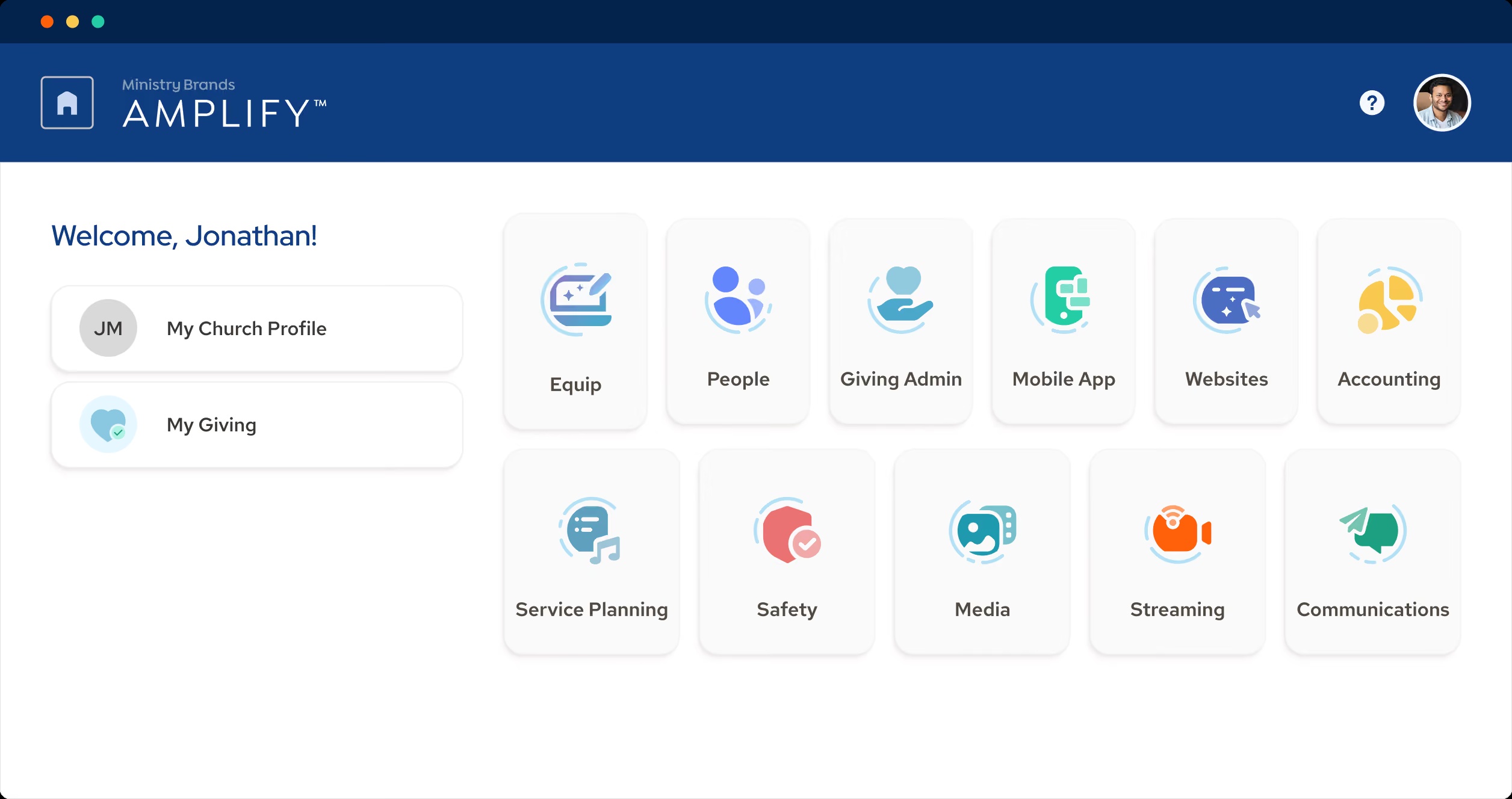
People, its membership module, brings attendance, directories, events, and giving information together. Accounting addresses restricted funds and clergy payroll. Those details matter: a church treasurer needs more than a total bank balance. The practical attraction is less time translating information between applications, with records organized around the institution’s actual responsibilities.
The wider portfolio serves different institutions. ParishSOFT addresses Catholic parishes; DonorDirect handles nonprofit donor relationships; Protect My Ministry supplies screening capabilities. Customers include pastors, finance teams, communications staff, and volunteer coordinators. Ministry Brands says it serves more than 90,000 churches and nonprofit organizations across its business. Its Amplify page separately cites 55,000 organizations. Those are different scopes, not interchangeable totals.
- 01GiveA donor contributes
- 02RecordA giving record
- 03ReconcileAccounts agree
- 04AcknowledgeA donor hears back
When the payment stalls
The most instructive product may be one a donor never notices. In August 2023, Ministry Brands introduced DonorShield to address intermittent failures and outages at third-party payment processors. A payment failure can create uncertainty as well as delay: did the gift go through, and will trying again create a duplicate?
DonorShield was designed to detect duplicate payments and queue donations during outages. It checks for recovery, processes queued transactions when the system returns, and sends confirmation. The announcement identifies a failure mode, rather than documenting a particular first outage. The lesson is useful beyond churches: design what happens when a dependency stops answering, including the message the customer receives afterward.
Money going out deserves the same attention. An August 2025 partnership with AvidXchange brought accounts-payable automation and electronic payments into the offering. Its stated rationale was practical: reduce manual work, improve payment visibility, and reduce reliance on paper checks. Donations arrive through modern payment tools; supplier bills should not require a separate expedition through paperwork.
What the convenience costs
Ministry Brands combines subscription software, payment services, screening, and professional support. Amplify pricing depends on the organization and selected modules. A useful comparison therefore starts with the complete proposed bill: subscriptions, processing, implementation, and the staff time needed to move records and learn the system.
Equip, launched in July 2026, provides a more visible price point. Its published monthly plans are $39, $79, and $129, with different credit allowances and unlimited team members. The AI tools support sermon preparation and turn messages into material such as devotionals, study guides, and social posts. These prices cover Equip plans, not an entire Amplify installation.
Planning Center and Pushpay also offer church giving and management tools. Ministry Brands’ case rests on the breadth of its church-specific operations, including accounting and safety, alongside the wider specialist portfolio. Breadth deserves a demonstration. A buyer should trace an actual task through the proposed modules, checking where staff must still export a file or enter information twice.
The hour you get back
There are limits to what integration buys. A small congregation with simple records may gain little from a broad installation. Moving inconsistent data into a shared system will still require decisions about which records to trust. Screening tools support safeguarding; staff must still train people and act on concerns. Equip likewise depends on pastoral review of what it produces.
In June 2026, Ministry Brands announced a new headquarters in Milton, Georgia, with space for collaboration and customer gatherings. In September it announced another free Healthy Church Summit, building on a series it said had reached more than 10,000 leaders. Software is only part of the relationship it is selling.
The useful idea to copy is modest: follow one piece of work across the whole organization. Find the point where somebody becomes the bridge between two systems. Then decide whether that bridge needs better software, a clearer process, or both. For a church, the reward can be wonderfully ordinary: an administrator finishes the records and has time left for a person.