The collection plate is a wonderfully simple interface. Put money in it. Pass it along. Its limitations appear later, when somebody has to count the money, identify the donor, assign the gift to a fund and enter it into the books. A payment has happened. An afternoon of administration may still be waiting.
- Vanco connects giving and payments to church and school administration.
- Recurring gifts reduce the need to remember every contribution.
- Its pricing combines processing fees with plans and optional tools.
- A December 2025 deal brought ACS Technologies into the business.
Vanco occupies that less picturesque end of generosity. It supplies the digital equivalent of the plate, certainly: online donation pages, mobile giving, text-to-give and card payments. But the interesting part is the connection between the person making a payment and the person responsible for explaining it. The same problem turns up in a school office. A parent pays. Which child? Which fee? Which account?
Seen this way, Vanco’s choice of customers makes sense. Churches, nonprofits, schools and childcare centers all collect money in circumstances where the relationship outlasts the transaction. A donor returns next month. A student returns next semester. The software needs a memory.
01 / A payment with a memory
For a church, Vanco can put a giving page on the website, let members choose a recurring schedule and provide reporting through MyVanco. Its mobile app offers another route to participation; text giving offers another route to a gift. The company advertises more than 60 church management integrations. That last number is particularly revealing. Vanco wants to fit into an institution’s existing machinery.
Think of the buying decision as two demonstrations. In the first, somebody makes a donation. In the second, an administrator finds it, checks its designation and follows it into the relevant records. The first demonstration may be over in a minute. The second tells you whether the product will save time every week. A handsome button has never balanced a ledger.
or parent
or school store
processing
record
Ask to see the final step in your own software.
This is Vanco’s place in the market: specialized payments attached to specialized administration. Expertise means understanding both bank transactions and the vocabulary around them. A church fund, a lunch balance and a class registration are all payments. To the people doing the work, they are three different obligations.
02 / The congregation that stopped starting over
CDO Church House of Prayer in National City, California, supplies a useful example. In Vanco’s account, the bilingual congregation had too few gifts set up automatically after switching processors. Staff handled one-off donations, while inconsistent giving made budgeting harder.
The church introduced recurring giving through online, mobile and text channels, with bilingual options and implementation coaching. Vanco reports a tenfold increase in recurring givers. That measures participating givers, not a tenfold increase in revenue. It is a vendor-published result, rather than an independent experiment.
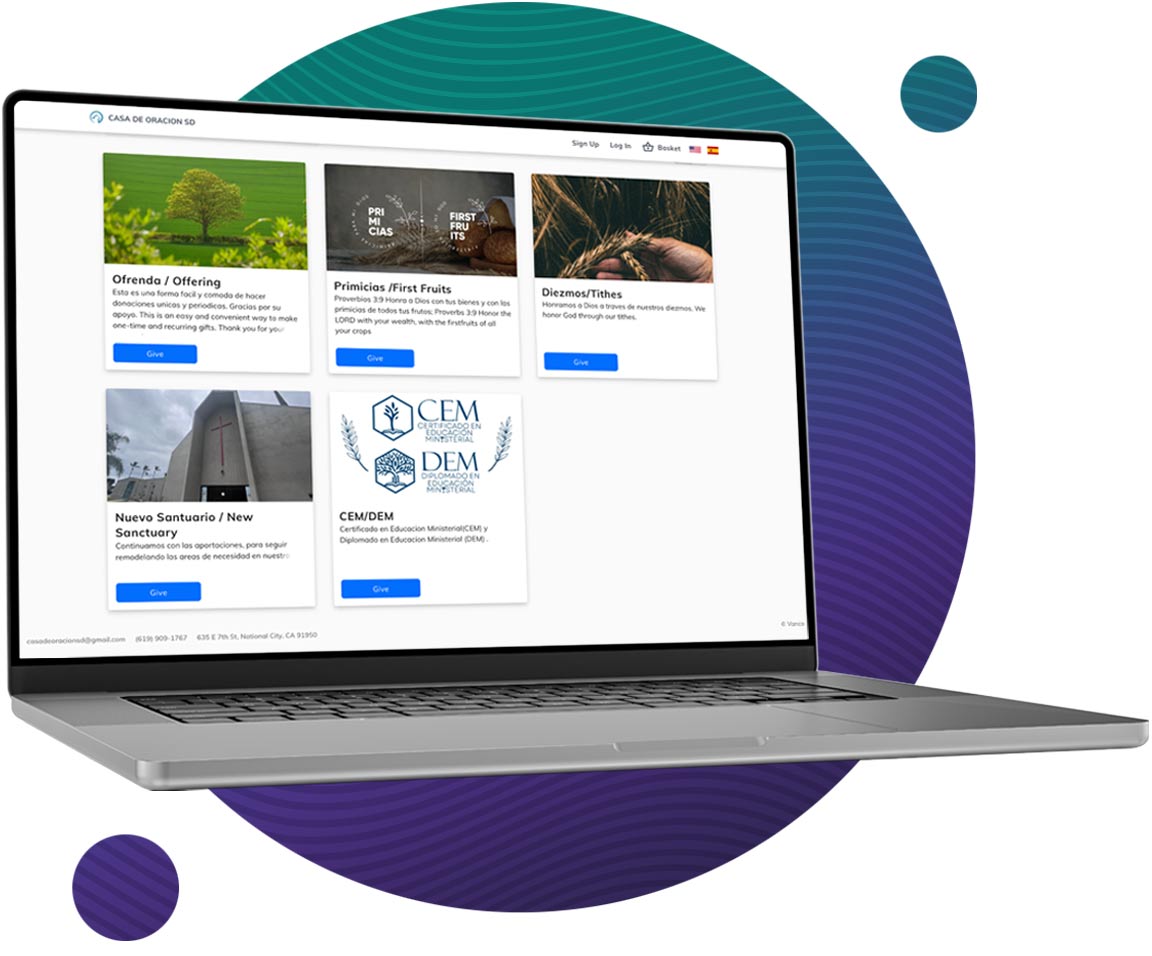
The lesson is practical: make repetition easy, in the language people use, and help them start. A church can copy that sequence without copying every product choice. Explain the purpose of the gift. Demonstrate enrollment. Make help available. Then check whether people actually completed the setup.
Recurring giving also changes the job of a reminder. Instead of asking somebody to repeat the mechanics of donating, the organization can spend more time explaining what the money supports. Automation handles a schedule. Trust still requires human attention.
03 / The arithmetic beneath the amen
Vanco earns money through processing fees, software plans and optional services. Its published church giving prices list Grow at $0 per month and Thrive at $54. Standard card rates are 2.90% plus $0.45 for Grow, and 2.65% plus $0.39 for Thrive. Grow’s ACH rate is 1.00% plus $0.45.
Illustrative transaction fees from published rates. Excludes batch fees, add-ons and exceptions.
A $100 standard card gift therefore incurs $3.35 in processing fees on Grow; the same gift by ACH incurs $1.45, before additional charges. Multiply that $1.90 difference across a recurring program and the payment method becomes a budget decision.
There is no contract or cancellation fee advertised for these giving plans. But the bill can include onboarding-related monthly charges, PCI non-compliance fees, chargebacks, ACH returns, daily-batch transaction fees, hardware and optional modules. American Express has a different rate. Prices can change.
The sensible comparison starts with your actual payment mix. How many gifts are small? How many arrive by bank transfer? Which extras will staff use? A percentage alone cannot answer those questions. Neither can a monthly price presented in reassuringly large type.
04 / Why a church processor went to school
Vanco Services began offering ACH payments in Minneapolis in 1998. Veracity Payment Solutions acquired it in 2014, and the combined Vanco Payment Solutions brand launched in January 2015. This is an assembled business with older roots than its current name suggests.
The October 2018 merger with Connexeo widened the frame. Connexeo brought education administration, music programs and event-related software into the combination. Great Hill Partners owned the resulting business. Earlier that year, Connexeo had received a $110 million growth investment from Great Hill; that was investment in Connexeo, not a disclosed price for the Vanco merger.
Accept electronic bank payments.
Connect payments with education administration.
Bring church management and payments together.
Today, RevTrak handles online school payments, including fees and meal accounts. ASAP handles community education registration and class management. Smartcare covers childcare administration, including attendance and billing; Vanco announced that acquisition in January 2021. Event tools add ticketing, seating and attendance.
PowerSchool and Skyward integrations show what the education proposition looks like in practice. Families can pay within a familiar school software environment, while staff get a route to reconcile the money. The parent wants one place to pay. The finance office wants records it can use. Both are reasonable requests, and neither is satisfied merely by accepting a card.
05 / The partnership that moved in
In June 2024, Vanco expanded its giving platform with Smart Video, Outreach and Insights modules. Searchable sermon libraries, communication tools and donor analytics moved the offering further into the relationship surrounding a gift. Payments were becoming one part of a broader church software service.
The larger organizational step arrived in December 2025. Vanco acquired ACS Technologies after more than a decade of partnership. Their announcement reported combined reach above 40,000 churches and ministries. Vanco’s faith business would operate under ACS Technologies, with payments connected to platforms including Realm and MinistryPlatform. Education solutions would operate under RevTrak.
The stated rationale was fewer handoffs and clearer responsibility when customers need help. That is a revealing ambition for a software acquisition. An institution may have excellent products and still spend too much time deciding which supplier should answer the question.
“It’s a relief to know I have a partner who really understands us”Matt Baringer, Xperience Church administrator pastor, in a Vanco-published customer story
Support is part of the product here. Vanco describes implementation specialists, giving coaches and ongoing assistance. Its own workplace descriptions include paid volunteering and opportunities for staff participation. Those are the company’s account of its culture; the customer-facing test is more concrete. Can someone explain the workflow, help launch it and resolve a problem?
06 / Buy the whole journey
Vanco has company in this market. Pushpay combines giving, church management and apps. Planning Center Giving sits within the Church Center ecosystem. Online giving and recurring donations are widely available. Vanco’s case rests on its particular integrations, payment expertise and assistance with adoption.
That proposition has conditions. A connection to software you do not use has little value. A recurring gift program needs willing participants. An analytics module needs someone with time to act on it. If the objective is simply occasional card collection, a broader administration suite may offer more machinery than the task requires.
Before choosing, ask the vendor to follow one real kind of payment through your institution: the designated gift, the sibling’s lunch payment, the refunded event ticket. Check the records, the exception handling and the total cost. Then let an actual staff member try it.
Vanco’s useful insight is that collecting money and managing money are connected jobs. The collection plate was elegant because everyone knew what to do next. Digital payments deserve the same courtesy, including for the person left holding the books.