A donation can disappear for a wonderfully dull reason: the card expired. The donor still cares. The church still needs the money. Somewhere between those two intentions sits a payment system, quietly declining the transaction. Pushpay built its business around removing obstacles like this. Then it began buying companies that addressed a larger question: what else disappears when a church’s records cannot talk to one another?
- Giving opened the door; church management widened it.
- Two acquisitions cost $237.5 million combined.
- Catholic records demanded a product of their own.
- Pastoral care is the next test of connected data.
The offering plate acquires a back office
Chris Heaslip and Eliot Crowther founded Pushpay in Auckland in 2011. The iOS giving app arrived in August 2012; Android followed a month later. The proposition was straightforward: make donating from a phone quick enough that the machinery does not interrupt the impulse. Churches became the company’s particular territory.
Today, Pushpay sells software subscriptions and payment processing to churches and mission-based organizations. Giving sits beside people records, volunteer schedules, child check-in, groups, apps and reporting. This places it in a specific corner of the market: financial technology attached to the daily administration of religious communities. A generic checkout can take a payment. It has rather less to say about who is staffing the nursery.
The decisive expansion came in December 2019. Pushpay bought Church Community Builder for $87.5 million in cash, funded partly through a $62.5 million debt facility. The businesses already had a two-way integration. Buying the management system meant Pushpay could sell more of the work surrounding a donation: the relationships, activities and records that make a congregation function.
Buying the rest of Sunday
ChurchStaq launched in 2020, combining giving, management and engagement. Then came Resi. The $150 million streaming acquisition closed in August 2021, as churches were learning to meet through screens. Pushpay’s annual report explicitly linked the purchase to demand for digital content and engagement during COVID-19. More than 70% of Resi’s roughly 3,900 customers at acquisition did not already subscribe to a Pushpay product.
That is an acquisition with two uses: additional software for existing customers and an introduction to customers who arrived through another door. Resi provides live and on-demand video. Member apps can carry sermons, giving, group messaging and volunteer arrangements. The company was assembling the parts of a Sunday that continue after everyone leaves the building.
ParishStaq, launched in 2022, added a different kind of specialization. Catholic parishes need household and sacramental records, certificates and diocesan oversight. In September 2026, Pushpay announced that Detroit’s archdiocese would adopt ParishStaq as its standard parishioner and sacramental record system. The archdiocese comprises 209 parishes and pastoral centers. Here, a baptism certificate is a product requirement, not an exotic feature request.
The offer that needed a second Sunday
Expansion did not make every forecast come true on schedule. In November 2022, Pushpay lowered its expected FY2023 revenue growth from 10-15% to 4-8%, while describing the year as one of investment. Historical FY2022 operating revenue was $202.8 million. That number measures the company’s business, not the donations moving through it.
Its sale also encountered resistance. The first scheme failed the shareholder vote on March 3, 2023. Revised terms offered NZ$1.42 per share to most shareholders, with NZ$1.34 retained for a specified group. The second vote passed in April; the transaction was implemented on May 19. Entities associated with BGH Capital and Sixth Street took Pushpay private. The price changed. The vote changed. That is enough explanation without inventing anyone’s private conversion.
A name behind every row
The next purchase brought the company closer to the purpose of its customers. In April 2026, Pushpay acquired Nurture, founded by former executive pastor Luke Denton. Nurture combines signals from attendance, giving, groups and serving, then directs follow-up to the appropriate leader. Its acquisition announcement commits to continued integration with other church management providers.
“Because the gap was never the data. It was always what happens after you see the data.”Luke Denton · Nurture acquisition announcement
This is the interesting distinction in Pushpay’s strategy. Reporting can reveal a pattern; somebody must still own the response. A lapse in attendance may deserve a conversation, though it cannot explain itself. Nurture’s promise is to make that conversation more likely by connecting the evidence and assigning the next step.
- 01ConnectGiving, groups, attendance
- 02NoticeA change in participation
- 03AssignA leader owns follow-up
- 04RespondA human conversation
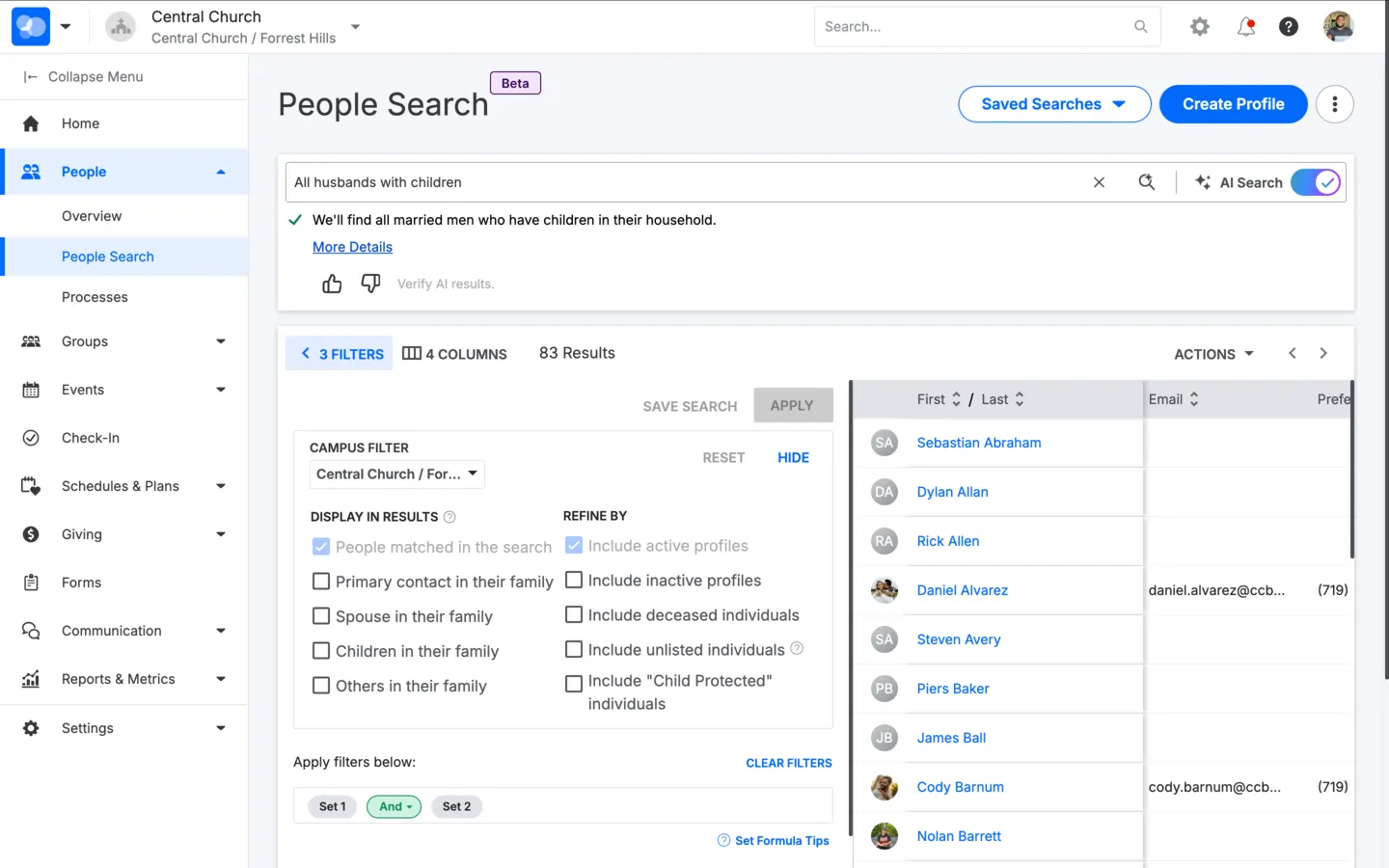
September’s product announcement takes a similar approach. AI Profile Summaries assemble giving, attendance, serving and staff notes into a briefing. Workflows began rolling out to replace legacy Process Queues. Single Staq Giving updates were intended to reduce reconciliation between management and giving records. These are administrative interventions whose value depends on the quality of the records underneath them.
Price the whole Sunday
Pushpay’s commercial advantage is the breadth of connected church-specific tools. Its public pricing page lists Core, Advanced and Complete packages and directs buyers to sales for prices. Churches should price subscriptions, processing, implementation and staff time together. Eligible pre-launch church plants can apply for a twelve-month no-cost technology grant.
Alternatives include Planning Center’s modular approach, Tithe.ly’s giving and management products, and open-source Rock RMS. Pushpay also integrates with competing tools. A church needing only basic donations may find a broad suite excessive. A larger ministry juggling disconnected records has a stronger reason to investigate it. Neither a purchase nor an integration will repair neglected data or create staff capacity by itself.
The transferable lesson is modest: start with one recurring irritation, study the work around it, and give the resulting information an owner. Pushpay’s long journey from a phone payment to pastoral care follows that logic. The donation arrives. The record updates. Then someone has to pick up the phone.