Before Mindi Cox became the executive responsible for both people and marketing at O.C. Tanner, she worked on bids and proposals. It is an instructive place to begin. A proposal is a promise with a deadline. It requires a person to understand what an organization says, what it can actually deliver, and where those two things fail to meet. Cox has spent the rest of her career closing that gap.
She joined the Salt Lake City company in 1998 and moved through corporate communications, culture, sales, marketing, and human resources. There was an intermission as a principal at mkc consulting, followed by a return. Today she is the kind of employee she publicly recommends that companies make room for: a boomerang, carrying institutional memory in one hand and an outsider's fresh view in the other.
The nearly three-decade tenure can look, from a distance, like constancy. Up close it is a sequence of different jobs, different questions, and a gradually widening field of view. Cox's career has not been about climbing away from the work. It has been about seeing more of the system around it.
“It's the difference between working with your head down and your head up.”Mindi Cox, on noticing the possibilities around a job
proposals
comms
& return
great work
marketing
The company with an awkwardly high bar
O.C. Tanner sells recognition software, service awards, and workplace-culture expertise. That gives its own people operation an awkwardly high bar. A restaurant can quietly eat somewhere else. A culture company must live with its own cooking.
Cox's unusual remit puts the promise and the practice in the same office. Marketing explains what the company stands for; people operations determine whether employees encounter it on an ordinary Tuesday. Her work has included policies and programs, but her public language repeatedly returns to the direct manager. Culture, she says, lives and scales through frontline leadership. A fine corporate initiative has limited powers against a miserable daily relationship with a boss.
This is why her ideas tend to arrive as verbs. Notice. Explain. Invite. Recognize. Adjust. She has described changing the timing of company meetings for different shifts and staggering ways to join company events. Neither makes a stirring lobby banner. Both answer the decisive question: can the people named in the promise actually use it?
A spark is more useful than a slogan
Cox calls the distinctive contribution a person can make beyond a job description a “soul spark.” The phrase is warm, but the structure beneath it is sturdy. In interviews, she groups fulfilling work around autonomy, competence, and relationships. People need room to exercise judgment, chances to get better, and evidence that they are connected to somebody beyond the task queue.
Her bachelor's degree in journalism and MBA from the University of Utah make an apt pair here. Journalism trains attention outward: What happened? Who is affected? What detail makes the abstraction real? Business school trains the inward machinery: What must change? What does it cost? How will it operate? Cox's career sits at their intersection, forever asking how a human story survives contact with an organization chart.
In 2013, she worked with O.C. Tanner colleagues and outside experts on Great Work, a research project that examined accounts of award-winning work, led to a book, and became an experiential workshop. The subject was not simply performance. It was the conditions under which people look beyond the expected and make a contribution worth remembering.
Enough trust and room for judgment that work belongs, in part, to the person doing it.
The chance to build mastery instead of circling the same narrow task forever.
Connections that make contribution visible and purpose more than a private exercise.
When culture stopped being theory
Every company values transparency while the news is good. The useful test arrives when the news becomes awkward. During the pandemic, Cox drove frequent communication between O.C. Tanner's executive team and more than 1,500 employees. The updates covered operational changes and business developments, including the unfavorable ones.
The approach was consistent with her broader conviction: people can handle candor better than leaders sometimes imagine, particularly when the alternative is a vacuum filled by rumor. Dave Petersen, then O.C. Tanner's president and CEO, called her the cornerstone of the company's organizational structure and said the leadership team relied on her when the status quo was challenged.
Recognition followed. The Stevie Awards had named her a Human Resources Executive of the Year in 2018. Utah Business selected her for its 2022 class of 30 Women to Watch, after earlier honors as an HR Executive of the Year and in its 40 Under 40. In 2023, Silicon Slopes named her Chief People Officer of the Year.
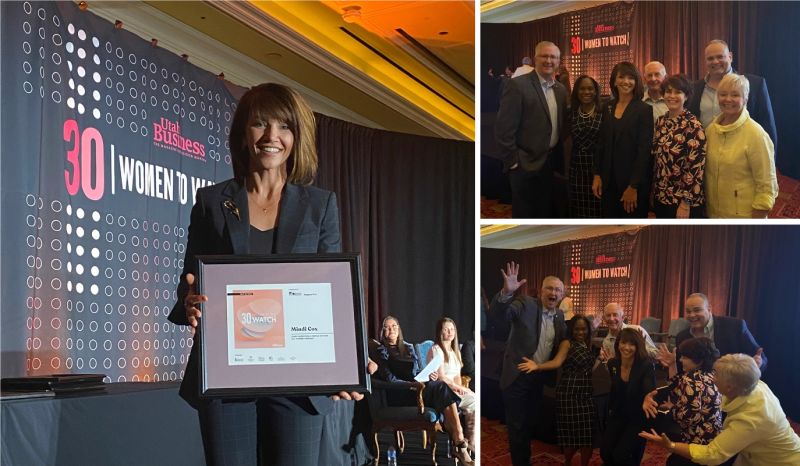
Her acceptance language deflected the solitary hero story. Cox described success as joyful, sometimes difficult work done beside people she enjoyed, at a company they believed in. It was gracious, but also precise: a workplace honor had meaning because the workplace was plural.
Empathy needs an instruction manual
Cox is suspicious of asking leaders to be empathetic without explaining what happens next. Feeling for somebody is not yet an organizational response. Her preferred term is “practical empathy”: listening, understanding where help begins and ends, backing concern with action, and designing systems that let managers respond responsibly.
This matters because personality is a poor implementation plan. If empathy is treated as a trait that some managers naturally possess, an organization can admire it without spreading it. Treat it as a practice and leaders can learn the steps, employees can know what to expect, and boundaries can stop compassion from turning into vague promises.
Her recognition habit is similarly concrete. Cox likes to use the first five or ten minutes of team meetings for shout-outs. The praise should name the contribution and its effect. “Thanks for the hard work” is pleasant fog. Telling a colleague that her process change saved the team several hours proves somebody looked closely enough to see the work.
“Recognition becomes meaningful when it's specific, personal and connected to outcomes.”Mindi Cox, 2026
The boomerang keeps the door honest
Cox's own departure and return give her interest in boomerang employees a personal edge. She argues that former employees are an overlooked pool of talent. They know the systems and language, but they have also seen another way of working. If invited to speak plainly, they can tell a company what is genuinely distinctive and what merely sounded distinctive inside the building.
An open path back also says something about the quality of a workplace relationship. It allows an employee to make a choice without requiring either side to recast the other as a villain. Cox describes returners as potential ambassadors for loyalty and long tenure. Her point is larger than recruiting efficiency: careers and organizations can remain connected without pretending that every departure is betrayal.
That belief extends beyond O.C. Tanner. Cox joined the board of Upwardly Global, which helps immigrants and refugees with international credentials restart professional careers in the United States. She has also served on a board connected to the University of Utah's David Eccles School of Business. Both roles orbit a familiar concern: how institutions recognize capability that a conventional résumé or narrow job slot can miss.
A human test for the machine age
When generative AI entered executive conversations, Cox reached for the word's older meaning. Humans are generative too. They absorb different inputs, synthesize them, and make something new. Her question is whether technology can increase that capacity instead of reducing a person to the operator of an answer machine.
At O.C. Tanner, she has advocated safe access, role-relevant training, and careful attention to data. The goal is not transaction for its own sake. It is augmentation: give people the technology, then help them use it to create, solve, and contribute with more range. This is the soul-spark idea translated for a new set of tools.
In 2026, her writing returned to recognition. Annual gestures are too rare and generic to carry a culture. Gratitude needs to be steady, sincere, shared by leaders and peers, and embedded in the way work gets done. The claim is unfashionably patient. There is no dramatic transformation montage, only the compound interest of paying attention.
Cox began with proposals, those formal documents in which a company describes what it promises to do. Her career since has become a longer proposal to the workplace itself: let people look up, give them room to become capable, keep the door open, and notice what they contribute while it is still happening. Then repeat it tomorrow, when nobody is handing out an award.