At thirteen or fourteen, Mike Yan became absorbed by two subjects that rarely share a syllabus: psychology and card magic. Psychology promised an explanation for why people behave as they do. Magic demanded that he predict where they would look. Yan could sit before a mirror for five hours, repeating one move and checking every angle. He imagined he might become a magician. Instead, he built software whose best work also happens just out of sight.
Manychat, the company he co-founded with Antony Gorin in 2015, automates conversations on Instagram, TikTok, WhatsApp and Facebook Messenger. A customer sees a quick reply to a comment, a useful direct message, an answer, a booking prompt. Behind it sits a sequence of triggers and decisions. The mechanism is elaborate; the desired experience is pleasantly ordinary. Somebody asked. Something helpful happened.
This is Yan's durable idea: the internet may keep inventing grand new interfaces, but people remain devoted to the small rectangle where they talk to one another. Put a useful business inside that rectangle and software begins to feel less like a destination. It becomes part of the exchange.
A child with a toolbox
Yan was born and raised in Moscow. He remembers himself as playful and curious. In first grade, after learning a simple educational programming language, he assembled a booklet of logic and mathematics challenges for classmates. The impulse is recognizable in hindsight: learn a system, then turn it into something other people can use.
A family computer arrived when he was around six. Games such as Quake II and Heroes of Might and Magic III supplied the initial attraction. In high school, playing gave way to making. When he wanted a website, he learned HTML. When he wanted Flash cartoons and games, he learned ActionScript. Technology was a box of parts rather than a feed to consume.
His father was an entrepreneur, and economics or management looked like the expected course. Yan tried it for roughly half a year and found it dull. He moved toward psychology at Moscow's Higher School of Economics. It seemed eccentric to people around him. To Yan, the connection became obvious later: businesses are arrangements of people, decisions and relationships. Products, sales, hiring, partnerships and culture all eventually run into the human mind.
“Psychology sits at the core of everything we do in business.”Mike Yan, Startup Dad interview
Magic supplied a second education. His father's response to the possible career was neither prohibition nor applause. He suggested talking with people already living that life. It was practical advice about testing an imagined future against reality. Yan did not become a professional magician, but the habits stayed: rehearse, observe, consider the audience's view and remove visible friction.
The bot that built bots
In the summer of 2015, Yan and Gorin built Manychat on Telegram, one of the first Western messaging apps to open its programming interface to automated exchanges. The original product was delightfully recursive: a chatbot for building chatbots, with no separate app or website required. Its modesty was an advantage. It entered a behavior already in motion instead of asking users to acquire a new one.
Investors were less immediately charmed. Yan has said the pair were rejected by 40 investors while attempting to raise a seed round. The refusal count makes a good founder anecdote, but the more useful detail is what happened next: the platform changed and the company changed with it. Telegram led to Facebook Messenger, then Instagram, WhatsApp, SMS and TikTok. Manychat did not cling to the original container. It followed the conversation.
In 2016, the founders joined 500 Startups' sixteenth batch. In 2019, Bessemer Venture Partners supplied an $18 million Series A. By 2022, Yan wrote that the business had grown from two co-founders with no revenue to more than 150 employees. Manychat says it now serves more than one million businesses in over 170 countries and powers billions of messages each year.
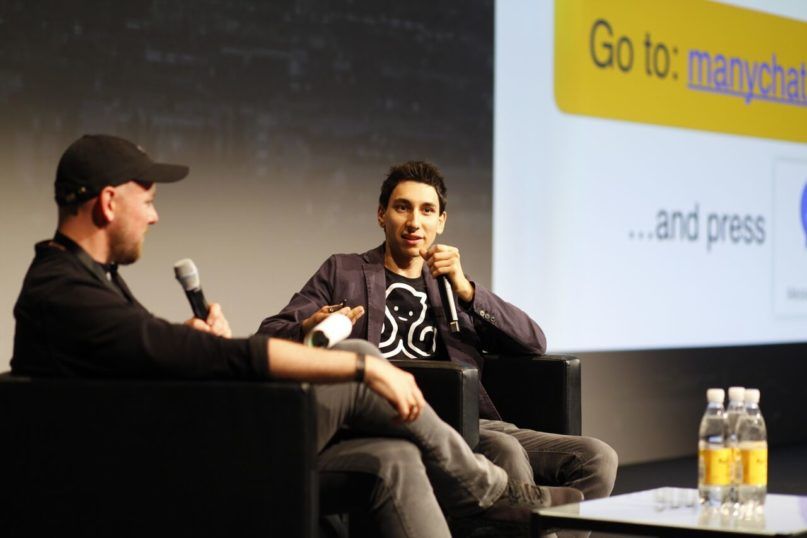
The platform beneath the platform
Every platform-dependent company lives with a peculiar mixture of leverage and vulnerability. A policy change by Meta can redraw the map overnight. An API opens, closes or acquires new rules. The operator's job is partly product design and partly weather reading. Yan's public talks often sound like reports from this shifting climate.
In 2020, he declared that “mobile has eaten the world.” The line was less prophecy than inventory. Customers were already carrying the interface, checking it constantly and preferring its conversational grammar. Manychat's opportunity was to help a business behave appropriately there: respond quickly, remember context, collect permission and hand the exchange to a human when judgment becomes necessary.
Capital for the conversation layer
Selected institutional rounds, shown in proportion. The 2025 raise brought disclosed total funding to $163.3 million.
Instagram made the thesis especially visible. Manychat launched Instagram DM automation in 2021. By its 2025 Instagram Summit, the company reported one million connected Instagram accounts and five billion conversations. The interesting conversion is conceptual as much as commercial: a follower is an audience statistic; a person who starts a conversation has expressed intent.
This is the useful system hidden in the company's pitch. Content gets noticed. A comment or keyword opens a private exchange. Automation handles the predictable turns. A creator or business can then devote attention to the moments that need a person. The promise is not infinite messaging. It is a better allocation of finite human attention.
Leaving the chair, keeping the product
In September 2022, after seven years as chief executive, Yan handed the role to Sunny Manivannan. He remained chairman and head of product. The announcement was unusually specific about the company's condition: break-even, funded, and seeing rapid growth on Instagram and WhatsApp. It was not a departure dressed as succession. Yan kept responsibility for the thing he had been shaping since the Telegram days.
By the close of 2024, Manychat's public materials again called Yan its CEO. The company has not made the intervening loop a grand drama. That restraint suits the story. Founding careers are not tidy ascents. Sometimes an operator changes seats, learns what the company looks like from another angle and returns to the original one.
Yan and Antony Gorin launch Manychat on Telegram.
Bessemer leads an $18 million Series A.
Yan becomes chairman and head of product.
Manychat again identifies Yan as CEO.
Summit Partners leads a $140 million growth investment.
Parenthood also interrupted the mythology of uninterrupted founder availability. Yan has spoken publicly about preparing his team and board for paternity leave, and about the organizational clarity required to make it possible. The lesson fits his wider thinking: alignment saves energy. A company that understands who decides what can survive the founder temporarily looking somewhere else.
AI, with the machinery backstage
In April 2025, Manychat announced a $140 million growth investment led by Summit Partners. The round brought total disclosed funding to $163.3 million. The stated uses were global expansion, research and development, and AI-agent features across new and existing channels. It was a large financial endorsement of the small interaction Yan had been studying for a decade.
“The more useful and effective our technology becomes, the more our customers can focus on delivering exceptional value in their space.”Mike Yan, 2025 funding announcement
That sentence places a useful limit on the AI ambition. The technology is not the performance; the customer's work is. A creator wants to make, teach or sell. A shop wants to answer questions and book orders. The agent earns its place by making those activities easier, not by demanding admiration for the model beneath them.
Yan's childhood interests now look less like colorful biographical garnish and more like an operating manual. Coding taught him to construct the sequence. Psychology taught him to ask why a person might enter it. Magic taught him that the mechanism should not spoil the effect. His current leadership profile describes intense, honest debate, open context and a balance of high expectations with trust and fun. It sounds like somebody still checking the move from every angle.
The platforms will keep moving. The vocabulary has already traveled from bots to automation to agents. Yet the durable product remains almost comically old-fashioned: a good exchange at the right moment. Manychat's wager is that software can make more of those exchanges possible without making them feel manufactured. Scale changes the backstage equipment, but it does not change what the person at the other end came to accomplish. Yan has spent ten years arranging the trick. The audience just wants a reply.