Mikael Yang’s first online customers paid to find out how they had been fooled. He sold card-magic lessons: watch the trick, visit the website, buy the explanation. Years before he would help businesses automate their replies, he had a modest business built around a very reliable human response. Somebody sees something interesting and wants to know more.
The business was an online magic school, started with friends while he was at university. He later sold it for a small sum. At nineteen, the sale felt consequential. It put a price on something he had made and suggested that an interest could become a product. He would go on to build entertainment apps and messaging software. The question of what makes an audience act would stay.
Today Yang, also known professionally as Mike Yan, is the co-founder and CEO of Manychat. His company makes software for conversations between businesses and customers. Its territory includes the Instagram direct message, the WhatsApp exchange and the Messenger reply. These are intimate little spaces in which to build a company. A message arrives beside messages from people you know. The business has to earn its place there.
A small business in disappearing cards
His early ventures were more interested in amusement than commerce. YouComedy, developed in 2011, combined entertaining content with social features. Then came Banaan, a GIF app launched in 2014. Yang described its browsing experience as swiping through jokes. There are less pleasant ways to spend an afternoon, though pleasant afternoons do not necessarily pay the people building the app.
He had users, and he had experience managing a team. What he lacked was the kind of viral distribution that could sustain a consumer business with very little advertising revenue per person. The entertainment products taught an inconvenient distinction: people can enjoy what you make without introducing enough other people to it. Retention and distribution were separate problems, each capable of spoiling the arithmetic.
Yang graduated in psychology from HSE University in 2013. His later explanations of business repeatedly returned to people: the customer’s problem, the relationships inside a team, the founder’s willingness to examine an uncomfortable fact. A degree does not explain a career by itself. Still, his preferred questions often sound closer to an inquiry into behavior than a celebration of software.
“A founder is always the bottleneck of their business.”
Mikael Yang
A bot that could make another bot
In 2015, Telegram opened its bot platform to developers. Yang wanted a simple way to broadcast content through the messaging service. Making a bot himself involved more infrastructure than the modest task seemed to warrant. He and his co-founder, Antony Gorin, built a tool that let other people make bots. The first useful product took about a week.
There was an appealing economy to the idea. A person who wanted to publish through Telegram could create a bot without first becoming a software developer. The tool itself worked inside the messenger. Even the machinery for making a bot was a bot. For anyone who has ever abandoned a project halfway through setting up a server, the attraction requires little explanation.
By October 2015, the project had reached about 20,000 bots. Yang later put the following month’s figure at 30,000. The growth helped get the team into 500 Startups. He joined the accelerator in January 2016, bringing an experiment in messaging into a setting where it would have to become a business.
Getting to the accelerator interview supplied its own small farce. Yang had allowed extra time for the journey from Palo Alto to San Francisco. A flat tire consumed the margin. With help from friends, a tow truck and an Uber, he arrived five minutes before the meeting. He recalled being accepted the next day. The product had traction; the car had been less cooperative.
Then Facebook opened Messenger to developers in April 2016. Yang and Gorin faced a decision made harder by their progress. Telegram was already working. Facebook offered access to businesses that had established pages and audiences. They chose to build there, launching Manychat for Messenger in May. A founder can become attached to a growing product. Yang’s next market required loosening that attachment.
The reply mattered more than the performance
The early bot boom invited elaborate demonstrations. Yang’s pitch was practical: help a business acquire a lead, continue a conversation or answer a customer. He reduced the distinction to three words: “businesses want results.” A piece of software could be clever and still leave the person paying for it wondering what had improved.
One of the growth tools made the proposition easy to understand. Someone commented on a Facebook post with a keyword; a bot could reply through Messenger. The business had a route from public interest to a direct exchange. Yang stressed that the person needed a reason to participate. The technology could deliver an offer. It could not make an uninteresting offer desirable.
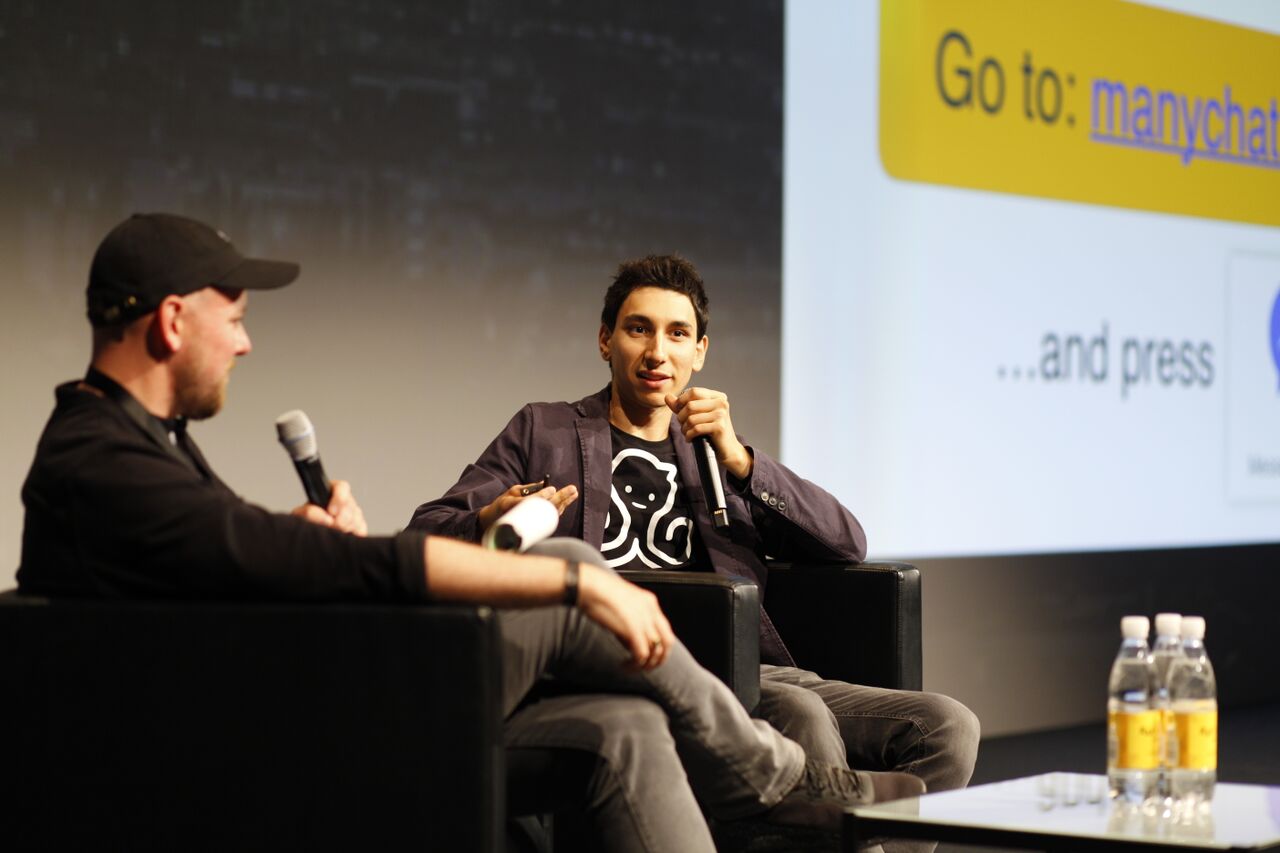
The distinction also shaped his view of the audience. In a 2018 discussion of Messenger marketing, Yang explained why the customer’s control over the interaction mattered. He expected engagement figures to become less striking as more businesses entered the channel. That was a useful qualification from someone selling access to it: a new communications habit could create an opening without suspending the consequences of sending people things they did not want.
His public advice eventually made room for a person to take over. At the 2022 Instagram Summit, he argued for combining automated responses with live chat. Automation could handle routine exchanges and help identify the next useful step. A human conversation could deepen a relationship. That division of labor suits the everyday awkwardness of customer service, where a simple question sometimes turns complicated halfway through the answer.
Manychat’s own community mattered as well. Yang credited users with helping the company spread in its early years. Marketers learning a new channel could teach one another what worked. A product that lets people build their own workflows has an advantage here: each customer’s experiment can become another person’s example. The founder no longer has to supply every demonstration himself.
Five minutes, accounted for
For a revealing glimpse of Yang away from a funding announcement, consider his timekeeping. In a 2020 conversation about planning, he described logging his activities in five-minute increments. It is a rather exact way to discover that an afternoon has gone missing. Most of us prefer the softer accounting category of being busy.
He compared the exercise to an athlete reviewing footage. The point was to see what had happened and improve the next attempt. His advice involved choosing what to eliminate as much as deciding what to add. A new hobby or another language could not occupy an imaginary spare day. It would need time already being used for something else.
The interval Yang used to record his activities. A small unit for an honest look at a whole day.
There is a family resemblance between that habit and his software. Repeated questions, like unexamined minutes, can accumulate without announcing their cost. Making the pattern visible creates a chance to change it. The resemblance is an interpretation, but an apt one for a founder whose work concerns what happens to attention after somebody asks for it.
Passing the chair, keeping the product
In September 2022, Yang announced that Sunny Manivannan would become CEO. Yang would remain chairman and head of product. It was a specific change of responsibility after seven years, with the founder retaining a direct role in what the company made. By his account, Manychat then had more than 150 people and had reached break-even.
His retrospective included forty investor rejections during the seed fundraising effort and the later $18 million Series A from Bessemer Venture Partners. Put side by side, those facts resist the polished version of a company’s beginnings. A financing announcement has a date. Rejection tends to arrive as a series of ordinary appointments, each taking another piece of the week.
By 2025, Yang was publicly identified as CEO again. That March, he also discussed becoming a father and preparing his board and executive team for parental leave. The conversation added another dimension to the familiar founder question of delegation. The company needed to work when he was attending to a life outside it. Even a five-minute log cannot give one person a second calendar.
The next conversation
On April 22, 2025, Manychat announced a $140 million growth investment led by Summit Partners. The announcement described a profitable company serving more than a million businesses in over 170 countries. Those are dated figures, but they establish how far the enterprise had traveled from the Telegram prototype. The customer was now as likely to be a creator working through social media as a conventional business.
April 2025
Reported April 2025
Yang’s stated ambition was to simplify emerging technology so customers could concentrate on their own work. The new money was intended to support expansion, research, customer support and AI-agent development. Manychat had introduced its AI offering in 2024. The vocabulary had changed considerably since a bot for making bots, while the proposed benefit remained recognizable: fewer technical obstacles between a person and a useful exchange.
Later in 2025, Yang joined creator Gannon Meyer for a public session about trust and authenticity. These are difficult qualities to put on an automated schedule. They also explain why the ordinary reply deserves attention. A business can send a message instantly and still fail to answer the question. Yang’s career has kept returning to the space between those two events. The trick is finished only when somebody has a reason to reply.