Mike Read once described the naming of a business he had assembled as “a very original name called Teledyne Oil & Gas.” The joke was small, dry and tucked into a discussion of underwater connectors. It also supplied a useful introduction to his working world. The engineering could be elaborate. The name could get straight to the point. What mattered was whether the pieces worked together when a customer needed them.
Read has spent much of his career dealing with connections, first through businesses supplying physical links beneath the sea, later through the organizations surrounding them. Electrical connectors, optical cables, acoustic instruments, underwater vehicles: each has a job. Getting their makers to serve a customer together is another job entirely. It is the one that keeps appearing in Read’s professional history.
In March 2026, he became the public face of OceanSight, a new ocean technology group backed by XPV Water Partners. Its early businesses included Ocean Floor Geophysics, Neptune Sonar and Sound Metrics. For Read, formerly president of Teledyne Marine, the setting was familiar: specialist companies, demanding underwater work and a practical question about what a larger organization could help them do.
A connector is a good place to begin
Read’s education began with chemistry. He earned a B.Sc. at Aston University in Birmingham and later attended executive education programs at Harvard Business School and INSEAD. His earlier management roles included Raychem and Tyco International. Chemistry, management and marine equipment may look like separate entries on a résumé. His subsequent work brought them into the same industrial neighborhood.
He was president and chief executive of Ocean Design, Inc., known as ODI, when Teledyne announced an agreement to acquire a majority stake in August 2006. Based in Daytona Beach, ODI made electrical and fiber-optic interconnect systems for offshore production, research and military applications. Its equipment allowed underwater vehicles to make connections beneath the surface. A plug, in this business, had considerably more expected of it than finding the socket behind a desk.
The acquisition announcement described an initial transaction of approximately $30 million and a structure for buying participating shareholders’ remaining shares through 2009. Read’s accompanying comments emphasized shared technical capabilities and broader systems for existing customers. Even at that point, he was talking about what could happen between businesses once they belonged together.
The work between the companies
By August 2009, Read was assembling Teledyne Oil & Gas. ODI, Impulse and DGO brought harsh-environment connector expertise. Cormon added sensing and monitoring for asset integrity. Cable businesses subsequently broadened the offering. In his 2015 account, Read walked through this accumulation with the specificity of someone explaining which tool belongs in which drawer.
He also stressed the value of getting involved near the beginning of a customer’s project. The point was to help with design decisions while those decisions were still available. An equipment supplier brought in early could contribute to the system; one called much later might have a narrower assignment. Read’s argument was about timing as much as technology.
There is an appealing lack of ceremony in that proposition. A customer arrives with a problem. People who understand the components get a chance to examine it. The business becomes useful before its invoice becomes inevitable. Read returned to early customer involvement again in 2016, when offshore energy’s downturn was putting cost and design choices under closer scrutiny.
Forty-one places to make one promise
On September 3, 2015, Teledyne announced Read’s promotion to president of Teledyne Marine, effective four days later. The new responsibility covered businesses serving research, transportation, offshore energy, defense, security and water resources. The appointment put him in charge of a marine organization with approximately $665 million in annual revenue.
The scale was substantial: 41 manufacturing and service centers around the world and 2,400 employees in the organization described at the time. These are figures from the appointment announcement, a snapshot of that particular moment. They establish the size of the assignment he accepted, rather than the size of OceanSight today.
Teledyne chief executive Robert Mehrabian said he wanted customers to have a single point of contact across the marine offerings. That ambition is easy to print and harder to administer. A customer seeking help should not have to reconstruct the parent company’s acquisition history to discover which office can answer. Read’s expanded remit made the internal connections part of his daily responsibility.
Historical scope of the organization Read was appointed to lead.
When the market stops being polite
In 2016, Read described integrating 23 Teledyne Marine brands into a common operating team. The businesses were organized around imaging, instruments, interconnect, seismic technology and vehicles. Manufacturing centers and regional sales support were part of the work. He was discussing an organization’s plumbing while its customers were worrying about the price of oil.
The downturn had affected the business. His response included closer attention to costs and activities that added little value during design, production and deployment. It also included working with customers earlier to match materials and system designs to a project’s actual performance requirements. The conversation remained concrete even when the market was anything but accommodating.
His later outlook was similarly measured. In 2018, he discussed opportunities across autonomous subsea vehicles, government applications, civil engineering and aquaculture. He expected growth, but described it as measured. The vocabulary suits an executive whose customers need instruments to keep working long after a product launch has finished attracting attention.
The customer gets a seat at the bench
Read’s interest in collaboration extended to development itself. In 2018, he discussed approximately $25 million in customer-funded research and development at Teledyne Marine that year. The figure put a tangible amount beside a familiar business phrase. Customers were helping fund the work that would answer their technical needs.
One collaboration involved Research Products Development Company and technologies developed for Saudi Aramco. The initial work concerned the Shallow Water Inspection Monitoring Robot, or SWIM-R. Read described customer understanding as part of development from the concept stage through product support. The relationship continued beyond choosing something from a catalog.
There was also a public, practical version of that exchange. Teledyne Marine’s 2017 technology workshop included dockside demonstrations, vehicles, sensors and combined systems. Read said the gathering helped the company understand how and why its equipment was used. A demonstration could show the customer a capability; the conversation afterward could show the supplier a missing one.
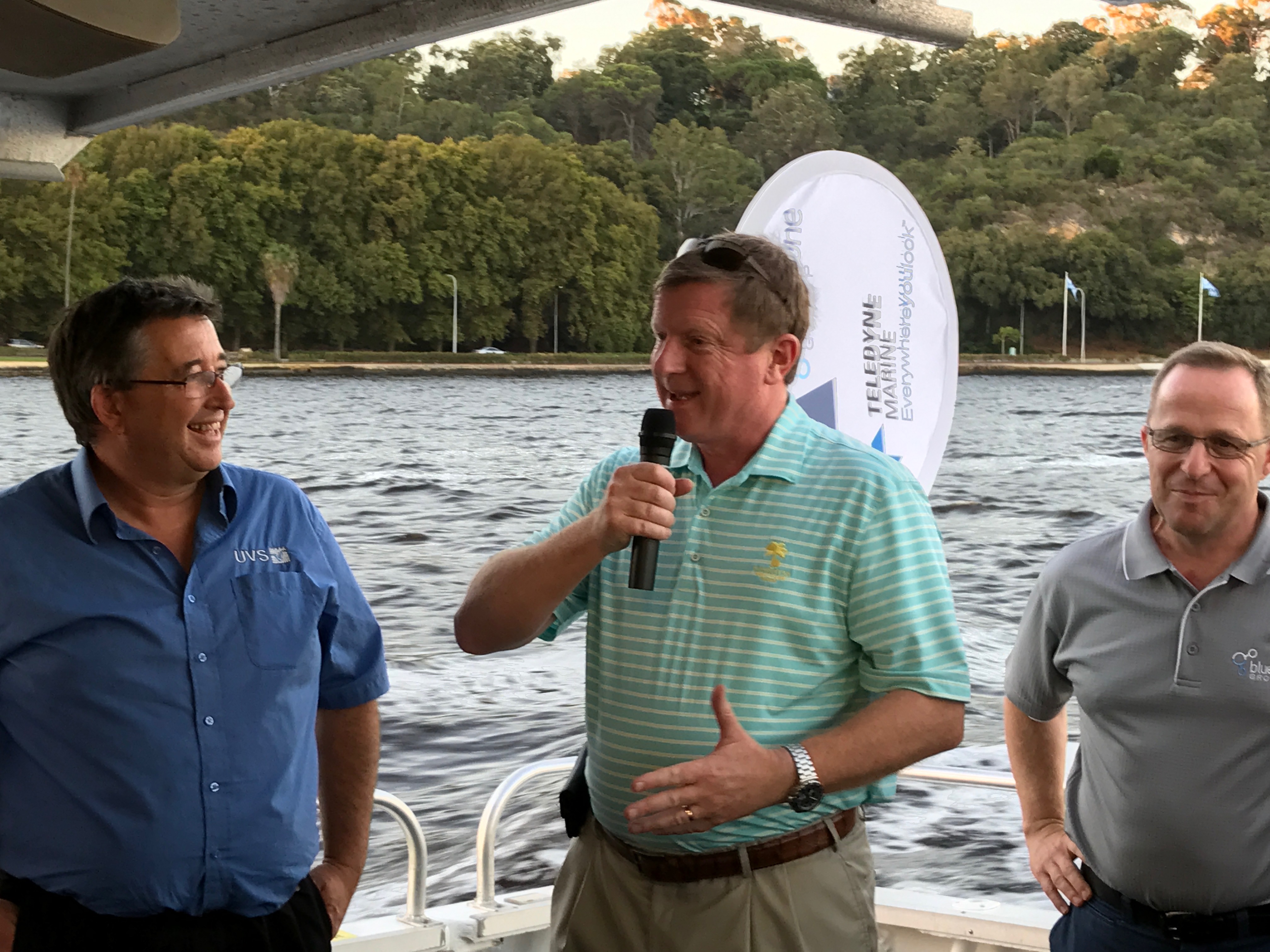
A 2017 visit to Perth supplies a less formal picture. Read led a Teledyne delegation working with BlueZone Group at Australian Oil & Gas. In a photograph from the trip, he stands between Mark Musarra and BlueZone director Neil Hodges aboard a dinner cruise on the Swan River. Marine business had found a fairly literal venue.
That trip combined equipment demonstrations with discussions about local support. A later visit took him to Manila and Jakarta to meet naval and research organizations about port security and deep-water sonar. The international work had identifiable people and places attached to it. For all the breadth of the portfolio, someone still had to travel, talk and follow through.
The unglamorous achievement of getting along
In 2018, the Marine Technology Society recognized Read with its Distinguished Achievement Award. The honor placed his name in a long-running list of contributors to marine technology. By 2020, his account of Teledyne Marine’s development focused on a five-year effort to bring its businesses onto common operating, sales, service and software arrangements.
A common software platform was particularly relevant to instruments and imaging products that needed to communicate. Acquiring capabilities had produced an extensive collection; connecting them required another kind of persistence. The organizational work continued after the purchase announcements, in processes a customer might only notice when something failed to join up.
Read’s description of customer relationships was much shorter: “this is a people to people business.” It is an undramatic sentence for a sector associated with deep water and complex machines. It also fits the workshops, research partnerships and regional visits. The machinery depended on conversations conducted above the surface.
“this is a people to people business”
Mike Read, 2020
A new group, a recognizable problem
OceanSight’s March 2026 launch returned Read to the task of assembling complementary businesses. XPV introduced him as chief executive and described a group that would grow through investment and acquisitions. Its early portfolio brought together geophysical measurement, sonar technology and acoustic imaging. It was an organization built around different ways of understanding the same underwater environment.
Sound Metrics joined the group in March. The Bellevue, Washington company’s imaging sonar produces detailed acoustic pictures in conditions that frustrate optical cameras, including darkness and turbid water. Its announcement said it would continue operating from Bellevue while collaborating with the other OceanSight companies. Belonging to a group would involve cooperation across locations.
Read publicly welcomed the incoming team. OceanSight then celebrated its launch at Oceanology International in London, where he discussed the venture in a filmed interview. The event offered another version of a familiar scene: technology businesses, customers and partners meeting around equipment, with Read explaining the connections.
Three ways to read the water
Complementary capabilities within OceanSight’s 2026 portfolio. A capability map, not a performance ranking.
The next connection is closer to the customer
By June, OceanSight had announced six new regional channel partners for Ocean Floor Geophysics. Their territories included Italy and Greece, Norway, Korea, India, the United States, and France and Francophone Africa. This was the less theatrical sequel to a launch: building the routes through which customers could obtain technology and support.
The announcement described a sales network tailored to each business’s applications and operating environments. Read emphasized regional customer relationships, sales channels and operational support as part of helping companies grow. The task had moved from bringing businesses into the group to improving their reach outside it.
In August, he again described OceanSight’s goal as bringing together specialists with complementary expertise. It is a thread running back through his earlier work: a connector business joining a larger technical organization, marine brands learning to operate together, customers getting access to a broader set of capabilities. His latest venture gives that thread a new company name.
For Read, the next chapter has concrete work attached: supporting the businesses already assembled and finding others that fit. The ocean supplies plenty of difficult questions. His career has repeatedly returned to the people, equipment and organizations that can answer them together. The name on the stand has changed. There are still connections to make.
Follow the connections
Company pages, interviews and further reading.