Mike Francis’s favorite story about learning begins with attempted cheating. As a boy struggling with math, he programmed a TI-89 calculator to solve problems he did not understand. The machine was meant to be a shortcut. Building the program forced him to teach the calculator, which forced him to teach himself. The cheat collapsed into an education. Years later, that little inversion still reads like an operating manual for his career: make something, watch it closely, and let the act of making change the maker.
Francis is not a chemist. He says so plainly, then points toward the scientists at NanoTech Materials, the Houston-area company he co-founded and now runs as CEO. His own training is in computer systems, business and corporate product development. Yet the thing occupying his days is a ceramic particle small enough to disappear into paint and consequential enough to alter how a roof, a timber retaining wall or a hot pipe handles heat.
NanoTech calls it the Insulative Ceramic Particle, or ICP. The company blends it into three main coating systems: one meant to reject heat from commercial roofs, another intended to harden wooden infrastructure against fire, and a third designed to insulate industrial equipment. The names are practical because the work is practical. A coating has to survive weather, adhere to an existing surface, pass tests, move through an applicator’s equipment and justify its place in a maintenance budget. Molecules may be elegant. Procurement rarely is.
The founder inside the corporation
Before the garage, there were conference rooms. Francis began working in product development at National Oilwell Varco in 2006 and later led corporate product management. He helped create a product-development process and managed innovation across hundreds of projects. The experience gave him a sheltered version of founder work: propose an idea, win internal support, assemble momentum and persuade a large organization to move.
He calls that role intrapreneurship. The word is clumsy, but the apprenticeship was useful. An internal innovator still has to sell an idea before it exists. The difference is that the salary arrives while the argument is being made. Francis later moved through strategic business management at Halliburton, then led consulting and entrepreneurial ventures of his own. NanoTech would become his fourth company. He has said two earlier ventures produced successful exits.
“You do still have to sell your idea. You have to get momentum for your idea.”Mike Francis on learning entrepreneurship inside a corporation
The exit from corporate life was personal before it was technological. Francis wanted more control over his time with his wife and children. Startup life is famously greedy, but he believed that choosing the work would let him protect the hours that mattered. It was not an escape from labor. It was an argument over who got to arrange the calendar.
A torch, a piece of foam, a reason to look twice
The first convincing demonstration arrived through a video. A business partner showed Francis a piece of Styrofoam covered with a fire-protective material and put under a torch. It did not smoke. It did not turn black. Francis’s response was concise: “OK, this is something.” The chemistry still needed a company around it, and a company is a long chain of uncinematic chores. But the demo compressed the promise into a few visible seconds.
NanoTech began in a two-car garage with three people mixing early batches. Its founding period spans 2019 and 2020, and in 2020 it became the first startup admitted to Halliburton Labs. That mattered for more than borrowed lab space. The program connected the young company to industrial expertise and investors. Ecliptic Capital led a $5 million seed round at the end of that year.
The platform logic is the clever part. Heat problems occur in different costumes. On a roof, the goal is to send heat away and reduce the burden on cooling systems. On timber near a wildfire corridor, the job is to delay ignition and limit smoke. On industrial equipment, the concern is keeping exposed surfaces cooler while protecting the asset beneath. Instead of inventing a new material for every costume, NanoTech adapts one particle into coatings with different jobs.
That breadth could have encouraged an early sprawl. Francis says the company began with roofing because the market opportunity was legible. A roof offers a large, exposed surface and an energy bill that can turn performance into arithmetic. From there, the company moved toward walls, windows, public works and industrial facilities. The ambition is large; the path remains a sequence of surfaces.
When the garage becomes a factory
The romantic version of hard tech ends at the prototype. The business begins after it. Software can move from a laptop to a million users without anyone buying a mixing tank. Coatings must be manufactured, stored, shipped and applied. Tests take time. Customers put the product on assets they cannot casually replace. Every promising lab result creates a less glamorous question: can you make the same thing again, at volume, on Tuesday?
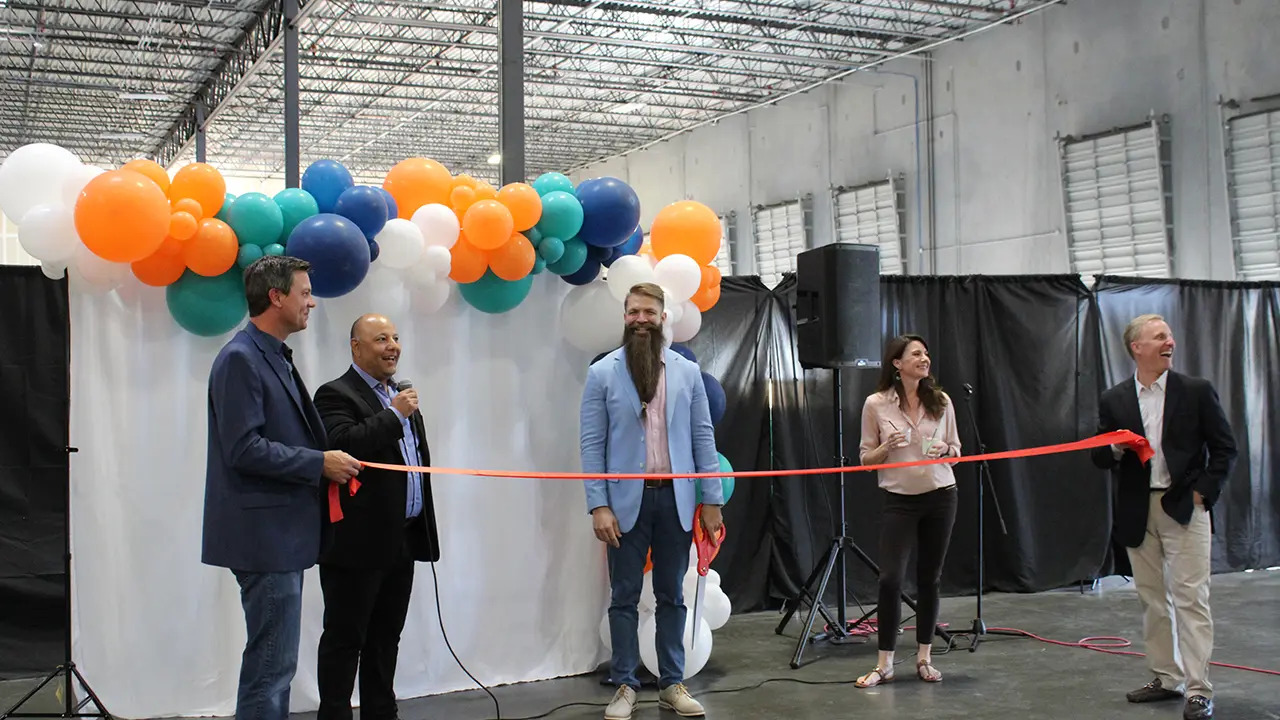
By 2024, NanoTech had left the garage and opened a 43,000-square-foot facility in Katy. Francis said the operation could produce enough coating to cover 50 million square feet a year. The company reports more than 100 million square feet coated to date. Those are not merely growth figures. They mark the point at which a science story becomes a manufacturing story.
TIME’s recognition in 2024 gave the particle a memorable test. NanoTech coated an egg in its wildfire material and set it ablaze. The egg remained raw. The same coating had moved beyond tabletop spectacle: it was used around SpaceX launch areas and on timber infrastructure along California highways. Francis emphasized smoke as well as flame. A barrier that buys access and visibility can matter to the people moving toward a fire while everyone else moves away.
The week the money almost stopped
Factories make confidence look inevitable. Francis is unusually willing to describe the moment when it was not. NanoTech once came within a pay period of running out of cash. Several leaders had personal funds ready. Halliburton Labs, he recalled, conveniently failed to process rent checks while the company was tight. Then an investor who knew and trusted him said, “I’ve got your back.” The funding landed before payroll.
The sentence stayed with him because it recast investment as something more human than a term sheet. Founders are trained to speak about capital as fuel. Fuel does not look you in the eye. Fuel does not decide that your team deserves another week. The close call also sharpened Francis’s preference for resilience in early employees. Brilliance is attractive. Resilience is the quality that still answers messages when the bank balance becomes the plot.
“You can have the best technology on the planet. It will sit on the shelf if you don’t have the right people behind it.”Mike Francis
That belief eventually became structural. Before the 2025 holidays, Francis gathered the NanoTech team and told every employee that they were now owners and would share in profits. He considers them partners who happened to join at different moments in the company’s history. The language of “ownership mindset” is cheap in offices. Matching it with ownership is dearer.
His inventory of progress is deliberately humble: an unpaid pilot, a passed test, the first bucket sold, a month with revenue, a seven-figure month, a factory. Each milestone sounds small only after the next one exists. Together they form the grammar of a physical startup, where optimism has to be poured into containers and shipped.
Fishing without the tournament
Francis spent years trying on grand explanations for why he worked. He once asked an entrepreneurship class at Texas A&M about purpose and listened as students delivered polished answers. He felt as if they had found a beacon he lacked. His 13-year-old son later supplied a less polished philosophy. The boy loves fishing and will spend a weekend on the water even when he catches nothing. Asked if he wanted to join a fishing team, he declined. Competition, he said, would ruin it.
Francis recognized himself in the answer. He likes the loop of curiosity, discovery and motion. No heroic mythology is required. The pleasure is in seeing whether the thing works, then finding the next thing to understand. It is the TI-89 story with better scenery.
That curiosity has recently pulled him toward software again. He has described working before dawn on a building-energy platform that uses models, weather data and digital twins to simulate materials and upgrades. The aim is to compress field comparisons that once took months into useful predictions made in minutes. For a company that sells coatings, the software is not a pivot away from matter. It is a faster way to ask matter better questions.
What the new money means
In April 2026, NanoTech closed a $29.4 million Series A led by HPI Real Estate & Investments, with GOOSE Capital and Milliken & Company participating. The company said the money would expand domestic manufacturing and accelerate its roofing, insulation and wildfire-mitigation lines. Francis described a quieter reaction than the triumph he felt after his first raise. He went home, sat near the pool while his children played, and cried from gratitude.
The difference, he wrote, was motive. Early capital had helped him prove that he was capable. This round felt like a commitment to build for other people. That shift may be the cleanest measure of the journey from garage founder to factory executive. The company is no longer an argument about whether Mike Francis can make something. It is an organization of employees, investors, applicators and customers whose plans now depend on what gets made next.
His stated priority is to scale without sanding away the culture that carried NanoTech through the lean period. He wants people in marketing, research and operations to feel like founders inside their domains. The idea contains an old corporate lesson and a newer ownership promise: give people room to sell an idea, and give them a stake in what happens when the idea works.
The ceramic particle remains the technical center of the business. Yet Francis’s more revealing material may be trust - applied in thin layers, tested under heat, useful only when it holds. One investor supplied it just before payroll. A stubborn early team returned it. Now Francis is trying to manufacture the conditions in which more people can say, with evidence, that the company belongs to them too.