Before Michael Wasserman built software for livestream fundraisers, he worked in rooms where the performance had a hard stop. First came music, then film production. A movie wrapped. An edit finished. An audience bought a ticket, watched, and went home. The route from those rooms to Tiltify began during the long wait after a film he worked on in 2006 had gone into post-production. The recession was arriving, studio jobs were vanishing, and an acquaintance at a Los Angeles children’s hospital called with an oddly specific favor: could his entertainment contacts help bring recognizable hosts to a holiday fundraiser?
Wasserman said yes. Justin Timberlake and Jessica Biel hosted. Kevin James joined, along with others. The event worked, but the part he later described as life-changing was not the guest list. It was the time he spent with the children that day. Word traveled through the charitable-event circuit. Another organization called, then another. Before long, the producer was helping charities stage Los Angeles galas, poker tournaments, and campaigns through his own consulting work.
It was a career pivot with suspiciously good narrative timing: entertainment had taught him how to hold attention; philanthropy showed him where attention could go. Yet the nonprofit world kept handing him the same anxious line. How do we attract younger donors? How do we find younger fundraisers? The question appeared so often that it stopped sounding like a request for marketing advice. It began to sound like a product brief.
The question hiding in plain sight
Traditional fundraising, as Wasserman encountered it, was built around mail, email, and attendance. Even as social media remade daily life, much of the charitable technology still treated the donor as a visitor to a static page. Younger people had not disappeared. They were simply somewhere else, gathering around Twitch streams, YouTube channels, gaming communities, podcasts, and social feeds.
The crucial reversal behind Tiltify was almost grammatical. Instead of beginning with what the charity wanted from its software, Wasserman and his collaborators asked what the fundraiser wanted. They spoke with hundreds of creators and social-media users. What would make them participate? What was keeping them away? The answers pointed toward a page that behaved less like a form and more like a show: targets that moved, polls that invited a choice, rewards that made a contribution tangible, and alerts that let a donor enter the scene.
“The way I always describe most charity sites is they’re like empty mailboxes.”Michael Wasserman
It is a wonderfully unglamorous image. You approach, drop something in, and leave. Tiltify’s alternative was a conversation. A livestream host could thank somebody in real time. A donation could unlock a challenge. A community could watch itself push a total over a threshold. None of these mechanics changed the beneficiary. They changed the donor’s sense of presence.
The modern telethon fits in a chat window
Tiltify launched from Los Angeles in the 2013-2014 period, when livestreaming was becoming accessible to ordinary creators. The old telethon already contained the seed of the idea: entertainment, urgency, public progress, and an invitation to act. Creator platforms made the format personal and portable. A gamer with a webcam could now hold the room, operate the tote board, perform the challenge, and speak to donors by name.
The company eventually moved well beyond the label “gaming fundraiser.” Its tools could travel with a podcaster, a fitness creator, a video essayist, or a group attempting a physical challenge. The format mattered less than the relationship. This became especially clear in Tiltify’s collaborations with Jacksepticeye, the creator behind Thankmas. In 2020, the two sides worked on the #HopeFromHome campaign, inviting many streamers to rally around a shared cause. The campaign generated $1.9 million, and the following Thankmas raised more than $4.7 million. Wasserman’s lesson was that the event became larger when the invitation changed from “watch me raise” to “we can do this together.”
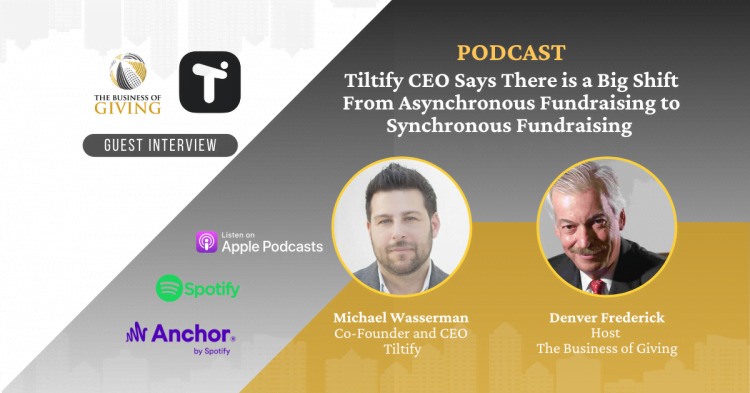
There is an unfashionable steadiness to the wager. Creator platforms change names, features, and favorite formats with caffeinated speed. The human mechanics beneath them are older: someone trusted asks, a group responds, and each response makes the next one easier. Tiltify’s product work has been a sustained attempt to make that social chain legible on a screen.
Popular is not the same as famous
Wasserman found a neat way to describe the distinction after his seven-year-old niece asked him what separated popularity from fame. Fame, in his answer, is reach: many people know who you are. Popularity is relational: people feel connected to you. The distinction explains one of the less obvious patterns in Tiltify’s data. A household name with a huge following is not automatically the strongest fundraiser. A smaller creator with a committed community may inspire considerably more action.
Tiltify reported more than $100 million in creator charitable donations during 2025, roughly twice its 2024 figure. Its top 30 fundraisers generated more than $70 million, and the list was not a parade of interchangeable celebrities. It included different formats and communities. The common element, Wasserman said, was interactivity. None behaved like a shy fundraiser who posts a link and hopes.
The most telling number may be 40 percent. Tiltify linked about two-fifths of the money raised in 2025 to a creator-designed incentive, twice the share it had seen in earlier years. A thank-you card, a shirt, or a shout-out can look trivial beside the gravity of a cause. Yet these objects and gestures give the audience a handle. They make generosity easier to enter, easier to share, and more pleasurable to repeat.
This is where Wasserman’s background in entertainment returns through the side door. A charity livestream can be generous and enjoyable at once. A viewer may contribute partly because the cause matters and partly because the event is a good way to spend an evening. The old border between an entertainment budget and a giving budget begins to blur. Nobody needed to make philanthropy frivolous. They needed to admit that attention has its own economics.
“The through line is that they’re all interactive, and they all have a strong community.”Michael Wasserman on Tiltify’s leading 2025 fundraisers
Reducing the terror of the blank campaign
The next friction point is creation itself. A first-time fundraiser may support a cause, know an audience, and still stare helplessly at an empty campaign setup. Tiltify’s 2026 product direction includes Beakr, an AI-assisted fundraiser tool designed to prompt people through choices such as goals, incentives, and platform integrations. Wasserman’s phrase for the design logic is practical: it is easier to edit than to ideate from the beginning.
Tell the assistant you like five movies, golf, and copious chocolate, and it can propose rewards or challenges. The fundraiser remains the editor. The machine supplies a first draft sturdy enough to argue with. For a company founded by listening to why people did not fundraise, this is less a fashionable detour into AI than a continuation of the original job: remove the awkwardness between good intent and the first public ask.
That job has widened. In 2024, Tiltify launched a personal fundraising product, applying its interactive mechanics beyond registered charities. The company’s core charitable platform routes donations directly to a nonprofit’s payment processor after the organization connects its banking information. The architecture reinforces a point Wasserman returns to often: trust is not decorative. It must be visible in how money moves, how campaigns are verified, and how platforms describe their role.
A producer of participation
Wasserman’s career now reads less like a sequence of reinventions than a steady change in venue. Music business, film production, celebrity events, online campaigns, creator software: each asks how to assemble people around a moment. His degrees in music business and law are an unusual pairing, but useful preparation for a field where spectacle meets regulation and a bright donation alert must eventually resolve into a clean payment.
The aspiration is not to turn every donor into a broadcaster. It is to recognize that modern supporters are also viewers, players, commenters, and makers. They do not leave those identities at the door when they decide to give. A platform can flatten them into a billing address, or it can give them something to do.
The holiday fundraiser that redirected Wasserman’s life worked because people entered the room. Tiltify’s wager is that a room can now be a stream, a chat, a challenge, or a community scattered across continents. The screen is not the obstacle. Used with care, it is the place where everyone can see the number move, and understand that their hand was on it.