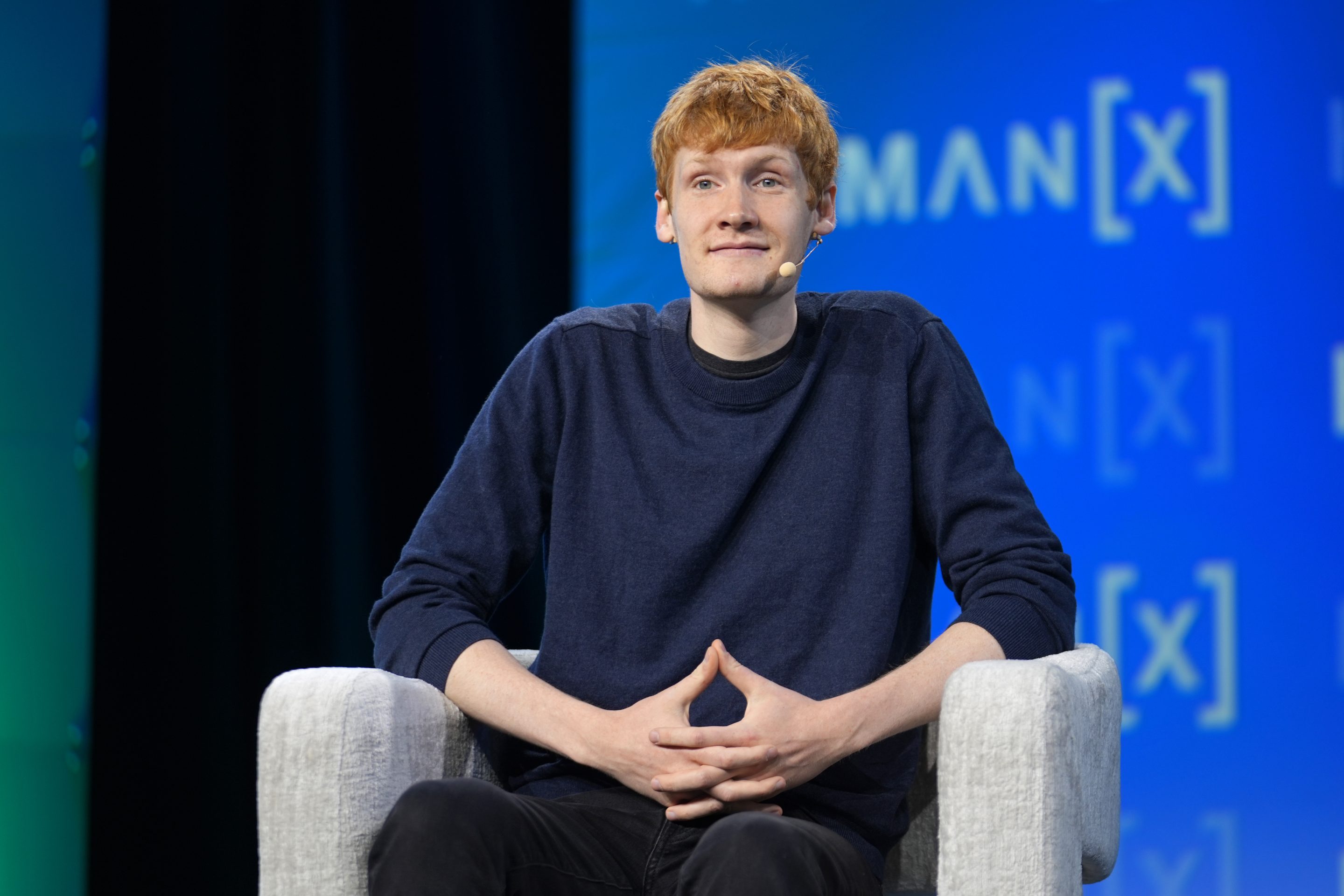
BreakingSpaceX secures $60B acquisition option for Cursor Michael Truell: youngest CEO of a decacorn startup Cursor crosses $2B ARR — fastest SaaS growth in history $29.3B valuation at Series D • November 2025 IOI medalist, Cutler-Bell Prize winner, MIT dropout, billionaire Built Halite at 14. Built Cursor at 22. "Taste will be the irreplaceable skill in AI development" — Michael Truell BreakingSpaceX secures $60B acquisition option for Cursor Michael Truell: youngest CEO of a decacorn startup Cursor crosses $2B ARR — fastest SaaS growth in history $29.3B valuation at Series D • November 2025 IOI medalist, Cutler-Bell Prize winner, MIT dropout, billionaire Built Halite at 14. Built Cursor at 22. "Taste will be the irreplaceable skill in AI development" — Michael Truell
Michael Truell, CEO of Cursor
Co-founder & CEO · Cursor / Anysphere

Michael
Truell

The man building the end of coding — as we know it

He started at age 11 making mobile games. He ended up making the fastest-growing software company in history.

$2B ARR (2026)
$29.3B Valuation
25 Years old
$1.3B Net Worth
APRIL 2026 — SpaceX (xAI) secures option to acquire Cursor for $60 billion  |  Cursor reaches $2B+ annual recurring revenue  |  Forbes estimates Truell's net worth at $1.3 billion

The kid who coded to play, then coded to change everything

He was 11 years old, growing up in New York City, and the game he wanted to play didn't exist yet. So Michael Truell built it. That instinct — close the gap between what you want and what exists — turns out to be the one trait that scales from a Bronx bedroom to a $29.3 billion company.

By 14, Truell was at Horace Mann School in the Bronx and co-creating Halite, an online programming competition with classmate Benjamin Spector that would eventually draw more than 5,500 participants — many of them college students, some of them learning to code for the first time. The project won the 2017 ACM/CSTA Cutler-Bell Prize in High School Computing, a $10,000 award and one of the most prestigious recognitions in student computer science. He was also winning medals at the International Olympiad in Informatics, one of the most competitive programming contests in the world.

None of this is the interesting part. The interesting part is what he did next: went to MIT, interned at Google building language models for feed ranking, met Ali Partovi (the early investor behind Facebook and Airbnb) by completing a written coding test "in record time," became one of 30 annual Neo Scholars — and then, in 2022, dropped out of MIT to build something that had no name yet.

The goal with the company is to replace coding with something that's much better.

— Michael Truell

The company they incorporated was called Anysphere. The product they built was called Cursor. The premise was maximalist to the point of absurdity: don't build a plugin for an existing editor. Don't add AI to VS Code. Build a new editor from the ground up — one where AI is structural, not cosmetic.

They launched publicly in March 2023. By January 2025 — twelve months after reaching meaningful scale — Cursor had crossed $100 million in annual recurring revenue. No SaaS company in history had grown that fast. Six months later it was $500M. Then $1B. By February 2026: $2 billion ARR.

From $8M seed to $29B valuation in 24 months

Valuation Trajectory

Seed (2023)
$8M
Series A (Jul '24)
$60M
Series C (Jun '25)
$900M
Series D (Nov '25)
$2.3B

ARR Milestones — Fastest SaaS Climb in History

Jan 2025
$100M ARR
Record: 12 months to 9 figures
Jun 2025
$500M ARR
5x in 6 months
Nov 2025
$1B ARR
First AI-native IDE to unicorn ARR
Feb 2026
$2B ARR
SpaceX acquisition talks follow

Four MIT kids and a contrarian bet

In 2022, Michael Truell, Aman Sanger, Sualeh Asif, and Arvid Lunnemark were nearing the end of their time at MIT. They were building in AI before the term "AI startup" became a cliche — before ChatGPT rewired the industry's imagination in November 2022. They had already been exploring a "copilot for mechanical engineers." They tried it for six months. It didn't feel right.

Then they looked at software development itself — the profession they were trained in, the one they loved — and asked what AI could do to it. The honest answer was: almost everything. They saw it coming. The intimidating part was that everyone else saw it too. AI coding tools seemed "too competitive" to enter. That hesitation lasted about one conversation.

"We realized we were really inherently excited about the future of coding," Truell has said. Excited enough to drop out. Excited enough to not add features to VS Code, which would have been faster, cheaper, and strategically inferior. They built their own editor.

"Something beautiful is happening to code."

— Michael Truell

The seed came from the OpenAI Startup Fund in October 2023 — $8 million, alongside early checks from GitHub's former CEO Nat Friedman and Dropbox co-founder Arash Ferdowsi. Andreessen Horowitz led the Series A in July 2024. Thrive Capital, Google, and Nvidia followed. The raises got bigger. The intervals got shorter. In November 2025, Accel and Coatue co-led a $2.3 billion Series D at a $29.3 billion valuation — five months after the previous round.

In April 2026, SpaceX (through Elon Musk's xAI) secured an option to acquire Cursor for $60 billion — or pay $10 billion for a deep collaborative arrangement. The MIT dropout who first coded to make games was now fielding acquisition offers larger than the GDP of most countries.

Not a better editor. A different kind of programming.

Truell's vision isn't "GitHub Copilot but better." It's categorically stranger. He talks about a future where the representation of software logic looks more like English than Python — where the editor becomes an interface between human intent and machine execution, not a place to type imperative instructions.

This shaped every product decision from the start. Cursor was built as a standalone editor rather than an extension because Truell believed all programming would eventually flow through AI models. If that's true, the editor's architecture matters at a fundamental level. You can't retrofit.

Where most AI tools measure daily active users, Cursor's team measured something they called paid power users — developers who code four or five days a week and actually pay. "If someone's willing to pay for your product, they think it's genuinely useful," Truell has noted. The metric kept the team honest about real adoption instead of flattering vanity numbers.

I think that one thing that will be irreplaceable is taste — the ability to define what should actually be built.

— Michael Truell, on the future of engineering

He's also candid about the risks. When the "vibe coding" movement — building software by delegating blindly to AI without reading the output — gained attention in 2025, Truell issued a pointed warning: "If you close your eyes and you don't look at the code, and you have AIs build things with shaky foundations as you add another floor, and another floor, and another floor — things start to kind of crumble." The thing that will separate good engineers from fragile ones isn't raw syntax fluency. It's judgment. Taste.

On competition from the same model providers his product relies on — OpenAI, Anthropic — Truell is characteristically unfazed. He compared any product from these companies to "a concept car engine without the surrounding vehicle." What Cursor does, he argued, is take the best intelligence from multiple providers and build the full car around it. The end-to-end matters.

A career that shouldn't fit into 25 years

🏆
ACM/CSTA Cutler-Bell Prize
Won $10,000 prize in 2017 for creating Halite programming competition at age 14-17
🥇
IOI Medals
Multiple medals at the International Olympiad in Informatics, one of the world's most competitive programming contests
🎓
Neo Scholar
Selected as one of 30 annual Neo Scholars by early Facebook/Airbnb investor Ali Partovi
🚀
Fastest SaaS Growth Ever
$100M ARR in 12 months — no software company has grown faster from zero to nine figures
💰
Youngest Decacorn CEO
Led Cursor past $10B valuation at age 24-25, one of the youngest founders to achieve this
📈
$1.3B Net Worth at 25
Forbes estimates ~4.5% equity stake in Anysphere, making Truell one of AI's youngest billionaires

From Halite to $60B

Age 11
Started coding to build his own mobile games, growing up in New York City.
2014 / Age 14
Co-created Halite — an online programming competition with Horace Mann classmate Benjamin Spector. Over 5,500 participants joined across competition runs.
2017-2018
Won the ACM/CSTA Cutler-Bell Prize ($10,000) for Halite. Competed in and won medals at the International Olympiad in Informatics.
2018
Enrolled at MIT studying Computer Science and Mathematics.
2019
Interned at Google building language models for feed ranking. Impressed investor Ali Partovi by finishing a written coding test "in record time." Selected as a Neo Scholar.
2019-2021
Internships at Two Sigma and Octant. Continued machine learning and statistical mathematics research alongside studies.
2022
Left MIT. Co-founded Anysphere with MIT classmates Aman Sanger, Sualeh Asif, and Arvid Lunnemark. Began building Cursor from scratch.
March 2023
Launched Cursor publicly — an AI-native code editor built ground-up for the AI era.
Oct 2023
Raised $8M seed round led by OpenAI Startup Fund, with angels Nat Friedman and Arash Ferdowsi.
Jul 2024
Closed $60M Series A led by Andreessen Horowitz at $400M valuation.
Jan 2025
Hit $100M ARR — the fastest any SaaS company in history has reached this milestone.
Jun 2025
Raised $900M Series C led by Thrive Capital at $9.9B valuation. $500M ARR.
Nov 2025
Closed $2.3B Series D (Accel, Coatue, Google, Nvidia) at $29.3B valuation. $1B+ ARR. Acquired code-review platform Graphite ($290M+).
Feb 2026
$2B ARR. Forbes estimates Truell's net worth at $1.3 billion. At 25.
Apr 2026
SpaceX (xAI) secures an option to acquire Cursor for $60 billion — or pay $10 billion for a partnership arrangement.

The network behind Cursor's rise

Ali Partovi (Neo Scholars) — spotted Truell during his Google internship and committed to backing him before he had a company idea. Nat Friedman (former GitHub CEO) and Arash Ferdowsi (Dropbox co-founder) wrote early angel checks. Andreessen Horowitz, Thrive Capital, Accel, and Coatue led successive mega-rounds. Google and Nvidia are strategic investors in the Series D. And then there are the model providers — OpenAI (whose startup fund backed Cursor's seed) and Anthropic — whose APIs power the product while their own coding tools compete with it.

OpenAI Startup Fund Andreessen Horowitz Thrive Capital Accel Coatue Management Google Nvidia Nat Friedman Arash Ferdowsi Ali Partovi / Neo

Share this profile