Warren Buffett declined. In May 1988, Michael L. Riordan had asked him to join the board of Gilead Sciences, invest in the company, or consider both. Gilead was less than a year old. Buffett answered by hand, explaining that his name was about all he could offer. Riordan answered by hand, too. “You are very modest,” he began.
Then he made the case again. Financing belonged beside research and production among the essential jobs of building the company. An experienced business mind could help shape that financing. The invitation had substance behind it; Riordan wanted judgment as well as recognition. Buffett did not come aboard. The correspondence survives as a small study in how to take a refusal: read the objection, address it, ask again.
It is also a useful introduction to Gilead's founder. A person prepared to make that request had a fairly expansive idea of whom a young company should be able to recruit. A person prepared to explain it twice had some stamina. The envelope was small. The recruitment brief was not.
An education with several exits
Riordan was born and raised in Wichita, Kansas. At Washington University in St. Louis, he studied biology and chemical engineering, graduating in 1979. His undergraduate life also included varsity swimming, a Langsdorf Scholarship, and service as a student representative to the university's Board of Trustees. Even before his first company, there were laboratories, institutions, and a pool competing for his attention.
He chose a Luce Scholarship for 1979-80, spending the year in the Philippines. The programme began with seminars in Hong Kong and ended with meetings across China. He would go on to earn degrees at Johns Hopkins and an MBA at Harvard. His academic record eventually also included a master's in international public policy from Johns Hopkins' School of Advanced International Studies.
Those subjects ask different questions. Engineering asks how something can be made. Business asks what resources will keep the making going. International policy asks how institutions and interests shape the conditions around it. Put them on one curriculum vitae and the document looks restless. Put them inside a founder's working day and the arrangement begins to make sense.
The telephone could outrun the business plan
Before founding Gilead in 1987, Riordan worked at Menlo Ventures. Venture capital gave him a place from which to investigate research and the possibility of a company around it. Menlo supplied Gilead's first $2 million. The connection between investor and founder was therefore present at the beginning, before a public listing or a board full of familiar names.
Researcher Jack S. Cohen later recalled a particularly brisk encounter. After a conference presentation in San Francisco, Riordan called him and asked to visit. He flew out that night. Cohen also remembered a later call, received while he was at a restaurant in Washington's Chinatown, in which Riordan announced that he had founded the company that became Gilead.
The recollection gives the early work a human scale: a presentation, a telephone, a flight, another conversation. Company histories tend to compress these movements into a founding date. The people involved remember being interrupted at dinner. There is something reassuring about that difference. Institutions arrive with a name; the work of assembling them happens one appointment at a time.
Recruiting a company into existence
Norbert Bischofberger had a job at Genentech when Riordan recruited him to Gilead. Years later, Bischofberger compared the experience to being pursued by a bulldog. It is an unusually vivid employment reference. The compliment, insofar as a bulldog is a compliment, concerned persistence: once Riordan had decided he wanted someone, the invitation was difficult to escape.
John Martin joined in 1990. His arrival mattered beyond the addition of another executive to an organisation chart. He brought relationships with researchers in Europe, including Antonín Holý in Prague and Erik De Clercq in Leuven. Gilead's early development depended on the movement of people, knowledge, and agreements across those institutional boundaries.
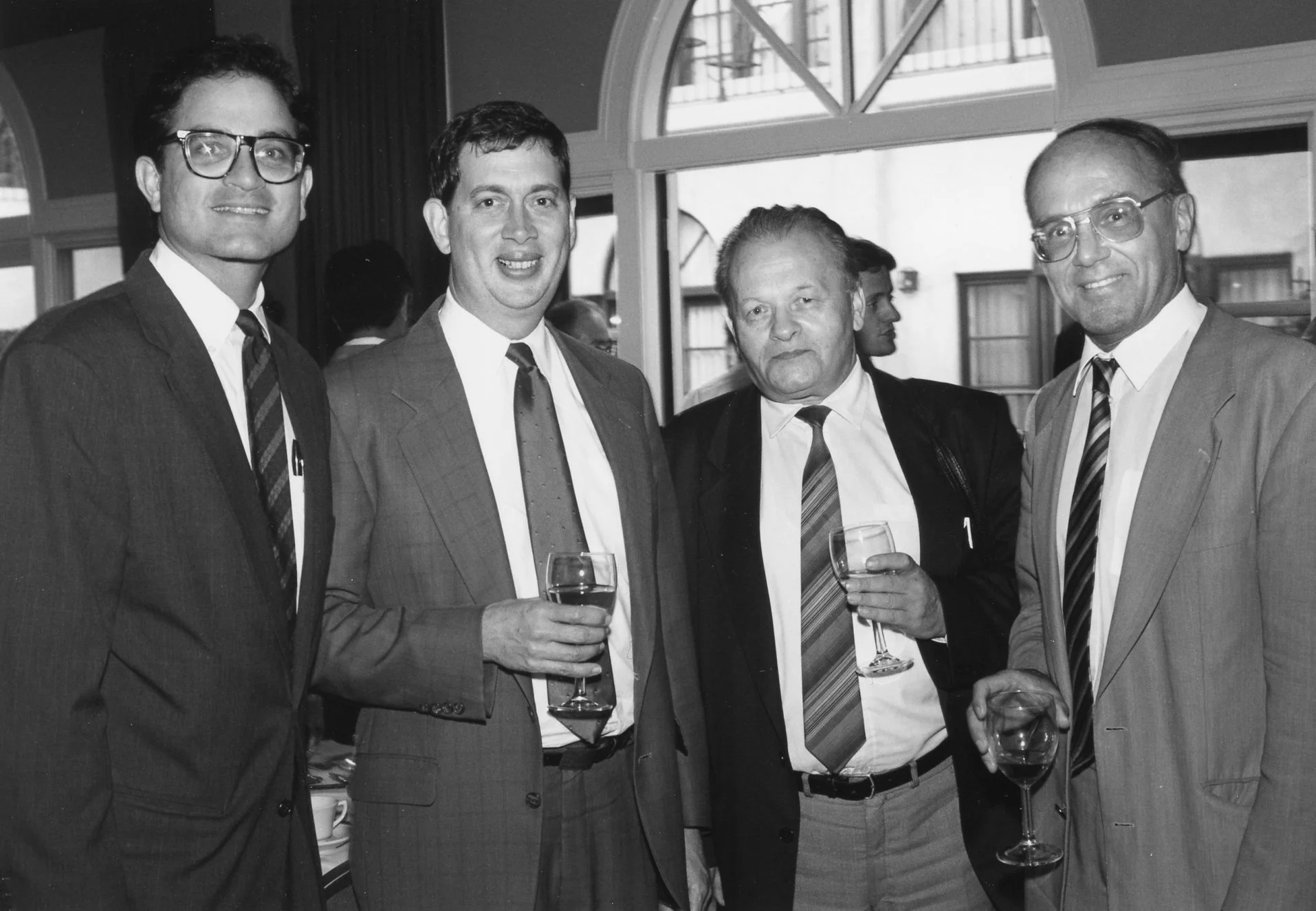
De Clercq later remembered a meeting with Riordan, Martin, and Holý at a Best Western in Paris. He described the leap from working with a large established company to working with a small unfamiliar one as a risk. His confidence in Martin mattered. For a founder, that is an instructive form of persuasion: hire someone whose existing relationships make other people willing to take the next step.
The cash arrives before the cliff
Gilead completed its initial public offering in January 1992, raising $86.25 million. The company was still in the expensive business of developing its capabilities. An IPO could provide resources for that work; it could also place a young organisation under a new kind of public scrutiny. Riordan had moved from asking individual investors for support to asking the market.
Later offerings added more capital. In its April 1997 resolution recognising his contribution, Gilead's board credited him with raising a total of $400 million through the IPO and subsequent equity offerings. These are historical company financing figures. Their importance lies in what they allowed the organisation to attempt over time.
Riordan described his approach with a deliberately unromantic word: conservative. He preferred to raise money while there was still room to manoeuvre. “We raise money for the company before we need it,” he said. The logic has none of the theatrical appeal of a last-minute rescue. That was rather the point. A founder can enjoy a dramatic pitch without wishing to live inside a permanent emergency.
“We raise money for the company before we need it.”
Michael L. Riordan, 1997
Raised in the January 1992 initial public offering.
Total raised through the IPO and subsequent equity offerings, as recognised by the board in April 1997.
The welcome meeting was part of the job
By February 1996, Gilead had 212 employees. Riordan still described sitting down with each new employee to talk through the company's principles. The same founder who had sought Buffett's attention was giving his own attention to people arriving at work. Both activities involved explaining why this particular organisation deserved someone's effort.
His shareholder letter set out seven themes: data, innovation, teamwork, agility, perseverance, integrity, and fun. They cover a revealing range. Some concern how people reason; others concern how they behave toward one another. Fun gets the final place, a small concession to the fact that the people expected to accomplish all this would also have to spend their days together.
The combination helps explain why the personal meeting mattered. A list in a letter can look effortless. Discussing that list with each arrival requires a founder to keep returning to the same questions. What conduct earns respect here? How should colleagues work together? What happens when a useful new opportunity appears? Growth makes those questions more frequent, even when everyone would rather get on with the work.
Room for thrift, change, and a little enjoyment
A separate record of Riordan's onboarding discussion went into more practical detail. People were to be evaluated on merit and performance. Individuals were responsible for their professional development. Communication and the acquisition of information mattered. So did patents, confidentiality, standards, and the careful use of money. These are the subjects through which an organisation becomes a place people can actually operate.
Thrift extended beyond surviving the early years. Riordan wanted leanness to continue after profitability, so the business could withstand future hardships. He also told employees to expect change as the organisation grew. The principles allowed for a company that would develop new habits without treating every alteration as a betrayal of its beginnings.
Then came the instruction to have fun at work. It is easy to smile at such a line in company principles. Still, its inclusion acknowledges something sensible: perseverance asks a great deal of people. Respect, fairness, and some enjoyment make the request more credible. Even an ambitious institution has to be somewhere its employees can bear to spend Monday.
A founder's decade, with an ending
Riordan served as chief executive from Gilead's founding until 1996, when Martin succeeded him. He had become chairman in 1993. On January 3, 1997, Donald Rumsfeld succeeded him in that position; the announcement said Riordan would continue as a director. The changes mark distinct jobs and distinct handovers within the company he had started.
When the board formally thanked him that April, it praised his financial and organisational work alongside more personal qualities. The directors remembered steadiness, warmth, humor, and ethical responsibility. Coming after the fundraising figures, that part of the resolution gives the record a different texture. People who had helped govern the enterprise also wanted to describe what working with its founder had felt like.
His later career includes chairing Beaufort Twelve Holdings, a diversified holding company emphasising emerging technology investments. His public biography also records international affairs affiliations and twelve years on the International Crisis Group's Advisory Council. The breadth of interests continued beyond his Gilead executive roles.
The 1988 Buffett correspondence remains a fitting place to leave him. A young founder had made a large request, received a courteous refusal, and sat down to explain himself again. The second letter was about the useful work a person could do. In the company that followed, Riordan kept returning to that question: whom do we need, and what will make their work possible?
Follow the invitations
- Michael L. Riordan on LinkedIn ↗
- His Luce Scholars biography ↗
- The 1988 Buffett correspondence ↗
- The February 1996 shareholder letter ↗
- Riordan’s employee discussion principles ↗
- The 1997 Washington University magazine profile ↗
- The company’s early financing history ↗
- Erik De Clercq’s recollections ↗
- Jack S. Cohen’s account of the early calls ↗
- Gilead’s early recruiting, revisited in 2003 ↗
- The January 1997 chairman succession ↗
- The board’s April 1997 appreciation ↗
- Gilead Sciences ↗