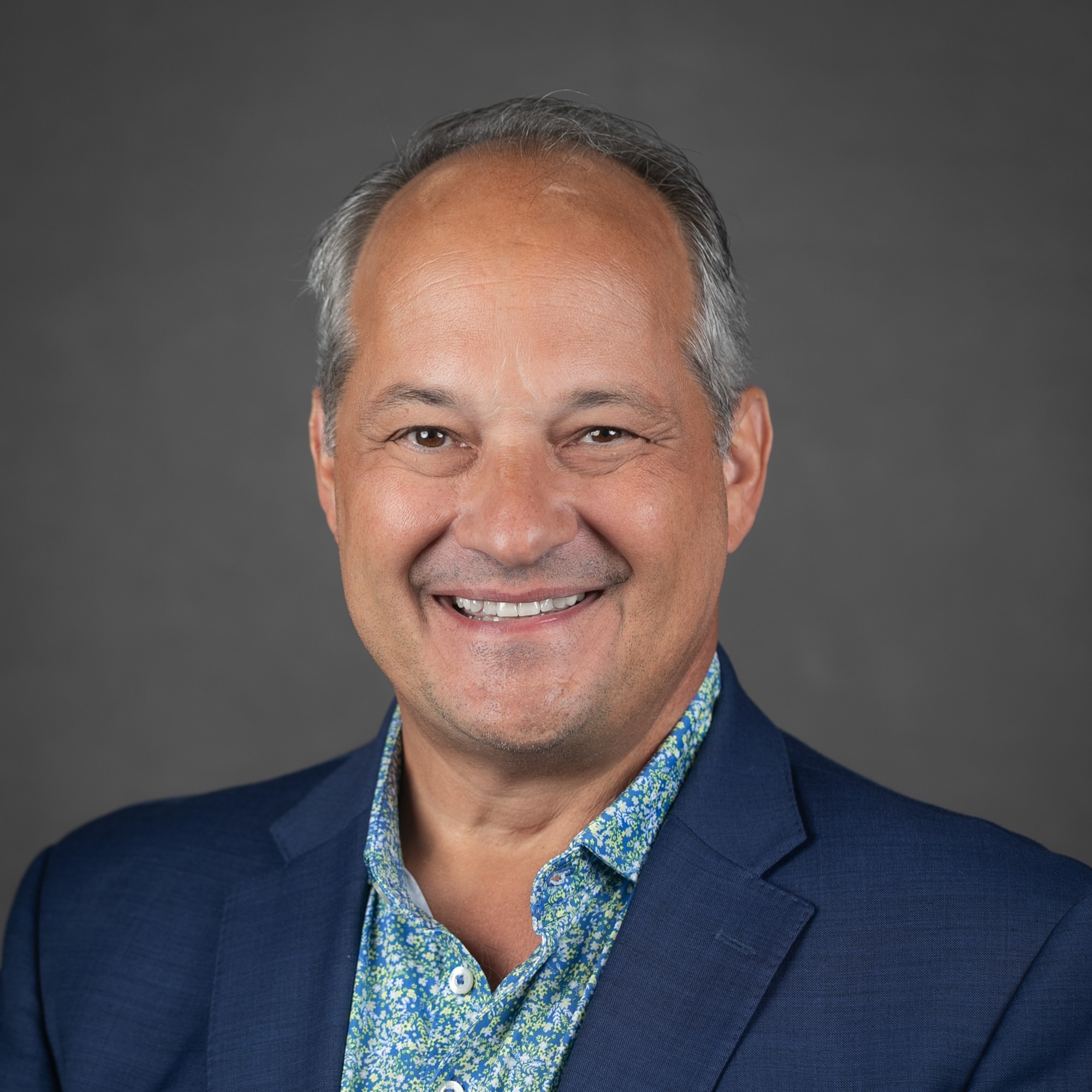
The battleship taught him one lesson that a business school never could: you cannot fight with a supply you cannot see. Thirty years later, that lesson runs a company.
Michael Prokopis runs DARVIS, a Houston company that points cameras and artificial intelligence at the least glamorous corner of a hospital - the supply room. The pitch is deceptively small. Hospitals hold tens of thousands of items, from gauze to orthopedic implants, and most of them cannot say, on any given afternoon, exactly what is on the shelf. DARVIS watches the shelves so nobody has to walk them. Its "Digital Shelf" technology replaces barcode scanning and manual counts with a camera-based system that Prokopis says delivers over 98% inventory accuracy across different hospitals and different rooms.
He took the CEO job in August 2025, succeeding co-CEOs Jan-Philipp Mohr and Michael Dietz, who stayed on as Chief Product Officer and CFO. What makes the appointment interesting is not the title. It is the direction of travel. Most technology CEOs sell to hospitals. Prokopis spent 25 years inside them, on the other side of the table, holding the checkbook and the frustration.
I couldn't count my inventory. It took us three days to wander around every nook and cranny.— Michael Prokopis, on the problem that found him
That sentence is the whole origin story compressed. As Vice President of Supply Chain at MD Anderson Cancer Center, Prokopis managed more than 75,000 active SKUs across one of the most complex patient populations in American medicine. When supply disruptions hit, the difference between a stocked shelf and an empty one was not an inconvenience. It was a treatment delayed. And the tools he had - RFID tags, weighted bins, spreadsheets - carried four and five year payback periods that no hospital chief financial officer would sign off on.
So he went looking. He evaluated the technology the way any tough customer would - skeptically, with a calculator. Then he found DARVIS. "The minute I walked in," he said, "I said, this is it. These guys can help me realize this vision." He was a believer before he was an employee, and a customer before he was a boss. That sequence matters, because it means the person selling the product once had to be convinced to buy it.
The count that took three days
To understand why Prokopis is worth watching, you have to understand the specific, unglamorous problem he is obsessed with. Retailers manage inventory in the hundreds. "In healthcare," he says, "we're not managing a couple of hundred. We're managing tens of thousands." A single cancer center runs more distinct items than a mid-sized grocery store, and unlike groceries, running out is not a matter of a disappointed shopper.
The traditional fixes are worse than the problem. RFID means tagging every item. Weighted bins mean special hardware under every shelf. Both are expensive, both are slow to install, and both take years to pay back. Prokopis frames the whole industry through a single unforgiving filter: "The product has to show ROI within 12 months, or healthcare CFOs won't approve it." It is a sentence you can imagine him repeating in every board meeting, because it is the rule that killed every solution he tried before DARVIS.
Before the cameras, the clipboard
Prokopis did not arrive at DARVIS as a technologist. He arrived as an operator with a long ledger of wins that read like a supply chain textbook. During COVID-19 he built a self-distribution model that cut PPE transit times and lowered inventory costs by 20% across 39 hospitals - the kind of number that gets remembered when the next crisis hits. He created an orthopedic implant pricing model that saved over 25% annually, a category notorious for opaque pricing. He founded a demand planning consortium to sharpen forecasting. He led the supply chain integration of a five-hospital acquisition.
He also has a green streak that predates the buzzword. At Steward Health Care he won the Stryker Sustainability Platinum Award for eliminating 70,000 pounds of landfill waste. It is a strange, specific, verifiable number - the sort of thing an operator counts because someone told him it couldn't be counted.
His credentials are almost comically well-rounded for a computer vision executive: a finance degree from the University of Utah, an MBA from Dartmouth's Tuck School, and a master's certificate in supply chain management from MIT. Three institutions, three disciplines - finance, general management, logistics - stacked into one resume. He sits on the ECRI Board of Trustees as Treasurer, which keeps him close to the evidence-based side of healthcare technology evaluation.
The efficiency he chased, visualized
Figures drawn from published bios and interviews. Bars indicate reported improvement percentages.
The officer of the deck
Long before the shelves, there was the sea. Prokopis served in the United States Navy from 1987 to 1991, a Gulf War veteran who left as a Lieutenant and Surface Warfare Officer. He carries one distinction that no MBA can hand out: he was the first Ensign in the history of the USS Iowa to qualify as both Surface Warfare and Underway Officer of the Deck. On a battleship, the Officer of the Deck runs the ship when the captain is not on the bridge. It is a job about situational awareness - knowing, at all times, where everything is and where it is going.
You can draw a straight line from that deck to the supply room. Both are exercises in the same discipline: total visibility of a complex system in motion, with real consequences for a blind spot. A CEO's origin story is usually a metaphor stretched too far. In Prokopis's case the metaphor is load-bearing.
We are a 24-over-seven real-time visibility company that helps healthcare manage its inventory.— The DARVIS thesis, in one line
Why the buyer-turned-builder matters
There is a quiet advantage in a founder-CEO who used to be the customer. Prokopis knows the exact objection a hospital will raise before it raises it, because he raised it himself for two decades. He knows the CFO's 12-month test is real, not theoretical. He knows what a three-day inventory count feels like at 6 p.m. on a Friday. That empathy is not a soft skill. It is a sales strategy and a product roadmap rolled into one.
DARVIS itself has an unusual pedigree. Its co-founders, Jan-Philipp Mohr and Brian Earp, pivoted from mobile gaming and aerospace inventory work, launching a commercializable healthcare product by late 2024. Prokopis was the operator who could translate that camera-and-AI capability into the language hospitals actually speak: accuracy, ROI, waste, stockouts. Executive Chairman Frank Niehage put it plainly when the appointment was announced: "Michael's visionary leadership and mastery of AI-driven solutions perfectly align with our mission to revolutionize healthcare logistics."
The company he now leads is small - roughly 43 people, Series A, Houston-headquartered - and the ambition is not. The bet is that every hospital in the country is running blind on inventory, and that a camera plus good AI is cheaper, faster, and more accurate than tagging the world. If that bet is right, Prokopis will have spent his whole career walking supply rooms just to build the thing that finally lets everyone else stop.
What comes next
The trajectory since August 2025 has been about proof. Prokopis has been out front - a "Healthcare HotShot" feature, a turn on the INspired INsider podcast walking through healthcare's inventory blind spots, the conference circuit where he used to sit in the audience as a buyer. The story he tells is consistent, which is its own kind of credibility: real-time visibility, autonomous replenishment, 98% accuracy, a 12-month payback. No hype, just the numbers a CFO can approve.
He is, in the end, an unlikely computer vision CEO - a finance major, a Navy officer, a supply chain lifer who found his way to AI not through code but through the frustration of a three-day count. That is the strange specific worth remembering about Michael Prokopis. He did not fall in love with the technology. He fell in love with the problem first, and went looking for the technology that could finally kill it.