Three hundred DVDs will do something to a person. They turn a pleasure into an inventory. There is the film you own, the film you remember owning, and the film whose box has apparently embarked on an independent career. Michael Malcolm had reached this point at home. For someone who had already helped build a company around making stored information easier to reach, the inconvenience must have had a certain comic symmetry.
He described his collection in a 2005 interview: “I was having that problem in my own home with 300 DVDs”. That detail gives an otherwise technical career a familiar doorway. The shared files of engineers and the films in a living room have different audiences, but both can become awkward to manage. A good collection is only useful if you can get to what you want.
Malcolm co-founded NetApp with Dave Hitz and James Lau in 1992 and became its first chief executive. He subsequently helped start CacheFlow, later called Blue Coat Systems, and Kaleidescape. Across those businesses, there is a recurring proposition: give a particular job a machine designed to do it. The jobs changed. The appetite for removing friction survived.
A storage problem with popcorn potential.
The professor’s railway
Long before the movie server, there were electric model trains. At the University of Waterloo, Malcolm taught hundreds of students to program real-time systems that controlled them. A railway is an appealing classroom instrument because it gives abstract work a visible consequence. Code can be discussed at length; a train has somewhere to be. Timing becomes rather less theoretical when the assignment moves along a track.
His academic interests ranged across operating systems, communication between processes, compiler design and numerical mathematics. He led work on Thoth and Waterloo Port. These were tools for coordinating computing, rather than merely applications running on top of it. That distinction matters in a career spent making complicated machinery behave like something a user can trust.
A 1979 account of Thoth’s development records Malcolm and Lawrie Melen implementing its early executive in May 1976 on a Data General Nova. It also describes the support software produced by a wider group and subsequent work with David Cheriton. The record is pleasingly collaborative. Operating systems emerge through accumulated decisions, revisions and people, even when the eventual machine arrives with a single name on its case.
Malcolm’s training crossed disciplines. He earned bachelor’s and master’s degrees in mechanical engineering at the University of Denver, followed by a master’s and doctorate in computer science at Stanford. He also built Waterloo Microsystems, serving as chairman and CEO. The classroom and the company supplied different settings for the same broad problem: how to get an intricate system to do useful work.
A lunch on December 2
The NetApp story has a date that survives because it coincided with a birthday. Hitz remembered meeting Malcolm for lunch on December 2, 1991, his sister’s birthday. Hitz and Lau had been pursuing software for pen-based computers. The platforms they needed were failing to materialize. Malcolm, whom they knew through Auspex, called with a different idea: a file server.
They kept consulting while working out whether it could become a business. In April 1992, initial funding and incorporation allowed the project to become their full-time occupation. The sequence has the practical texture of an early company: conversations first, architectural questions next, a corporation when there was money to receive. A founding date is wonderfully tidy. Founding itself tends to spill over its edges.
Their proposition was a dedicated storage box for Unix workstations on Ethernet. Cisco offered an analogy: routing had become a job for a specialized device, and perhaps network file storage could follow. The word appliance promised something comprehensible. Plug it in, let it do its work, and spend your attention elsewhere.
NetApp’s own history remembers the early NFS server as the Toaster. The nickname is almost aggressively domestic for enterprise equipment. It also captures the ambition. Nobody buys a toaster hoping for a stimulating relationship with its operating system. The less ceremony needed to perform the task, the better. That was a useful standard to bring into a room full of computers.
Shared files→Network
Ethernet→Dedicated box
File storage
When the seminar became a company
In the early engineering work, Hitz remembered Malcolm as a technical sounding board. The arrangement reminded him of being a graduate student with an adviser. Ideas could be argued around a table; Malcolm had opinions, and the others could challenge them. That picture gives the first CEO a more specific character than the usual founding photograph permits.
It also exposes a difficulty. In Hitz’s account, the approach became less effective as NetApp added layers of management and needed more delegation. He described the transition as painful and believed the growing organization required different leadership. Dan Warmenhoven became CEO in 1994. Malcolm’s contribution to starting the business and the decision to change its leadership belong in the same story.
The tension is recognizable beyond technology. A group small enough for everyone to contest every decision can feel intellectually alive. Add more people and the same freedom can make decisions difficult to settle. The meeting table remains the same size; the consequences of the meeting do not. A successful beginning does not automatically provide an organizational design for everything that follows.
Hitz credited Malcolm with initiating the venture even while explaining their disagreement. Tom Mendoza, who joined during those early years, later recalled that Malcolm hired him to run the US business. These memories place Malcolm at the junction of product direction and recruiting. NetApp went public in 1995, after his CEO tenure. His part was in getting the company into existence and through its first stage.
“very collegial, very roundtable of equals”Dave Hitz, recalling Malcolm’s early management approach
The next box kept a copy
In March 1996, Malcolm helped found CacheFlow. Its idea addressed another everyday nuisance of the network: waiting for frequently requested web material to travel again. A cache keeps a local copy, allowing repeated requests to be served closer to the user. Storage became a means of reducing delay.
The company’s financing history gives the idea some scale. Malcolm and Joe Pruskowski raised $1 million in seed loans from a dozen angel investors. Benchmark subsequently led a venture round. The company needed people, a product and customers before a public market could become relevant. It eventually went public in 1999 and later took the name Blue Coat Systems.
CacheFlow makes the connection between Malcolm’s businesses easier to see. NetApp organized access to shared files. Caching shortened the journey to material requested repeatedly. These are distinct products, but each asks whether users should have to endure the mechanics of moving information. The appliance encloses those mechanics in a box with a narrower purpose.
The hardware language can obscure the human objective. A person wants the file, or the page, or the film. The network has a route to negotiate. Malcolm’s businesses repeatedly occupied that gap. By the time the next venture turned toward entertainment, a server in the home was a change of setting with some familiar engineering questions waiting inside.
Hollywood enters the equipment rack
Kaleidescape began in February 2001 with Malcolm, Cheena Srinivasan and Dan Collens. In a twentieth-anniversary recollection, Malcolm connected its origin to the home theater he had just built and the inconvenience of buying, storing, locating and playing DVDs. The eventual ambition included Internet delivery and a movie library that organized itself for the viewer.
The early product used discs as its starting point. That was a practical response to the available content and to a commercial circularity: customers needed movies to justify buying a platform, while content owners needed customers to justify supporting one. There was little glamour in that impasse. The elegant experience on the screen rested on rather less elegant negotiations behind it.
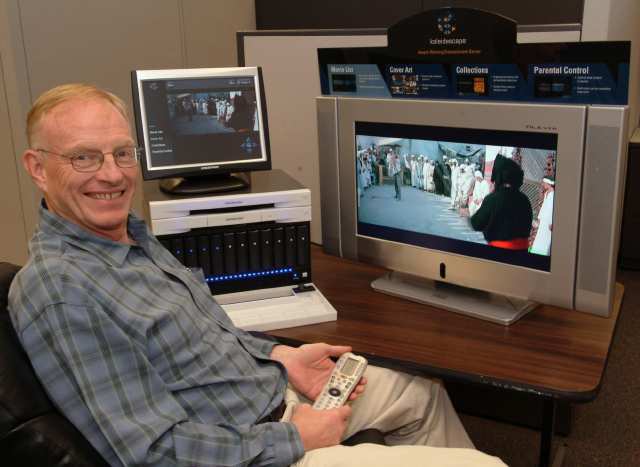
A 2005 demonstration showed what the experience could offer. Viewers browsed cover art and searched by actor, genre or director. A highlighted title could prompt related suggestions. Servers, readers and players handled the work across a network. A collection became something to explore from a seat, rather than something to excavate from shelves.
This was also a costly proposition for a particular market. A demonstrated system started at $22,500, with larger configurations available. The same report recorded Malcolm discussing customers with large yachts. Convenience has a different budget when the living room floats. The price makes the early business easier to understand: it was selling a carefully installed experience to people prepared to pay for one.
Press play, after the paperwork
The licensing work was substantial enough to become part of Kaleidescape’s public story. A 2004 discussion with Malcolm described the effort to secure permissions alongside the development of the system. The product’s usefulness and its legitimacy had to be considered together. A film could be technically available on a hard disk and still bring a complicated set of contractual questions with it.
The subsequent dispute with the DVD Copy Control Association lasted through multiple court proceedings. An initial 2007 ruling favored Kaleidescape; an appellate decision in 2009 sent the matter back, and a later trial favored the association. These reversals complicate any cheerful account of inventing a better remote control. Consumer equipment sits within agreements made by industries with their own interests and rules.
The product continued evolving. In 2011, the M700 Disc Vault automated the importing and storage of up to 320 discs. Blu-ray discs stayed in the vault to enable playback of their digital copies. The resulting machinery is an instructive artifact: the promise of immediate access, accomplished with a physical carousel and carefully defined conditions. Even the future sometimes needs a cupboard.
Shared files
Web content
Movie collections
A collection outlasts its collector
Malcolm served as Kaleidescape CEO from 2001 to 2012 and remained board chair until 2021. When he stepped away, the company’s statement named family, aviation and other adventures among his future pursuits. The detail changes the scale of the ending. After decades spent building systems for other people’s work and leisure, there was room for his own.
Kaleidescape marked its twenty-fifth year in 2026. Its Waterloo research and development presence continues the Canadian connection associated with Malcolm’s earlier academic life. That is a tangible continuity across classrooms, companies and countries: people who know how systems work, hired to make those systems useful.
The 300 DVDs remain the most revealing small detail. Malcolm’s career can be counted in companies, titles and dates, but a troublesome personal collection makes the work legible. Someone wanted to sit down and watch a film. Between that wish and the opening scene stood shelves, servers, software and agreements. He helped build businesses around shortening the distance.