The question arrived with a history attached. After Silversmith Capital Partners was founded in 2015, Jeff Crisan and Darren Black approached Michael Lester about building another company. They had backed his previous business, Accelecare. There was no need for the elaborate first-date performance in which everyone pretends to enjoy the same spreadsheet. They already knew what working together felt like.
That invitation offers a useful way into Lester’s career. The visible landmarks are companies founded, transactions completed and a Nasdaq listing. The less conspicuous thread is the return of people who have worked with him before. A new venture can begin with a blank sheet of paper while carrying years of accumulated trust.
LifeStance Health, officially founded in 2017, became the next expression of that relationship. Lester served as its founding chief executive and chairman. By June 2021, it was trading publicly under LFST. In September 2022, he handed over the top job. Today, Nira Medical lists him as executive chairman. The retirement announcement turned out to be a chapter break.
A company before the company
Lester’s business history reaches well behind LifeStance. He earned a bachelor’s degree in pharmacy at the University of Texas at Austin. He founded Radiant Research in January 1998, and later founded and led Accelecare. He also worked as a venture partner at Bain Capital and SV Life Sciences. His résumé crosses the table between running a business and helping finance one.
That movement matters. A founder has to live with the consequences of a growth plan after the presentation ends. An investor has to decide which plans deserve money before those consequences are visible. Lester has occupied both positions. It is a background that helps explain the emphasis on investor alignment in his account of building LifeStance.
There is an earlier geographic turn, too. After selling Dallas-based ContinueCare Health Systems in 1996, he moved to Seattle. By 2004, Radiant was operating about 50 facilities and had raised another $26 million. Its expansion was shifting from acquiring competitors toward enlarging existing locations and opening new ones. The recurring subject was the practical business of running across multiple addresses.
A collection of locations brings an unglamorous set of questions. Who hires? Who pays the bills? What should be consistent everywhere, and what should remain local? Lester’s career has repeatedly put him in businesses where those questions determine whether a growth plan survives contact with Monday morning.
The invitation had an 18-month prelude
The familiar investors did not simply pick a company name and start buying. Before LifeStance’s formal founding, Lester and the team spent 18 months researching the market. That interval belongs in the story because it interrupts the easy version of entrepreneurship: an idea appears, money arrives, the line on the chart goes up.
Silversmith’s account describes a relationship reaching back to Accelecare, when Crisan and Black worked at their previous firms. Their institutions changed; the working relationship continued. LifeStance therefore emerged from an existing network of operators and investors, with Summit Partners and Silversmith backing the venture from its beginning.
Lester’s own description gives that familiarity a practical purpose. Longstanding colleagues, he said, could move quickly because they already understood one another. The advantage was fewer preliminary negotiations over how to work. Trust can sound soft until one counts the meetings required to establish it.
“It’s all about the people you work with”
Michael Lester, on choosing partners
LifeStance’s co-founders included Gwen Booth and Danish Qureshi. The company’s founding group brought experience from earlier enterprises. In its 2021 presentation, LifeStance placed those overlapping careers on the same page. The implication was straightforward: this team had worked on the machinery of expansion before setting out together again.
- 1998Lester founds Radiant Research.
- 2007Accelecare begins its next company-building chapter.
- 2017LifeStance is officially founded.
- TodayExecutive chairman at Nira Medical.
Selected milestones, rather than a complete employment history.
The search behind the shopping list
LifeStance’s early strategy combined acquisitions with opening new locations. Silversmith helped review more than 150 companies in the search for a platform acquisition. That is a revealing number. The eventual announcement occupies a paragraph. The rejected possibilities occupy the calendar.
The approach depended on more than purchasing businesses. Silversmith describes involvement in company strategy, recruiting a team, acquisitions and the plan for opening new sites. Those activities overlap. Buying an organization changes the staffing requirements; adding locations changes the demands on finance and technology. A transaction is a date. Integration is an occupation.
In April 2020, LifeStance announced a partnership with TPG alongside its existing investors, Summit and Silversmith. For Lester, another phase of expansion meant bringing in additional capital while retaining relationships established at formation. The investor group grew around the company rather than requiring its early history to be packed away.
The mix of acquisition and internal expansion also resists an easy founder stereotype. This was neither a business assembled entirely by purchase nor one built exclusively through new openings. Its operating record contains both. Understanding Lester’s work requires following what happened after the deals as well as noting when they were signed.
Confetti, then the public calendar
On June 10, 2021, LifeStance began trading on Nasdaq. The offering was priced at $18 a share. The initial announcement covered 40 million shares, including 32.8 million issued by the company and 7.2 million sold by existing holders. That distinction matters: proceeds from the latter shares went to their sellers.
The company planned to use its own net proceeds to repay debt and support general corporate needs, including working capital, operating expenses and capital expenditure. Beneath the ceremony sat a familiar list of business obligations. The confetti photographs are livelier than a debt schedule, which is probably why nobody frames the debt schedule.
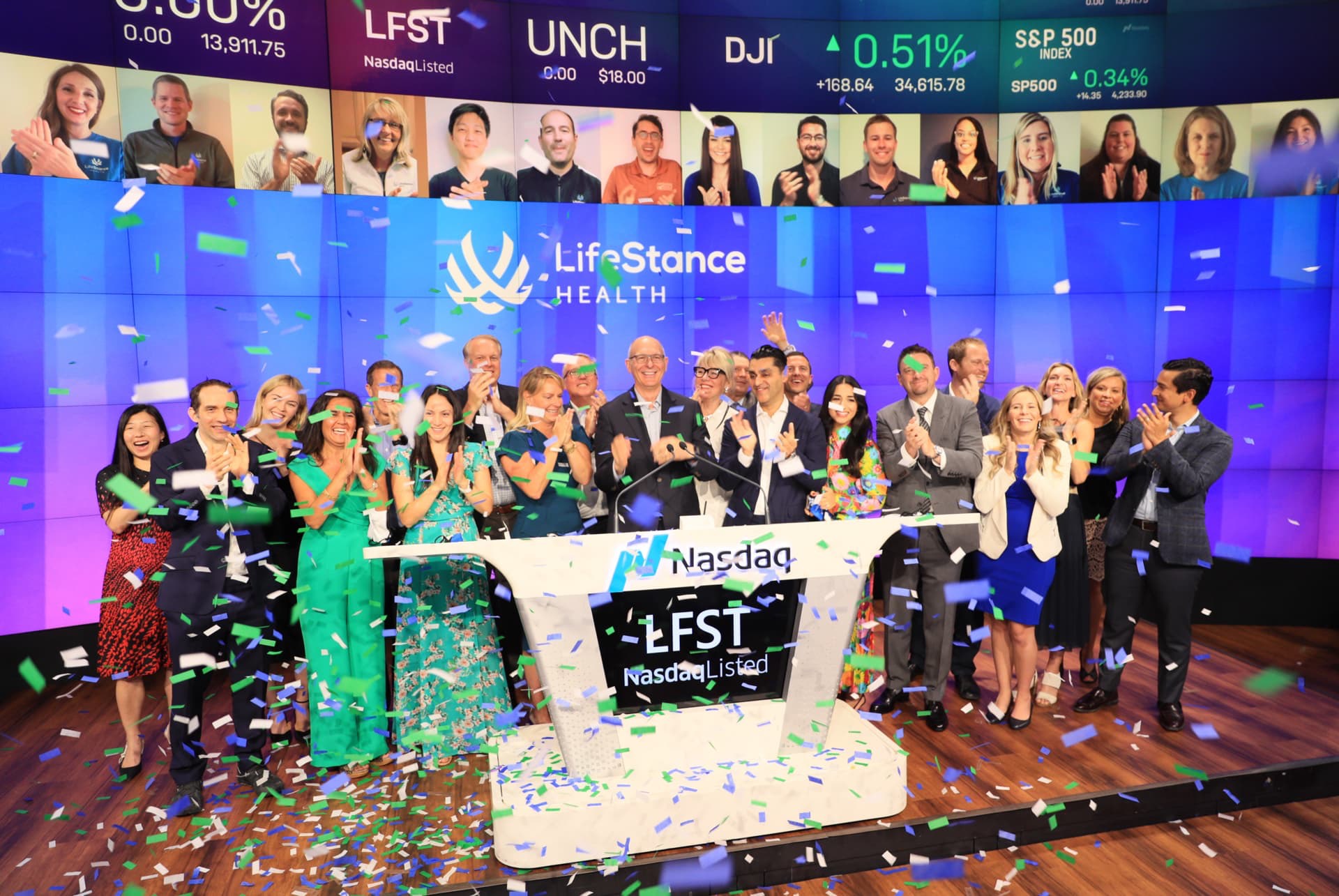
The listing changed the company’s audience. Public shareholders could now follow a business previously backed by private investors. Lester appeared in an IPO-day Yahoo Finance interview and later joined management presentations to investors. Company building had acquired a recurring appointment with the market.
In May 2021, LifeStance announced J. Michael Bruff as chief financial officer, with responsibility for finance, accounting, tax, treasury, internal audit and investor relations. That list shows how much infrastructure surrounds a public debut. A founder may stand near the bell, but a listing requires people whose most valuable work rarely produces a photograph.
LifeStance’s first trading day ended at $22 a share, compared with the $18 offering price. Its subsequent investor presentation recorded that result as a 22 percent increase. Those are figures from June 2021, a snapshot of the debut rather than a description of the shares today. Keeping the date attached preserves the meaning of the moment.
For the founder, the timeline had acquired another reference point. Radiant’s January 1998 start and LifeStance’s 2017 formation marked beginnings inside businesses. June 10, 2021 became a date that outside shareholders could share. A company built through private investment now had a public trading symbol, an opening price and a closing price. Four years of work had reached a very visible milestone.
Two ways of getting bigger
The 2021 operating tally makes the mixed expansion strategy tangible. LifeStance completed 24 acquisitions that year, taking its cumulative total to 77. It also opened 106 new centers during the year. The two figures describe different kinds of work and should remain separate. Purchasing an existing organization and opening a location are different projects, even when both enlarge a map.
The distinction is especially useful in reading Lester’s career. Earlier ventures had also involved acquisitions and expansion at existing or newly established sites. The repeated pattern is an interest in turning distributed operations into an organization with national reach. The particular business changes; coordinating people, money and locations remains a substantial part of the job.
Scale, of course, is a description of size. It does not settle whether an organization works well. The operating burden continues to grow with the map. Each new location introduces work that a headquarters presentation can make look deceptively neat. A small dot has a remarkable capacity to generate a large inbox.
He had handed over the keys before
When Lester stepped down in September 2022, Ken Burdick became LifeStance’s chief executive and chairman, effective September 7. Qureshi became president alongside his role as chief operating officer. Lester was to continue as strategic advisor. The announcement described a transition with several moving parts, rather than a founder simply disappearing from the organization.
There was precedent. In August 2006, Lester announced his retirement as Radiant’s CEO. President and chief operating officer Pamela Spaniac would succeed him; he would remain executive chairman. Spaniac had joined as chief financial officer in 1998. The succession placed a colleague with years inside the business in charge.
At the time, Lester said he wanted to spend time with his family before engaging in another business. That detail gives the corporate sequence a human scale. The next company was not an inevitable bullet point waiting to appear on a résumé. There was a pause, a successor and an intention to make room for something else.
His present role at Nira Medical makes the later LifeStance retirement easier to read accurately. He retired from a particular executive position. He subsequently returned to company building in a different capacity. Nira lists Abhishek Gupta as CEO and Lester as executive chairman, placing the daily executive role and the chairmanship with different people.
Across those transitions, the enduring question is the one his former backers brought him after Accelecare: would he build again? The answer has repeatedly involved familiar colleagues, another organization and a different distribution of responsibilities. The company name on the door changes. Lester’s interest in the people working behind it has been the more durable part of the story.