In 2019, Michael Har-Noy offered an unusually tangible account of international company-building: his airline mileage balances. He had accumulated 1.4 million frequent-flyer miles on United and another 800,000 on El Al. His work took him among Jerusalem, Phoenix and Thailand. The arithmetic came to 2.2 million miles, a number large enough to make the phrase “business trip” sound rather modest.
It is a useful place to begin his story. A researcher can be described by a field, an inventor by patents, an executive by a title. The mileage gives us movement. It suggests the practical shape of a career conducted across borders, with different operations in different places and a founder repeatedly traveling between them. The company had acquired a geography, and he was helping connect it.
Har-Noy founded Immunovative Therapies in Israel in 2004. Fourteen years later, he founded Mirror Biologics, Inc., a Delaware corporation. Across that span, he worked on research, manufacturing, equipment and the business arrangements meant to hold them together. The later chapters brought other executives, financing plans and disputes over authority. For an inventor, building the organization around an invention can become a second, much less controllable experiment.
The airfare version of a founder’s life
Before the international itinerary, there was a move from San Diego to Israel. Har-Noy went there to establish Immunovative at the Misgav incubator. A $300,000 grant from Israel’s Office of the Chief Scientist helped support the beginning. By May 2006, the company had left the incubator and raised $1.2 million from angel investors. These were separate steps: public support for an early project, then private money for a business moving beyond its first institutional home.
He arrived with previous company experience. His earlier ventures included Medcell and Biovest International. He also arrived with a candid assessment of work that had failed. “I was involved in a lot of things that didn’t work,” he said in 2007. It is a refreshing sentence in a founder’s biography, where unsuccessful attempts are often tidied into a vague prelude called experience.
“I was involved in a lot of things that didn’t work”
Michael Har-Noy, 2007
By January 2019, he was describing operations spread across three locations, with teams in Jerusalem, Phoenix and Thailand. The reported staffing was 25 in Jerusalem, 12 in Phoenix and eight in Thailand. Those figures belong to that moment in Immunovative’s history. They put people behind the mileage: a founder moving among workplaces where colleagues had their own tasks to perform, rather than simply collecting destinations for a presentation slide.
The machinery came with the idea
Har-Noy’s training crossed research and engineering. He attended an MD-PhD program at Rush University Medical School in Chicago, undertook postdoctoral work at the University of Minnesota and completed a research fellowship at Harvard Medical School. A later federal decision described him as holding a PhD in bioengineering. His background helps explain why equipment and production methods occupy so much space in his business story.
His executive biography credits his early work with a commercial-scale hollow-fiber bioreactor. A 2018 conference biography describes expertise in process-control algorithms for large-scale, high-density cell-culture bioreactors. These are specific interests in how a production process runs. The word “founder” accommodates that work rather badly; it puts a person’s place in the organization ahead of the technical problems that drew him into it.
In a 2018 interview, he laid out a manufacturing strategy centered on securing supply chains and developing critical inputs internally. He discussed proprietary processing systems, disposable products and equipment. The concern was interruption: one unavailable input could stop production. His plans gave manufacturing a central place in the business, with control over supplies and costs treated as part of the commercial design.
That choice also enlarged the organizational task. Developing equipment calls for engineering expertise. Producing supplies requires additional processes. A founder who brings more activities inside the company must arrange for more kinds of work to happen together. The attraction of control is understandable. So is the demand it places on the people responsible for making the arrangement function.
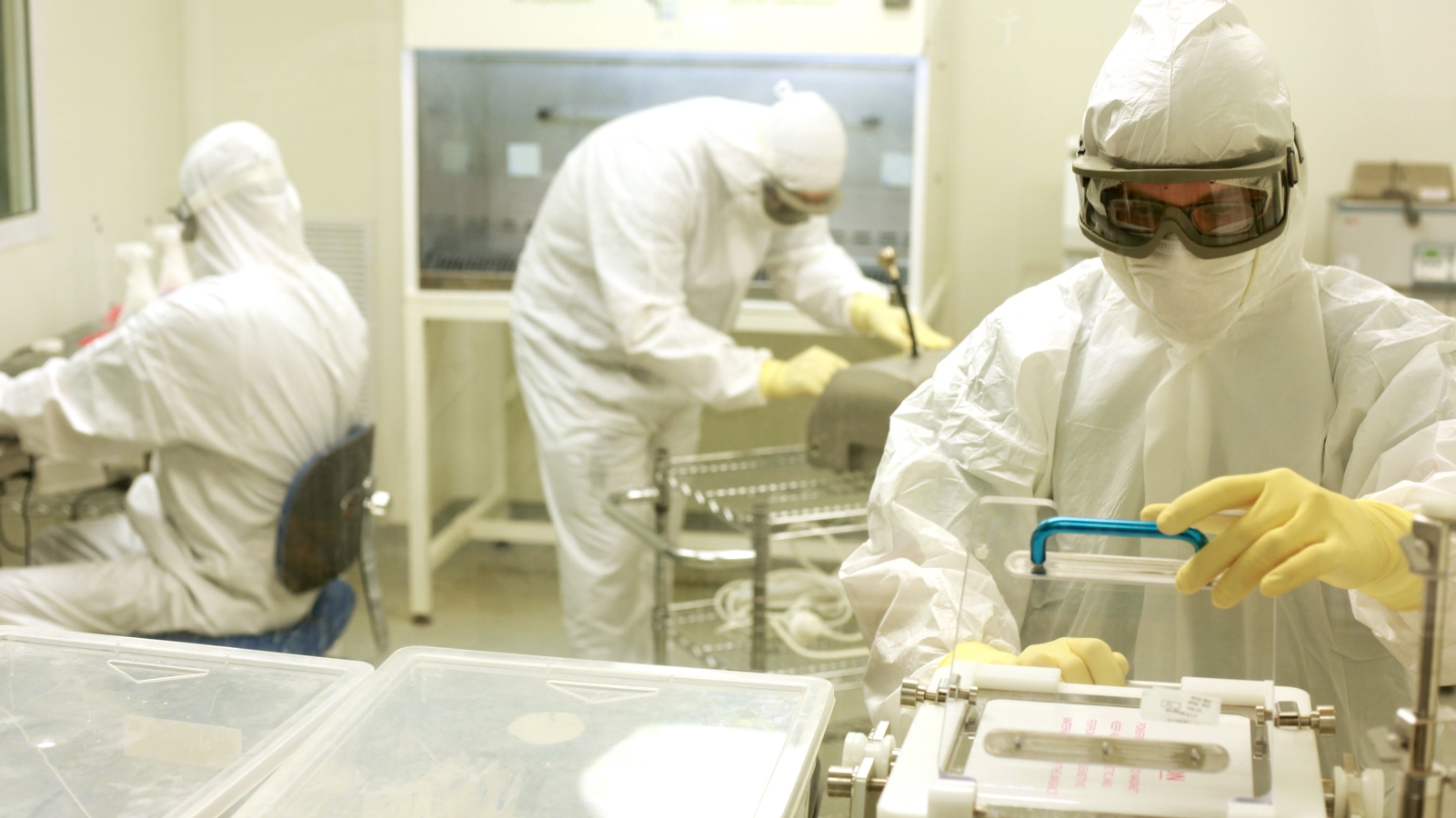
The photograph of Immunovative’s clean room supplies a visual counterweight to the executive titles. Workers in protective clothing attend to equipment and containers. It shows the sort of physical setting around which Har-Noy was building an organization. The rooms, the equipment and the people using them were part of the undertaking. A company history told entirely through financing announcements would leave much of this work outside the frame.
A new company, a familiar itinerary
Commercial arrangements had been taking shape well before Mirror’s incorporation. In 2009, Immunovative established a wholly owned subsidiary, Immunovative Clinical Research, Inc. In May 2011, Novo Energies announced a memorandum of understanding to acquire that subsidiary. The announced arrangement linked worldwide marketing rights to ongoing research payments. It was a proposed transaction, one of the business structures explored around the underlying intellectual property.
That division of responsibilities is revealing. An invention needs a route from its developer to the organization handling commercial rights and financing. Here, the route involved related entities and contractual obligations. Even in its announced form, the arrangement required attention to who held rights, who supplied funds and who had responsibility for particular activities. The company diagram was acquiring branches of its own.
Mirror Biologics, Inc. was incorporated in Delaware on November 5, 2018. The distinction matters: Immunovative’s 2004 beginning and Mirror’s 2018 incorporation are separate events. Har-Noy was Mirror’s sole shareholder and director at its founding. That placed ownership and authority together in one person at the outset, giving the new business a straightforward center of decision-making.
In January 2019, Har-Noy was scheduled to present at Biotech Showcase in San Francisco. The announcement specified 4:45 p.m. on January 7, in the Franciscan D room at the Hilton Union Square. It is the sort of wonderfully ordinary detail that sits beneath grand corporate ambitions: a founder, an investor conference and a room reservation. Companies seeking capital still have to fit their account of the future into somebody else’s timetable.
His plans that year included raising money, recruiting a professional management team and developing an automated production system. A possible public offering was also on his radar. Each ambition pointed toward a larger organization. Automation would change how work was performed; professional management would introduce additional expertise; public-company preparation would put greater weight on formal responsibilities and records.
The company acquires other voices
On August 20, 2021, Har-Noy assigned his patent rights to Mirror. The company was seeking financing and preparing for a possible initial public offering. Other executives, directors and advisers entered the picture. The business now needed decisions about governance as well as the work of an inventor. Ownership, operational involvement and board authority could no longer be understood simply by pointing to the founder.
A dispute with former chief executive Adi Raviv exposed the strain. In a 2024 federal decision, Mirror was found to have breached Raviv’s employment agreement. The court also criticized the company’s observance of corporate governance formalities. Its account described the difficulty of moving from a business dominated by its founder’s decisions toward the records, independent oversight and procedures associated with public-company preparation.
That episode belongs in Har-Noy’s biography alongside the founding dates. It shows that an organization can require changes its founder finds difficult to accommodate. The question of how a company should operate had become consequential enough to be argued in court. Technical experience and commitment to a project do not settle employment agreements or determine how directors should exercise their responsibilities.
There were more everyday examples of bringing other expertise aboard. A public LinkedIn recruitment post sought a senior control and automation engineer for Mirror in the Greater Tampa Bay Area. Har-Noy’s tags included MATLAB and SCADA. It was a concrete request for a particular skill set, consistent with his longstanding attention to the equipment and systems behind production.
In April 2024, Mirror appointed Elizabeth Adkins Czerepak as chief financial officer and vice president of corporate development. Har-Noy was identified as founder and acting CEO in the announcement. He welcomed her experience in financial transactions and partnering. The company’s stated ambitions called for someone who understood the finance side of the organization, adding another area of responsibility to the executive team.
The paperwork gets a chapter of its own
By April 2025, an article authored by Har-Noy identified him as Mirror’s chief medical officer. By August 2026, a Delaware court order described him as founder and former director of Mirror USA. Those dated descriptions mark different points in his relationship with the company. Founding a business remains part of a person’s history even when positions and authority inside it change.
The August 11, 2026 order addressed his entitlement to advancement of legal expenses connected with litigation in Israel. Mirror USA had brought the underlying action; Har-Noy sought payment under its bylaws. The Delaware court held him entitled to advancement, along with expenses for enforcing that right and prejudgment interest. The ruling concerned those payment obligations. The underlying allegations remained a separate question.
It is a sober later chapter for a career that began its Israeli business phase with an incubator and a grant. Har-Noy’s story now includes the machinery of corporate life: executive appointments, assignments of rights, employment agreements, board positions and bylaws. Each was part of the structure assembled around the original research. Some enabled work to proceed; others became contested.
The airline balances remain a particularly human detail. In 2019, Har-Noy described the distance involved in keeping an international enterprise connected. The subsequent business record adds another kind of distance, between inventing something and managing the organization built around it. His career gives both tasks their due. The first can begin with an individual’s work. The second keeps bringing other people, and their authority, into the room.