The easiest way to understand Steve Goodbarn's career is to begin with a number: 330 billion. It is not a DNS query count, though it would fit comfortably in that company. It is the amount, in dollars, that Janus Capital managed by the end of the period in which Goodbarn served as its chief financial officer. When he arrived in 1992, the figure was about $10 billion. By the time he left in 2000, Janus had grown internationally and the number had acquired two extra digits and a great deal of organizational consequence.
Scale teaches its own manners. It punishes casual controls. It turns a small process error into a large public problem. Goodbarn had already spent 12 years at Price Waterhouse, the accounting firm that later became part of PwC. At Janus, he was vice president of finance, treasurer, CFO and a member of the executive committee. The work crossed corporate and fund accounting, tax, regulatory reporting, legal compliance, trading operations and facilities. In short, he learned to inspect the beams while everyone else admired the building.
Then, in 2002, he co-founded a software company devoted to a part of the internet most people encounter without ever seeing: the Domain Name System. DNS translates a familiar name into the numerical address computers need. It is the internet's telephone directory, if telephone directories had to answer billions of questions, repel attackers and never take lunch.
The accountant finds a different ledger
The jump from mutual funds to network security looks dramatic only if accounting is understood as arithmetic. At senior levels, it is closer to architecture: who can touch what, which assumptions hold, where failure can travel and how an organization proves that its promises are real. Cybersecurity asks much the same questions, but the assets move at machine speed.
Goodbarn arrived at Secure64 with financial and administrative responsibilities. The technical conception came from co-founder William S. Worley, a former Hewlett-Packard fellow and chief scientist whose work included processor architecture. Early Secure64 software was designed around Intel's Itanium processors. The team was trying to reduce the exposed surface beneath an application, using a compact execution environment rather than depending on a conventional general-purpose operating system.
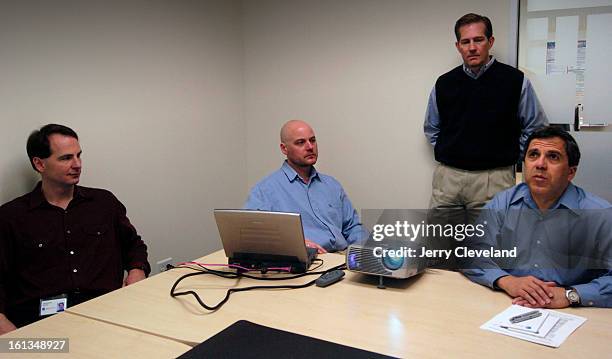
A Denver Post photograph from March 2005 catches the company before the language of cloud platforms became ordinary. Three men sit around a pale conference table, two laptops open, wires trailing like loose punctuation. Goodbarn stands behind them in a sweater vest, watching. There is no theatrical founder pose. The picture records the actual grammar of early enterprise software: demonstration, observation, another question.
He became CEO that year. In 2007, Secure64 released commercial DNS server software built on its SourceT architecture, describing resistance to malware and network attacks as design properties rather than accessories. Goodbarn framed DNS as a weak link in IT infrastructure. It was the kind of diagnosis an audit partner might appreciate. Find the dependency. Name the exposure. Build the control near the weakness.
“Secure64 DNS Manager fills an important need for service providers that want to reduce the costs and headaches related to DNS servers.”Steve Goodbarn, 2012
A product history written beneath the browser
Secure64's product line widened with the internet's demands. A DNSSEC signing appliance received federal cryptographic certification in 2009. DNS caching software added support for the transition from IPv4 to IPv6. A management product gave network engineers a central place to configure servers, install upgrades and watch performance across multiple locations. Later versions addressed reverse DNS for the much larger IPv6 address space.
The names are technical; the commercial argument is not. A carrier with DNS servers scattered across regions does not want each upgrade to become a small expedition. A mobile operator moving to IPv6 cannot treat address translation as a science fair project. A government system signing DNS records needs to know where its cryptographic keys live. Secure64's work sat where security, operating expense and service availability had to agree with one another.
Goodbarn was never pretending to be the engineer who invented the underlying architecture. His public role was to make the case around it, hire and organize the company that could sell it, and connect technical properties to the anxieties of buyers. This division of labor is easy to miss in founder mythology, which likes one person to write the code, close the contract and invent the future before breakfast. Secure64's record is more prosaic and therefore more believable: specialists built together.
Boardrooms above, infrastructure below
While Secure64 developed, Goodbarn also spent years in public-company governance. He joined the DISH Network board in December 2002 and remained until May 2018. SEC filings identified him as a CPA and the board's audit committee financial expert. He served on compensation and nominating committees as well. From 2007 to 2008, he sat on the EchoStar board during the initial spin-off period, and he later served on the board of mobile-video company MobiTV.
These were not decorative affiliations. An audit committee must ask whether controls work when management is optimistic, whether disclosures match the underlying reality and whether risk has been assigned an owner. That experience sits neatly beside infrastructure security. In both rooms, the useful person is often the one willing to ask what breaks, who notices and how quickly the organization can recover.
The exit, the interval and the return
In October 2016, after 11 years as chief executive, Goodbarn handed the role to Joseph Gersch, Secure64's longtime technical and operating leader. Goodbarn stayed on the board and served as an adviser. His statement at the time emphasized the platform rather than his departure: DNS existed in every country and could be used to distribute trust and security. The succession gave a technical executive the chair and left the founder close enough to help.
Three years later, Goodbarn returned. The company he resumed leading was not the company in the 2005 photograph. Secure64 reported that its subscriber base had grown more than 130 percent over two years and passed one billion. It had added 10 customers, built a larger order backlog and moved further toward recurring subscription revenue. Six of 15 major operators, by the company's count at the time, used its DNS technology.
His return also contained a revealing piece of credit. Goodbarn said those carriers had trusted Secure64 because of its technologists, sales, marketing, support and leadership teams. Founders are routinely asked to embody a company. Here, the founder redirected attention to the plural noun.
“They have placed this trust in Secure64 because of our people.” The sentence makes room for the company that continued to grow while its co-founder was away from the CEO chair.
From bespoke machinery to the cloud
The technological arc has been equally instructive. Secure64 began by exploiting particulars of the Itanium processor. Two decades later, it introduced CloudDNS using containers-as-a-service and Kubernetes. In between came virtualized products, security services, content filtering, DDoS mitigation and tools for detecting DNS tunneling. A company that began close to the chip learned to live in abstractions several floors above it.
That kind of migration is not a repudiation. It is what endurance looks like in enterprise technology. Customers keep old requirements even as deployment models change. They still want speed, predictable operation and defenses near the network layer. They simply want those properties packaged for the infrastructure they now run.
Goodbarn's own trajectory contains the same pattern. The Price Waterhouse accountant did not disappear when the software founder arrived. The Janus CFO did not vanish when the cybersecurity executive began explaining DNSSEC. Control, scale, delegation and verification kept returning in different clothes.
In February 2024, Secure64 appointed Brian Sloat chief operating officer. In September 2025, Goodbarn, described in that announcement as founder and executive chairman, announced Sloat's promotion to president. The company's current management page lists Goodbarn as chief executive and Sloat as president. Titles in a private company can tell a slightly untidy story; the direction is clearer. Operational authority has widened while the founder remains connected to strategy and governance.
The quiet work of keeping names true
There is a pleasing symmetry in Goodbarn's two careers. Accounting asks whether the name on an asset corresponds to something real. DNS asks where a name should lead. Both systems depend on records, authority and the unromantic discipline of getting the answer right repeatedly.
The public internet prefers its protagonists visible: the app, the device, the personality onstage. DNS sits underneath the spectacle, translating names in fractions of a second. Goodbarn has spent more than two decades at that lower level, where success often means nobody has a story to tell because the page opened, the request resolved and the attack went elsewhere.
A career built there will never be as legible as one built on a consumer screen. Perhaps that is the point. Goodbarn's path from audit files to name servers suggests that invisible systems still need visible judgment. The ledger changed. The obligation to make the numbers tell the truth did not.