In 2010, Michael Ehlers had a job description that could make an ambitious scientist stop updating his résumé. At Duke, he held the George Barth Geller Professorship of Neurobiology. He was also a Howard Hughes Medical Institute investigator. Then he left for Pfizer. A career that had acquired considerable academic weight was about to change its center of gravity.
Six years later, he gave the move a wonderfully dry retrospective title: Lessons from a Recovering Academic. It appeared in Cell, a serious place for a small joke about professional identity. By then, Ehlers was moving again, this time to lead research and development at Biogen. The professor had become a corporate research executive without losing the habit of writing things down.
His later career would bring venture capital, company incubation and an unusually circular relationship with the chief executive’s chair. At Ascidian Therapeutics, he was founding CEO, then chair, then CEO again. In July 2026, he continued as chair after another executive handover. The sequence is easier to understand as a series of working arrangements than as a ladder. Several rungs lead back to the same company.
An unusually good moment to leave
To appreciate that first move, consider what Ehlers already had. In March 2005, while an associate professor at Duke, he was selected as one of 43 new HHMI investigators in a national competition. The appointment placed him in an organization that explicitly offered researchers freedom and flexibility. Five years before he entered industry, an institution had already given him considerable room to pursue his work.
The academic record included the 2003 Eppendorf & Science Prize in Neurobiology, followed by the John J. Abel Award in Pharmacology and the Society for Neuroscience’s Young Investigator Award in 2007. These were recognitions attached to his research, well before company creation became a prominent part of his biography.
Leaving that setting changed the scale and context of his work. The 2010 move put him in charge of neuroscience research at Pfizer. It is the first major turn in a career that would repeatedly put scientific experience to work inside a different kind of institution. The title on the door changed; the scientific training came along.
From an endowed professorship at Duke to research leadership at Pfizer.
A collection before a career
Ehlers grew up in rural Nebraska. His early interest in science took the form of collecting insects and rocks, a beginning with more pockets than laboratory equipment. His biography also records a personal nudge toward neurobiology: his girlfriend, who later became his wife, suggested that mathematics was involved in the field.
He plays French horn and piano. His formal training took him to Caltech, where he earned a chemistry degree in 1991, and to Johns Hopkins for MD and PhD degrees. Richard L. Huganir was his doctoral adviser. Those details give the later executive biography a human scale: specimens, instruments, a conversation and years of study came before the management titles.
Learning to work at a different scale
At Pfizer, Ehlers’s responsibilities expanded beyond a single research specialty. He became group senior vice president for BioTherapeutics research and development and led the Cambridge and Boston research sites. He also had responsibility for a network of collaborations with academic and government institutions. The work now involved keeping organizations connected as well as directing research.
Biogen announced his appointment in April 2016, with his tenure beginning in late May. He would oversee global research, discovery, development and related functions, report to chief executive George Scangos and join the management team. By that announcement, he had authored more than 100 scientific papers. His publication record and his management responsibilities occupied the same biography.
There is a useful coincidence in the calendar. Lessons from a Recovering Academic was published on May 19, 2016, just as he was making that next move. The essay examined assumptions about scientific work in universities and industry, emphasizing projects that span disciplines, sectors and institutions. Its subject was collaboration across boundaries; its author was busy crossing another one.
The title supplies a little relief from the solemn language that accumulates around senior appointments. Ehlers had found a way to describe a consequential professional change with a wink. The substance concerned how work gets done when people with different expertise and institutional habits have to accomplish something together.
At Biogen, the organizational dimension was substantial. By the account accompanying his next appointment in 2019, he had overseen more than $2 billion in annual research and development investment. That figure describes the responsibility attached to his role. It also helps explain the distance between running an academic research group and deciding how a large company distributes its scientific attention.
- 2010PfizerFrom academia into industry
- 2016BiogenGlobal R&D leadership
- 2019Apple Tree PartnersScience, capital and company creation
- 2024MPM BioImpactEntrepreneur Partner
- 2026Formation BioCSO and Head of R&D
The founder who came back
In October 2019, Apple Tree Partners announced Ehlers as chief scientific officer and venture partner, effective October 21. The appointment included an operating job: CEO of portfolio company Limelight Bio. Investing and running a company arrived together. It was a practical introduction to the overlap between judging scientific ideas and taking responsibility for an organization built around them.
Ascidian became one expression of that work. Ehlers led its incubation as founding CEO. At the public launch in October 2022, Apple Tree Partners announced $50 million in Series A financing. Romesh Subramanian became president and CEO, and Ehlers moved to board chair. The founding work had happened before the announcement that introduced the company to a wider audience.
That distinction matters. A public launch can look like a beginning, complete with a financing figure and a newly appointed executive. Here, it also marked a handover. Ehlers’s relationship to Ascidian was already changing by the time the company was publicly presenting itself. The founder’s first act included preparing to hold a different job.
Thirteen months later, the arrangement changed again. On November 8, 2023, Ascidian announced a $40 million Series A extension committed by Apple Tree Partners and Ehlers’s return as interim president and CEO. He succeeded Subramanian while also chairing the board. The company was turning back to the person who had led its incubation.
The two announced financing commitments amounted to $90 million. More revealing than the arithmetic is the combination of roles: Ehlers had participated as a company builder, a venture partner, a board chair and a returning executive. Ascidian required several different versions of his experience, sometimes at the same time.
Series A plus extension commitment from Apple Tree Partners.
The colleagues inside the chronology
Executive histories can make each appointment look solitary. Ehlers’s record keeps introducing other people. At Biogen in 2017, Anirvan Ghosh arrived to lead research and early development, reporting to him. Later that year, Anabella Villalobos joined to lead biotherapeutic and medicinal sciences. These appointments put experienced scientists into defined leadership roles within the organization he headed.
At Ascidian, Robert Bell joined as head of research in 2021 and became the company’s first chief scientific officer in August 2024. The announcement also brought in leaders in regulatory strategy, technical development and talent. Company building had become a matter of assembling complementary expertise. The founding scientist could occupy several chairs, but the company required a table.
Daniel Rosan supplies a more personal connection. In a public message welcoming Ehlers’s move to MPM BioImpact in November 2024, Rosan described him as a longtime mentor and friend. At that point, Ehlers would retain his Ascidian CEO role while joining MPM as an entrepreneur partner. Their working relationship continued across that additional institutional boundary.
“The team is simply awesome.”
Michael Ehlers, on joining MPM BioImpact, November 2024
The sentence is pleasingly free of committee polish. MPM’s announcement described entrepreneur partners as investor-operators who worked alongside scientists and investment professionals. Ehlers was bringing both scientific and operational experience to that arrangement. His own brief description of the people involved was considerably less formal than the job specification.
Two days in July
On July 21, 2026, Ascidian announced a planned leadership transition. Ehlers had stepped down as president and CEO and would continue as chair, guiding scientific and company strategy. Rosan became president while retaining his financial and business responsibilities. The mentor and friend of Rosan’s earlier message would remain involved from the board.
“It has been a privilege to serve as Founding CEO, and I am proud of what we have built.”
Michael Ehlers, July 21, 2026
The following day, Formation Bio announced Ehlers as chief scientific officer and head of research and development, joining from MPM. His remit included portfolio strategy and the scientific direction of the company’s AI platform. Another change of setting, with new technology explicitly included in the responsibilities.
Formation’s announcement credited him with founding four companies during his time at Apple Tree Partners. Its co-founder and CEO, Benjamine Liu, welcomed someone with experience across scientific and organizational work. The appointment extended the pattern that began with leaving Duke: an established scientist taking his experience into another institution with a different structure.
Look back across those moves and the recurring action is concrete. Ehlers takes a role, works with other people, and eventually changes the arrangement. At Ascidian, that has meant returning as well as handing over. In July 2026, it meant keeping a chair at one company while taking a new job at another. The résumé needs a few extra lines. The story is better for them.
Read, watch & follow
- Ascidian Therapeutics
- Michael Ehlers on LinkedIn
- The July 2026 Ascidian transition
- Formation Bio’s July 2026 appointment
- Lessons from a Recovering Academic
- Duke’s 2005 HHMI announcement
- The 2010 career conversation
- Apple Tree Partners’ 2019 appointment
- Ascidian’s 2022 launch
- The November 2023 CEO return
- The MPM BioImpact appointment
- Ehlers at Caltech’s Merkin Institute
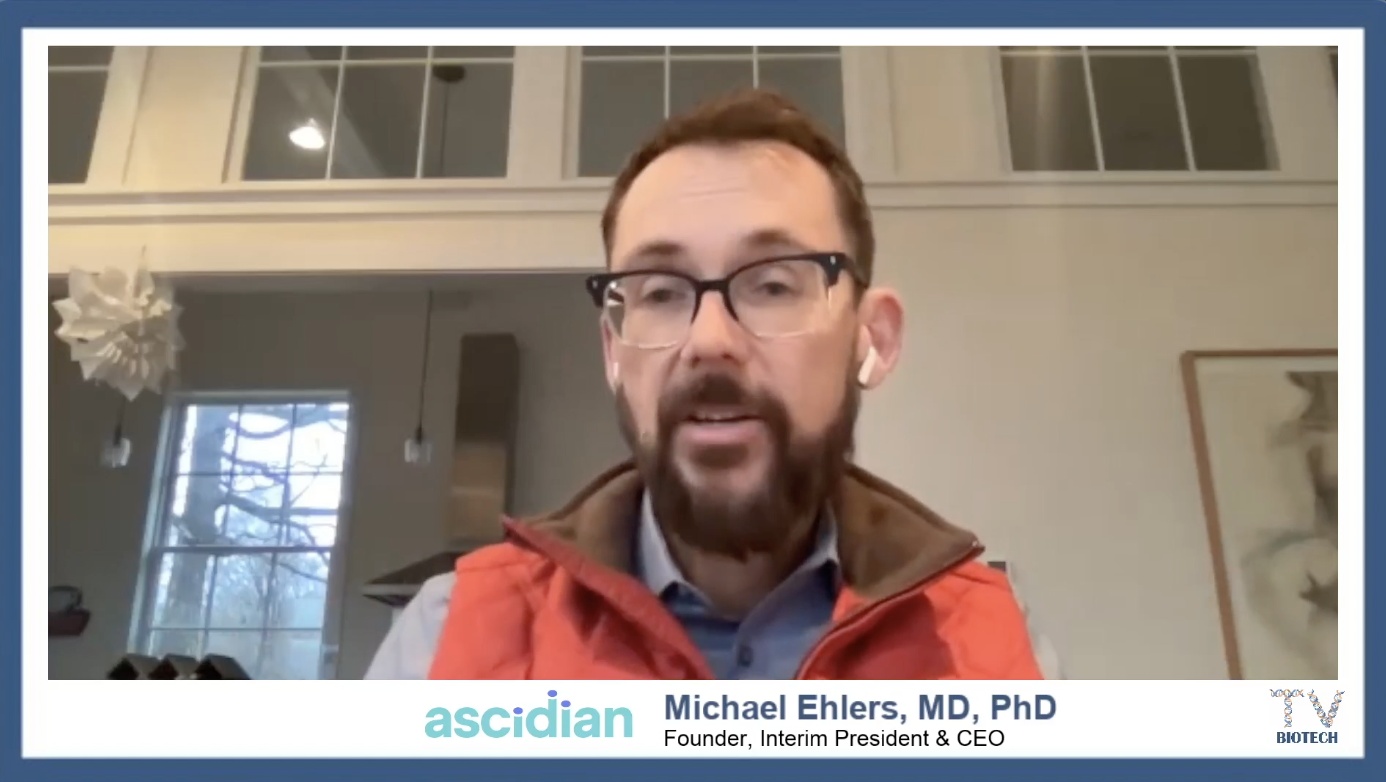
- Watch the January 2024 BiotechTV interview