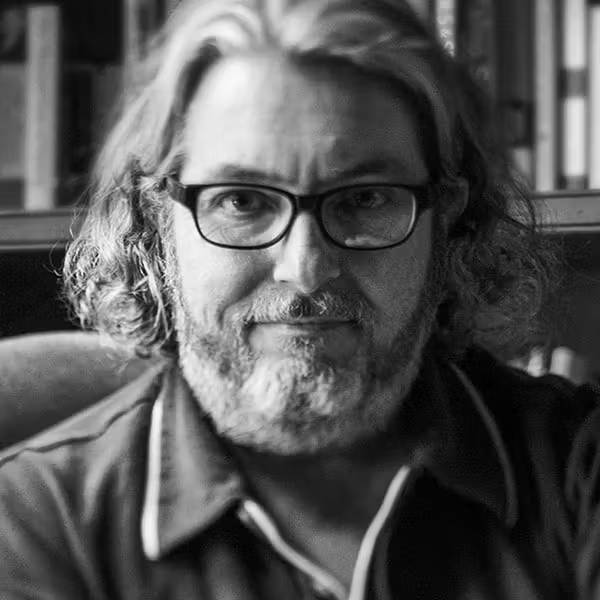
The Man Who Picks Winners Without Telling Anyone
In 2010, Kara Swisher wrote that Michael Dearing was "the hottest angel investor you've never heard of." He declined to be interviewed. He had lunch with her instead, and somehow talked her out of the video segment. The profile ran. The obscurity continued. This is, apparently, exactly how he likes it.
Dearing runs Harrison Metal, a solo-GP seed fund he's operated since 2006 out of Woodside, California. Six funds. One general partner. One hundred and seven portfolio companies. The math on that is either reckless or brilliant, and the exit record suggests the latter: AdMob sold to Google for $750 million. Acompli went to Microsoft for $200 million. Signal Sciences fetched $775 million from Fastly. PagerDuty rang the bell on the NYSE. MasterClass hit unicorn status eight years after Dearing first backed it - a timeline that says everything about his investment philosophy and nothing about impatience.
What makes Dearing interesting - genuinely interesting, not press-release interesting - is where he came from. He didn't graduate from a computer science program. He studied economic history at Brown, got an MBA with distinction at Harvard, and then spent the early part of his career at Bain, at Filene's Basement, and at Disney's corporate strategy team. He ran Industrial Shoe Warehouse as COO and then CEO. And when that business hit turbulence, he did something very Michael Dearing: he taught himself to sell on eBay to move the inventory. That experiment in liquidation turned into a career at eBay itself, where he eventually ran a business unit generating $1.7 billion in annual revenue and nearly $20 billion in gross merchandise sales. He built Buy It Now. He built eBay Stores. He built ProStores and Want It Now. He is, in the most literal sense, an operator who became an investor.
That matters more than it might sound. In a world of VCs who've never run a company's operations, Dearing brings a very specific kind of pattern recognition: he knows what competent management looks like because he's practiced it, studied it, and taught it. His contention - that great general management is "the scarcest input in our system" - isn't a talking point. It's a research position.
"We're short on great general management. The scarcest input in our system right now has been in short supply for 200-plus years of industrial capitalism - exceptional general management."Michael Dearing - Harrison Metal
Five Distortions That Are Actually Superpowers
In 2017, Dearing published "The Cognitive Distortions of Founders" on Medium. It's the kind of piece that circulates quietly for years before becoming canonical. Drawing on Aaron Beck's clinical cognitive behavioral therapy framework, Dearing identified five ways that founders systematically misread reality - and argued that each one, if properly understood, functions as a superpower rather than a pathology.
The piece works because it doesn't moralize. Dearing isn't scolding founders for their psychology - he's mapping it. Each distortion comes with what he calls "shock absorbers": structural practices that let founders channel the distortion's energy without the destructive blowback. It's clinical in the best sense: diagnostic, precise, and oddly kind.
His companion piece, "Factory vs. Studio," is equally sharp. He ran a classroom simulation at Stanford where students built children's books under radically different environmental conditions - assembly-line factory versus free-form studio. The finding: environment determines creative versus efficient output more than individual personalities do. It sounds obvious until you realize how few founders think about what kind of environment they're actually building.
Predetermined skill lists for early hires signal the wrong kind of thinking about what a seed-stage company actually needs.
Dearing has been consistent on this point for over a decade. He prefers priced rounds, regardless of how inconvenient they are.
The Professor Who Taught Entrepreneurship Like It Was Engineering
From 2006 to 2014, Dearing held a position as Consulting Associate Professor at Stanford, teaching across three departments simultaneously: Mechanical Engineering, Management Science and Engineering, and the d.school. He designed courses from scratch - Launchpad, Entrepreneurial Finance, Creative Product Marketing, Creating Infectious Action - and they became among the most popular in the university.
His pedagogical style was steeped in industrial history. He taught Daniel McCallum's 19th-century railroad management principles as seriously as he taught modern venture finance. McCallum - a railroad superintendent from the 1850s who developed the first formal organizational chart and the principle of delegating authority while maintaining accountability - became something of a patron saint for Dearing's worldview. "Thank You, Daniel McCallum," he later wrote on Medium, is both a tribute and a manifesto: align teams on priorities, delegate responsibility, measure progress, make corrections, treat people with respect. Simple. Rare. Apparently, the framework that built a $20 billion commerce business also builds good startups.
He also taught alongside Reid Hoffman in Stanford's CS183C Blitzscaling course, which produced a generation of Silicon Valley doctrine. He was, by all accounts, the operator in the room - the one who knew what actually happened inside the machine, not just around it.
"The special founder goggles create cognitive distortions. And the cognitive distortions create superpowers."Michael Dearing - "The Cognitive Distortions of Founders" (2017)
From Filene's Basement to $20B in GMV
When the Math Gets Loud
| Company | Acquirer / Event | Amount | Year |
|---|---|---|---|
| AdMob | $750M | 2009 | |
| Acompli | Microsoft | $200M | 2014 |
| TellApart | ~$533M | 2015 | |
| MoPub | ~$350M | 2013 | |
| Signal Sciences | Fastly | $775M | 2020 |
| PagerDuty | NYSE IPO | Public | 2019 |
| Orbit | Postman | Undisclosed | 2024 |
| Good Eggs | GrubMarket | Undisclosed | 2024 |
Four Dogs, a Cat, Four Chickens, and a Quietly Radical Worldview
Michael Dearing lives in a rural setting. He has four dogs. He has a cat. He has four chickens. He has said, in his Medium bio, that he likes animals more than he likes most people. This is probably not hyperbole.
He describes himself as an INTJ - the Myers-Briggs type most associated with strategic, systems-oriented thinking and a genuine preference for working alone. He is, by every account, a person who has designed his professional life to minimize friction with people and maximize impact on ideas. Harrison Metal, run as a solo GP with a small support team, is not an accident of circumstance. It's the organizational expression of a very specific personality.
His intellectual influences are unusual for a Silicon Valley investor. He reads economic historians. He teaches 19th-century railroad executives as management models. His favorite novel is A Confederacy of Dunces by John Kennedy Toole - which is, among other things, a book about a man who believes he's smarter than everyone else and is both right and catastrophically wrong about this simultaneously. Dearing admires David Sedaris. He describes his religion as "the Creative Destruction sect of Capitalism" - a joke that isn't entirely a joke.
He published a children's book. It's called "The Mutually Beneficial Trading Tree," and it's a parody of Shel Silverstein's "The Giving Tree," rewritten as a treatise on voluntary exchange and mutual benefit. He published it under the name "Grasshopper Harrison" through Harrison Metal Press. The ISBN is real. You can buy it.
He sits on the board of the Grace Science Foundation, which funds research into NGLY1 deficiency - a rare genetic disease. He funds Project Ellis, which provides lawyers to assist asylum seekers. These affiliations aren't advertised. He doesn't talk about them in interviews, because he doesn't do interviews. They exist because he chose them.
"I like all animals more than I like most people."Michael Dearing - Medium bio
Studios, Not Factories
At the heart of everything Dearing does is a single conviction: early-stage startups are creative studios, not factories. The distinction sounds semantic until you sit with it. Factories optimize. They run processes. They reduce variance. Studios create. They generate options. They increase variance - controlled variance, directed at making something new.
Most operational advice given to early startups is factory advice applied to studio problems. Optimize the funnel. Reduce churn. Hit the number. Dearing's counterargument - made in the classroom, in his writing, and apparently in how he runs board meetings - is that these tools come too early. You can't process-manage your way to product-market fit. You have to create your way there.
At the same time, he's not romantic about chaos. The McCallum framework - delegate responsibility clearly, measure progress honestly, make corrections when needed, treat people with respect - is not gentle management. It's rigorous management applied at the right stage with the right expectations. He teaches founders to run 1:1 meetings, to set objectives, to measure performance - not because startups should act like enterprises, but because clarity of accountability is what lets creative work happen without everyone drowning in ambiguity.
He also teaches pricing. Specifically, he teaches that pricing is not a math problem. It's a judgment problem. That sentence, delivered at a 2014 Harrison Metal talk, is the kind of thing that sounds obvious and then slowly rewires how you think about the entire product development process. Price is signal. Price is identity. Price is a lever most founders are afraid to pull because they've been taught it's a calculation, not a decision.
A framework Dearing returns to constantly. The number is the last thing you set - after you understand what you're signaling to whom.
Align on priorities. Delegate responsibility. Measure progress. Make corrections. Treat people with respect. Dearing's been teaching this since 2006. It still works.
His definition of authentic entrepreneurial drive. If you're working to convince people, the idea isn't ready. If they convince themselves, it might be.