Michael Chang. A physicist's stare, an engineer's patience, and a founder's habit of asking the data one more question.
He left the optics lab for the factory floor, then built JarviX so a foreman could ask a question and get an answer - without ever writing a line of code.
Michael Chang runs Synergies Intelligent Systems out of Cambridge, Massachusetts, and the thing he is trying to kill is the wait. The three-week wait for an analyst. The dashboard nobody reads. The question a factory manager has at 2 a.m. that dies because there is no one around who speaks SQL. His answer is JarviX, an augmented-analytics platform where you type a plain-language question - why did yield drop last Tuesday? - and the machine goes and finds out.
Synergies calls it search-driven analytics: no-code tools, machine learning and natural-language processing stitched together so that discovery, visualization and explanation happen in one breath. The pitch is deceptively small. Let people talk to their data. The consequence is large. If it works, the person who understands the problem no longer has to hand it off to the person who understands the query language.
Chang built the company in 2016 and developed its core AI analytics architecture in collaboration with MIT, where he earned his Ph.D. in electrical engineering and computer science. The platform now points at manufacturing, finance, retail and logistics - the unglamorous industries where a half-percent improvement in yield is worth a fortune, and where most of the data still sits in silos nobody can see across.
Gartner has taken notice, naming Synergies among the Global Top 40 vendors in augmented analytics and tagging it a Cool Vendor. In 2022 the conviction got a price tag: a $12 million Series A led by NGP Capital, with New Future Capital, to push JarviX deeper into the factory.
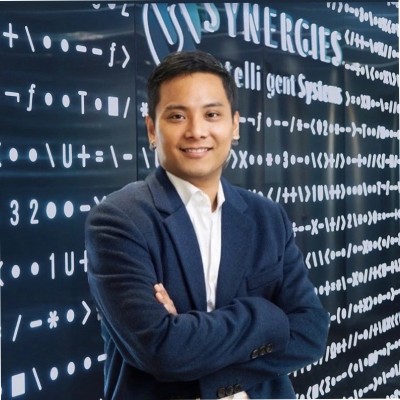
Chang's resume reads like someone who kept getting more curious, not more focused. He picked up a master's in biomedical engineering at National Taiwan University in 2007, then spent his MIT years in territory most founders never touch - optics, machine vision, big-data platforms, even the exotic edges of computational biology and fusion-plasma feature detection.
Then he did something unusual for a research scientist. He went to the factory. As an AI consultant and R&D director connected to Foxconn's leadership office, he pointed his methods at the least romantic dataset imaginable: production yield on a Shenzhen line. The work reportedly lifted the yield rate and saved the plant around $20 million - and it taught him where the real bottleneck lived. Not in the algorithm. In the gap between the person with the question and the person who could run the query.
Along the way he co-founded Flyberry Capital, a quantitative investment venture, held a Distinguished Fellow post at Taiwan's Industrial Technology Research Institute, and took a professorship at the University of Shanghai for Science and Technology. Three hats, three time zones, one obsession: making analysis something you can simply ask for.
There's a large market opportunity in the industrial sector. The refinement of production methods and the rise in labor costs accelerated the adoption of digital transformation.
- Michael Chang, on the $12M Series A
Type a question in plain language. No SQL, no code, no waiting on the analytics team.
The platform discovers, visualizes and describes what matters in a dataset for you.
Built to make manufacturing agile - a single decision engine instead of a wall of dashboards.
Aimed at finance, retail and logistics too - anywhere silos hide the answer.
Chang's endgame is a world where the dashboard is a relic and the coding requirement is gone. Where a plant manager, a merchandiser or a logistics lead poses a question in ordinary words and gets an AI-generated answer back - and legacy industries finally get to think as fast as they run.
Compiled from public sources including LinkedIn, The Org, NGP Capital, CIOReview, Crunchbase, CB Insights and Bloomberg. Figures such as the reported ~$20M Foxconn savings reflect public reporting. Where facts could not be verified, they were omitted.