Michael Berman started Ncontracts in a windowless office above a Mexican restaurant. There was one other employee. It was 2009, and the business concerned a subject unlikely to interrupt anyone’s lunch: the agreements between financial institutions and the outside companies they depended on. Yet those agreements contained something Berman had learned to recognize in his legal career. A contract could describe a service neatly while leaving a complicated operational problem underneath it.
A bank could hire another business to process payments or support its technology. The relationship created obligations, dependencies and questions about what would happen if things went wrong. Berman built a company to help financial institutions keep track of them. The office offered little in the way of a view. The problem offered considerably more.
The office above the restaurant
Before becoming a founder, Berman served as general counsel for Goldleaf Financial Solutions, Tecniflex and Imagic Corporation. His work brought him into contact with regulatory requirements, compliance and contract management, including the development of information systems to organize those responsibilities. He had an undergraduate degree from Cornell University and a law degree from the University of Tennessee. The route into software ran through the lawyer’s office.
That is a useful detail in understanding his choice of business. Contracts were familiar working objects. He had seen how agreements, vendors and risk could become fragmented responsibilities. Ncontracts gave him a way to work on the process surrounding the document, as well as the document itself. The company’s initial focus on vendor oversight followed directly from problems he had encountered professionally.
His geographical story also has more continuity than the usual startup relocation tale. Born in Chicago, Berman moved with his family to Nashville as an infant. He grew up in the area and built Ncontracts in Brentwood. In a 2019 interview, he said he was at his desk by seven on most weekday mornings. The details suggest a business developed through repeated working days, close to home, rather than a dramatic departure for somewhere else.
Six years, then a different sort of company
The first outside investment chapter that changed the company’s organization arrived in 2015, when Mainsail Partners invested. Berman had already spent six years serving financial institutions. Early support had included friends, family and angel investors. The work of establishing the business preceded the work of expanding it with an institutional partner.
Mainsail helped recruit executives across finance, technology, sales, marketing and human resources. Product development, previously outsourced, moved inside the company. By Mainsail’s exit, the product team included a chief technology officer and more than twenty full-time developers. Three acquisitions broadened an offering that had begun as a technology-supported service into a business more heavily built around software.
Those changes give the growth story its substance. A founder can remain in the same chair while the job changes around him. Berman now needed an organization capable of developing products, supporting customers and selling a wider range of services. In January 2020, Mainsail sold Ncontracts to Gryphon Investors. Berman continued to lead it. The investor changed; the accumulated work and customer relationships carried forward.
Buying a wider view
In December 2023, Ncontracts acquired Quantivate, another provider of governance, risk and compliance software for banks and credit unions. The announcement put the combined workforce at 350 and the customer base above 4,000 financial institutions. Berman remained CEO. Quantivate brought an established set of capabilities into the portfolio, expanding the ways customers could organize their work.
September 2024 brought a larger rearrangement. Ncontracts acquired third-party risk business Venminder, while software investor Hg bought out Gryphon and Venminder’s previous shareholders. Hg backed Berman to lead the combined company. The transaction was expected to take the customer base above 5,000. Its financial terms were undisclosed.
The pattern makes Berman’s career unusually continuous through changes in ownership. He had led the business before Mainsail, through Gryphon’s investment and into Hg’s backing. Acquisitions widened the company’s reach within the same professional territory: financial organizations trying to understand their obligations and dependencies. They also brought a practical complication. A broader portfolio must still make sense to the person trying to get a day’s work done.
Some expansion concerned the movement of information inside the institution. Ncontracts acquired the OnSemble intranet business in 2021, following Banc Intranets in 2020. Berman described customer demand for internal communication and information-sharing workflows. The connection to risk management is easy to follow: policies and decisions have limited usefulness if the people who need them cannot find them.
Three books, one recurring word
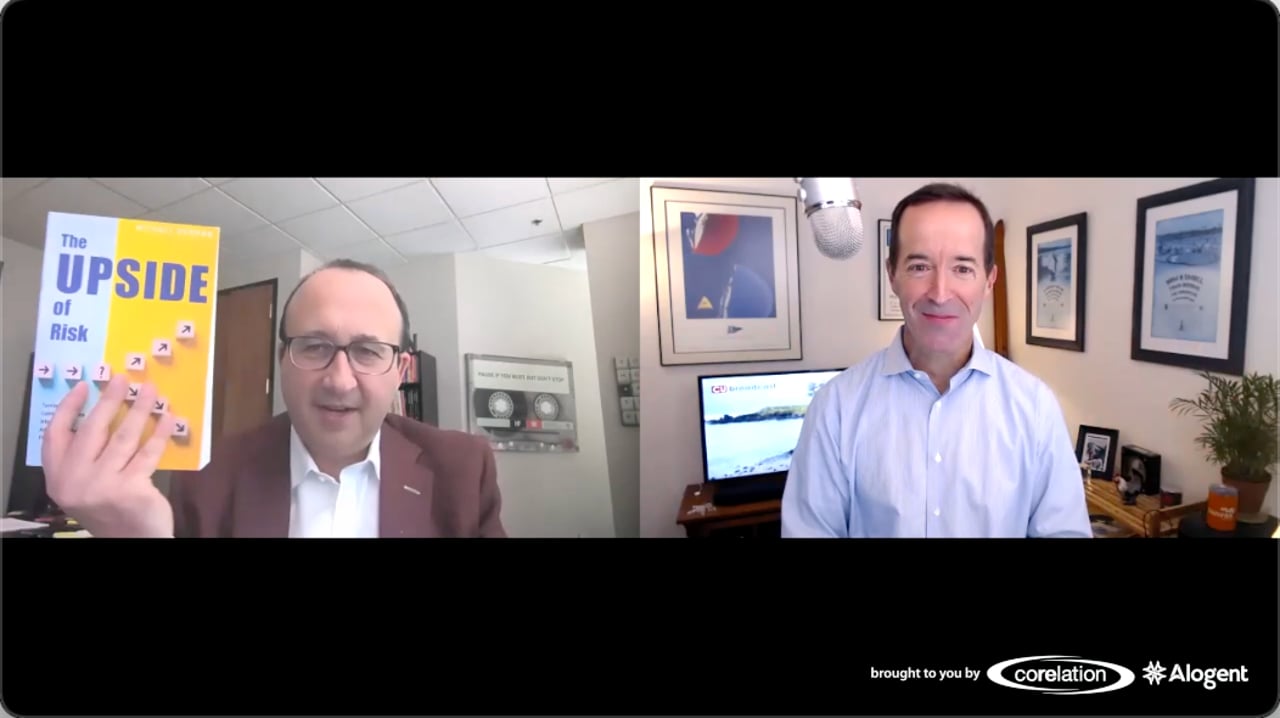
Berman’s first book, The Upside of Risk, appeared in 2021. Its subtitle, Turning Complex Burdens into Strategic Advantages for Financial Institutions, sets out his professional argument with admirable directness. Risk management belongs in the discussion of where an institution wants to go. Curiosity about exposure can produce better decisions about opportunity.
For his next book, he worked with Stephanie Lyon, Ncontracts’ vice president of compliance. Published in September 2024, The Upside of Compliance: Empowering Financial Institutions to Thrive applied that argument to compliance programs. The collaboration brought the founder together with a specialist responsible for the subject’s daily practice. Kathleen Kraninger, the former director of the Consumer Financial Protection Bureau, contributed the foreword.
“We wrote this book to share everything we wish we knew when we started our compliance careers.”
Michael Berman, on The Upside of Compliance, 2024
There is something approachable in that explanation. It makes room for the things people learn after the qualification, after the appointment and after the first difficult question lands on the desk. The stated ambition was to help readers build a functioning program that benefits the institution. A manual has to earn its shelf space.
In June 2026, Berman and risk practitioner Michael Carpenter published The Upside of Third-Party Risk Management. This time the focus returned to the relationships at the company’s origin. The book follows vendor oversight from strategy and due diligence through contracting and monitoring. It also asks readers to consider the connections between providers, integrations and shared systems. The vendor list is only the beginning of the picture.
THE RELATIONSHIP BEHIND THE RELATIONSHIP
institution→Direct
vendor→Vendor’s
providers
A conceptual view of third- and fourth-party dependencies. Each relationship can affect the service the institution relies on.
The contract gets an assistant
By 2024, artificial intelligence had brought Berman back to a familiar document with a different set of tools. Ncontracts introduced its Ntelligent Contracts Assistant as the company marked fifteen years in business. In a conversation with Rafael DeLeon, Berman discussed contract management across the vendor lifecycle, including onboarding, continuing oversight and termination.
The detail matters because an agreement has a life after signature. Its usefulness depends on whether people understand its terms and connect them to the service being delivered. Pricing occupies one part of that relationship. Performance expectations, security provisions and the handling of a transition occupy others. A document that has been reviewed once may still require attention as the relationship changes.
For Berman, AI became another way to help customers examine those obligations. The 2024 discussion connected automated analysis with the time financial institutions spend understanding agreements. It placed a new technology inside an established workflow, with consequences already familiar to the people doing the work.
In October 2025, Ncontracts expanded its AI offering with Complaint Ntelligence and Regression Ntelligence. The former was designed to classify complaints and identify patterns requiring attention. The latter supported statistical analysis of lending disparities. The applications moved beyond the contract, but stayed close to the same working problem: financial teams faced with more information to interpret and decisions to document.
Fast answers, a longer memory
The next step was Nquiry, introduced in May 2026. Ncontracts described it as regulatory intelligence built to return answers with citations and an audit trail. It also included a route to credentialed compliance experts for additional review. Berman framed the aim as giving teams speed and accuracy together. The product’s design acknowledged the follow-up question that professional users eventually face: how did you reach that conclusion?
A citation gives someone a place to look. An audit trail preserves the steps. Expert escalation offers another way to test uncertainty. These are modest-sounding features beside the spectacle of an AI response arriving on screen, but they address the conditions in which compliance work is judged. The answer may need to remain understandable after the immediate conversation has ended.
In a September 2026 Ncast appearance with DeLeon, Berman discussed AI agents, controls and the consequences of a changing supervisory environment. The episode considered what happens when an agent goes beyond its bounds and whether lighter regulation changes the underlying risk. His focus remained on infrastructure that must work even when an examiner is not asking for it.
Seventeen years after the office above the restaurant, the technology in Berman’s business has changed considerably. The basic question has remained recognizable. An institution relies on somebody else to do consequential work. It needs to understand the relationship, preserve a record and know what to do when circumstances change. Berman has built software, bought companies and written books around that question. The fine print keeps giving him work.