Somewhere on a power grid, a battery is doing the most lucrative thing imaginable: absolutely nothing. It waits while electricity prices drift, weather forecasts wobble and generators hum. Then a plant trips offline, or demand arrives faster than expected, and the market jolts awake. A megawatt-hour that recently traded near $50 can briefly fetch $5,000. In one five-minute interval, Michael Baker says, a well-positioned battery might earn as much as 20 percent of its revenue for the year.
The trick is to be full before the party and empty afterward. This sounds obvious in the same way that buying low and selling high sounds obvious. The difficulty lies in the clock. Batteries have limited duration, markets offer several products, and every choice changes what the machine can do next. A battery dispatched too early may watch the price spike from the sidelines. One held back too long has become a very expensive spectator.
Baker, the Oakland-based co-founder and CEO of Tyba, has built his career around this peculiar marriage of patience and speed. His company makes software that helps developers model storage projects and operators forecast prices, submit bids and dispatch batteries. The physical asset can react in milliseconds. The preparation behind that reaction takes years of market knowledge, mathematics and unglamorous attention to rules.
A company hiding in a spreadsheet
Tyba's origin begins deep in an Excel workbook. Baker was modeling the revenue potential of a storage project for his employer and found the industry's usual compromise: build something passable in-house and hope it survives contact with reality. The model was slow, costly to maintain and too brittle for an asset with thousands of possible operating choices. Storage, he realized, was becoming essential faster than its tools were becoming competent.
He had been gathering evidence for years. Baker earned a mathematics degree from Duke University in 2015. At EnerNOC, then Stem, he worked near the early commercial edge of demand response, behind-the-meter batteries and virtual power plants. When he joined Cypress Creek Renewables, he moved to the grid-scale side, eventually leading the team responsible for solar, storage and price-modeling tools as well as storage development work around the United States.
This was an unusually useful apprenticeship. He learned that battery hardware is only half the product. The rest is a continuous argument with uncertainty: what demand will be, what wind and solar will produce, which generator might fail, how a market will price scarcity and whether the battery should preserve charge for an opportunity that has not yet appeared.
“In a single five-minute interval, we might earn up to 20% of the revenue for a year.”Michael Baker, describing volatile Texas power markets
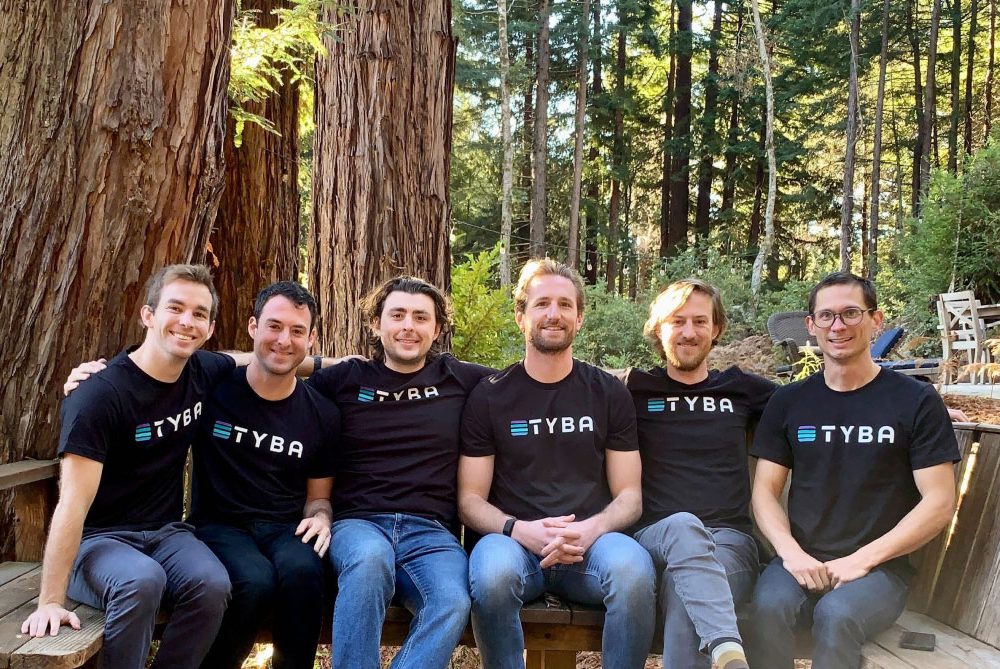
Tyba emerged in 2020 from that gap between fast machines and makeshift decisions. Baker paired his energy-market experience with co-founder Tyler Nisonoff's background in mathematical modeling and enterprise infrastructure. Tom Thunell brought energy-market relationships and product experience. Their division of labor was legible: product and modeling, technology at scale, and the commercial texture of the industry.
The battery as a choice machine
Baker's most useful way of explaining storage has little to do with chemistry. He treats a battery as inventory entering a supply chain that historically had almost none. Electricity was generated and consumed at nearly the same moment. Storage inserts a pause. That pause creates options, and options become valuable when the world is volatile.
Options, alas, produce decisions. A two-hour or four-hour battery cannot chase every attractive price. It may sell energy, provide frequency regulation or reserve capacity for later. It must respect state of charge, degradation, interconnection limits and market rules. It must plan in the day-ahead market without surrendering the flexibility that makes real-time operation valuable.
Tyba's software turns that unruly list into an operating strategy. Forecasting models ingest weather, load, generation outages and local supply-demand conditions. Optimization software evaluates price-and-quantity bids, considers physical constraints and keeps revising the plan. The aim is less fortune-telling than disciplined readiness. A forecast does not have to know the future perfectly. It has to improve the battery's position before everybody else can see the future in the price.
Why five minutes can matter more than five quiet hours
Credibility before scale
Early infrastructure software faces an awkward question: who will let an unproven company influence a costly physical asset? Tyba needed customers before it could build a record, and a record before many customers would trust it. White Pine Renewables and Copia Power broke that loop. Baker has repeatedly credited them for taking the early bet and for providing the feedback that stretched Tyba from project development through preparation and live operations.
That relationship produced unusually tangible work. For two White Pine projects, Tyba developed an optimization approach that balanced local PG&E constraints with opportunities in California's wholesale market. One battery could discharge on command to reduce pressure on an overloaded distribution line. Another followed restrictions related to heavy midday solar exports. Wholesale participation supplied as much as half of project revenue while the assets served local grid needs.
This is Baker's economic argument in miniature. Grid decarbonization is not separate from project profitability. Returns attract capital, capital builds more storage, and more storage makes renewable power easier to use. The spreadsheet and the climate mission meet in the same cell.
By February 2025, Tyba said its platform had simulated more than 100 gigawatts of projects and helped support more than $1 billion in projected financing. It was operating more than one gigawatt-hour of storage, with plans to double that figure by summer. That month, Energize Capital led a $13.9 million Series A, joined by new and existing investors including Pear VC, Mobilize Climate Capital and Borusan Ventures.
Markets made for the machine
Software can make a battery more intelligent, but it cannot by itself make a market less foolish. Baker increasingly works on the boundary between the two. In July 2025 he presented at a Federal Energy Regulatory Commission conference about real-time and day-ahead market software. His case was straightforward: storage can respond to grid signals in seconds, yet many power-market structures were designed around slower, less flexible assets.
A battery can absorb excess electricity, release it during scarcity, steady frequency and relieve congestion. But markets must assign value to those services, and their rules must allow storage to offer them without unnecessary friction. Baker's professional orbit therefore includes grid operators and regulators as well as developers and investors. Code executes the decision; market design determines which decisions are permitted.
“When you introduce the concept of inventory and storage itself to a supply chain that's never had it, and combine that with Moore's law type cost dynamics, that's just a really powerful - no pun intended - recipe for transformation.”Michael Baker on Watt It Takes
The pun is forgivable because the observation is good. Batteries are improving like technology while entering an industry accustomed to machinery. Their costs can fall, their software can update, and their value changes with every new renewable plant and data center added to the grid. Baker's ambition is to make Tyba the operating layer across that expansion, moving into new American and international markets and, eventually, other asset classes.
A taste for systems
There is a coherence to Baker's interests outside work: public transit, history, cooking and backpacking. Each involves systems, constraints and routes through uncertainty. A transit map compresses a city into choices. A recipe coordinates timing and transformation. A backpack makes scarcity literal. History is what happens when millions of plans encounter one another.
He grew up across several continents and speaks some Mandarin, experiences that he has connected to seeing how energy shapes opportunity. At Duke, his activities ranged from the Energy Club and student newspaper to boxing and TEDx. The list suggests curiosity without much concern for tidy categorization. His public comments about Tyba tend to redirect credit toward co-founders, colleagues, investors and early customers. The founder is present, but the system remains the protagonist.
That may be appropriate for a business devoted to timing. Tyba cannot create the storm, the outage or the scarce interval. It can prepare for them. The work is to observe more carefully, calculate more honestly and preserve the option to act. On most days, the result looks like a battery waiting. On the right day, at the right minute, waiting reveals itself as work.